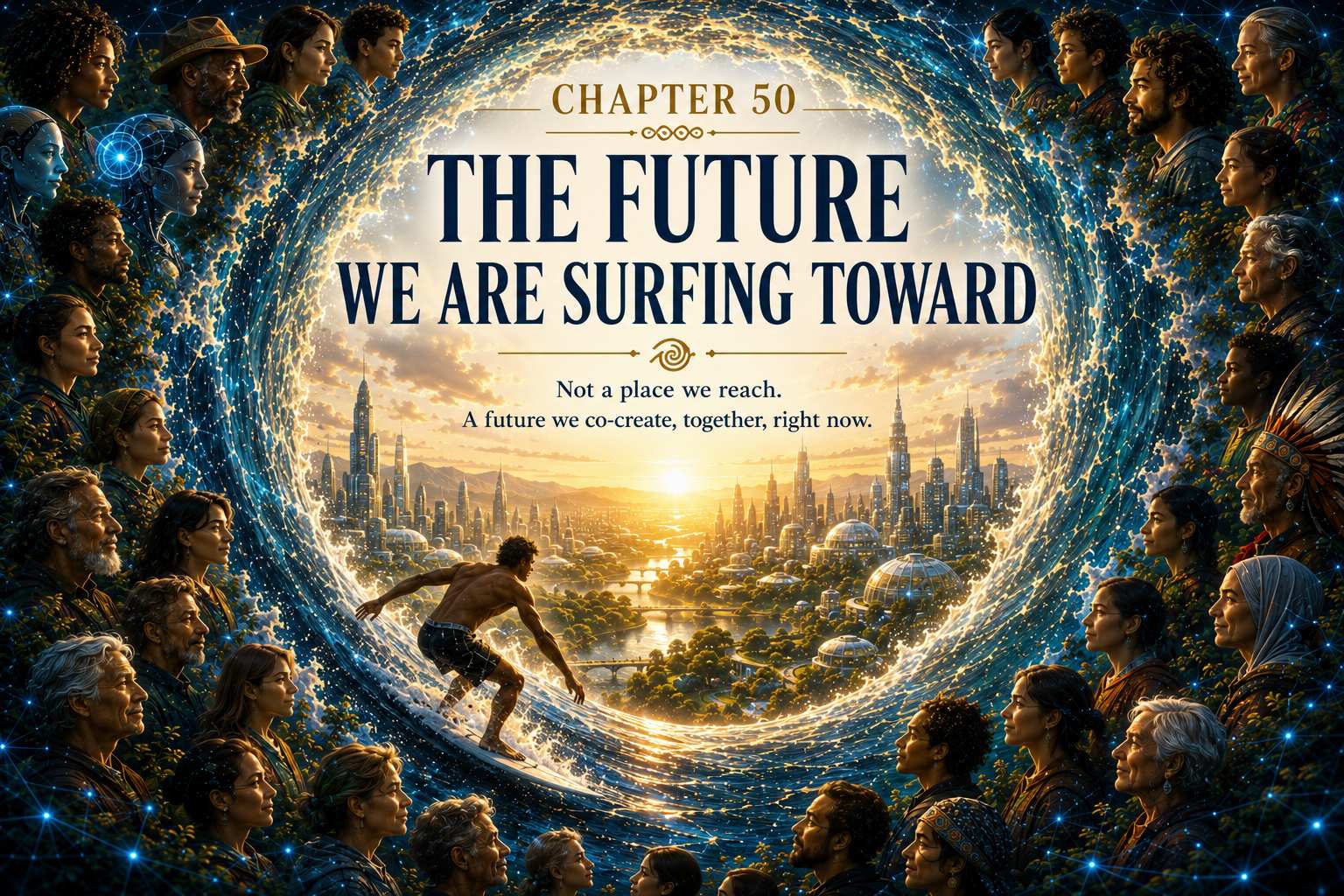
The Future We Are Surfing Toward
The future rarely arrives all at once. It appears first in small pockets of humanity experimenting with new ways of learning, building, gathering, healing, creating, and relating while much of the larger culture continues operating from assumptions that are already beginning to change.
At first, these pockets can seem unrelated: a retreat center in Costa Rica, an AI gathering in Bali, a founder dinner in San Francisco, a learning community in the desert. Different people, backgrounds, and reasons for gathering, yet over the years I began noticing the same question appearing again and again beneath the technology, business plans, investments, conferences, art, and innovation: How do we move forward without losing ourselves?
I heard versions of it at Summit gatherings from founders, scientists, artists, investors, technologists, and dreamers building extraordinary things while wondering how to preserve their humanity in the process. I heard it in Bali at Dwa Chandra, where creatives, entrepreneurs, seekers, and AI pioneers were exploring futures grounded in capability alongside presence, embodiment, stewardship, and relationship. I heard it at gatherings like Frequency, where wealth stewards and change agents came together to explore what conscious collaboration might look like in a world growing more complex by the day.
I witnessed it repeatedly through my Vortex transformation adventure programs as well. Some of the most capable people I know arrived carrying achievement, responsibility, and exhaustion in
roughly equal measure. After enough time in nature, something often shifted. Phones lowered. Bodies relaxed. Laughter returned. Conversations became more honest, and people remembered that life was something to experience as well as optimize.
Across those settings, I kept seeing the same pattern. When people experience enough honesty, beauty, belonging, trust, and presence together, creativity expands, curiosity returns, and generosity becomes easier. People become more fully themselves. That may sound simple, but modern life often pulls in the opposite direction, leaving people continuously connected yet emotionally isolated, constantly informed yet internally fragmented, highly productive yet deeply tired.
One of the builders I have watched wrestle seriously with this tension between technological progress and human flourishing is Bradley Horowitz.
Bradley Horowitz
Steward of Human Flourishing
Bradley has spent decades near the center of technological change. He co-founded the video technology company Virage, later held major product leadership roles at Yahoo and Google, and has invested in and advised generations of entrepreneurs. Yet what has always interested me most about Bradley has less to do with the scale of what he has built than with the humanity he has managed to preserve while building it.
Silicon Valley is often portrayed as a world driven by intelligence, ambition, competition, and speed, and all of those forces are certainly present. Bradley carries something else alongside them: curiosity without the need to dominate, accomplishment without much interest in impressing people, and a thoughtfulness that tends to make other people feel seen rather than evaluated.
Those qualities matter because technology is never only about technology. The systems we build shape how people communicate, learn, work, create, relate, and understand themselves. Every platform carries assumptions, every product rewards certain behaviors, and every innovation creates consequences that extend beyond its original design.
Over time, Bradley’s attention increasingly moved toward the relationship between innovation and human wellbeing. That inquiry now sits at the heart of Wisdom Ventures, where he is a General Partner investing in companies working at the intersection of technology, wellbeing, connection, and human development.
The name itself carries an important distinction. Intelligence helps us expand what can be done; wisdom helps us decide what should be done. As AI gives human beings access to increasingly powerful capabilities, that distinction becomes more consequential. Greater capability can amplify connection or fragmentation, creativity or extraction, flourishing or fear. The outcome depends partly on the values and incentives surrounding what gets built.
Bradley’s work reflects a belief that innovation and human wellbeing do not have to sit on opposite sides of an equation. Technology can strengthen connection. Businesses can create economic value while
improving human experience. Entrepreneurs can build ambitious companies without treating human consequences as somebody else’s problem. Progress can be evaluated not only by the sophistication of what we create, but by what those creations allow human beings to become.
This is why I think of Bradley as a Steward of Human Flourishing. He reminds me that the future is not simply something technology does to us. Human beings still make choices about what to build, what to fund, what to reward, what to normalize, and what forms of life our increasingly powerful tools are ultimately meant to support.
And despite all our technological sophistication, the things people seem to long for most have changed surprisingly little. We want meaning, belonging, purpose, friendship, love, laughter, and people with whom we can share both the difficult moments and the beautiful ones. We want to know that we matter to someone and that there is somewhere we can arrive without having to prove ourselves first.
For all the discussion about artificial intelligence, I increasingly suspect that one of the great opportunities of this era may be the rediscovery of forms of human connection that many modern societies have gradually weakened. I do not mean retreating into some romantically remembered past. I mean carrying forward the freedom, creativity, mobility, and extraordinary capabilities of modern life while rebuilding some of the human warmth that acceleration has stripped away.
The Longhouse and Honeycomb we explored earlier are simply two images for that possibility. There will be many others. I hope there are thousands of experiments in which builders, artists, teachers,
founders, technologists, parents, healers, investors, and dreamers discover new ways to contribute their distinct gifts to something larger than themselves. I am not imagining utopia. I am imagining something simpler and more believable: a warmer civilization.
When I look around the world, I certainly see danger, fragmentation, and profound uncertainty. But I also see emergence. I see people learning, adapting, healing, experimenting, building, and finding one another. I see communities forming around shared purpose rather than simple proximity, and people trying to develop wiser relationships with technologies whose power they fully understand they do not yet comprehend.
That is why my hope is not based on the belief that everything will work out. It is based on evidence I keep encountering in actual human beings. Again and again, I meet people carrying a genuine sense of mission, trying to build something useful, repair something damaged, connect people who should know one another, protect something precious, or leave a corner of the world slightly better than they found it.
Civilization has never evolved through certainty. It moves because people take the next step while the full path remains invisible, learn from what happens, and keep moving together. The wave is already here and the future is arriving faster than any of us can comfortably predict.
Yet everywhere I look, I see people learning to surf.
That is the future I believe we are surfing toward.