Coming Home to Yourself
We began beside a river. For more than thirty years, I have returned to the same stretch of water in the mountains above Taipei, a place I came to call the Shiva-Shakti Pools. Hundreds of people have found themselves there with me over the years: founders, CEOs, investors, artists, teachers, friends, family, seekers, people carrying enormous responsibility, and people simply trying to find their way. The ritual was rarely complicated. We got into the cold water, sat on rocks, ate fruit badly, laughed, and stopped performing for a little while. Something almost always happened. The titles softened. The stories became quieter. The person who had arrived carrying a company, a family, a crisis, a reputation, or an identity remembered that underneath all of it there was still a human being: alive, curious, playful, connected to other humans, connected to the living world, and capable of experiencing the sheer wonder of being here.
At the beginning of this book, I did not yet know where that river would take us. We have traveled through artificial intelligence and accelerating change, leadership and stewardship, childhood and conditioning, coherence and fragmentation, breath, body, voice, forgiveness, presence, Sacred Self, Sacred Union, Sacred Play, relationships, organizations, communities, and the systems we are collectively building around ourselves. We have met extraordinary people who are finding their own ways to remain deeply human while standing inside one of the largest technological transitions our species has ever experienced. After all of that, I find myself returning to something surprisingly simple: our task is to remain sufficiently present, awake, adaptive, and alive that we can participate in creating the future without losing ourselves along the way.
The Age of AI is barely beginning, and none of us knows exactly what the coming years will bring. The systems will become dramatically more powerful. Intelligence will become increasingly abundant. Work, education, organizations, and relationships will change. Entire professions will be reimagined, and new ones will emerge that we cannot yet name. Some institutions we have relied upon for generations will struggle to adapt, while extraordinary new possibilities appear alongside very real disruption. We will get some of it spectacularly right and some of it spectacularly wrong. That is what humans do. What matters is what we bring with us.
Artificial intelligence is an extraordinary amplifier. It can amplify knowledge, creativity, curiosity, speed, connection, and human capability, and it can amplify anxiety, fragmentation, certainty, extraction, manipulation, performance, and fear. That is why I have come to believe that one of the most important questions of the Age of AI is what these systems will amplify in us. Will they deepen wonder, presence, curiosity, stewardship, and relationship, or make us more efficient at running the patterns we have carried unconsciously for years? Those questions will be answered millions of times every day by ordinary human beings making ordinary choices through what we build, reward, consume, teach our children, ask of our organizations, accept from our institutions, and practice in our own lives.
Agency matters. I keep returning to the image of driving the race car and riding the racehorse because I want the power beside me without giving away the steering wheel. I want intelligence to expand my capacity while responsibility, judgment, values, purpose, and choice remain with me and with us. The healthier the partnership becomes, the clearer that distinction feels. We can welcome astonishing capability without slowly outsourcing the very qualities we most need to strengthen.
Something unexpected happened while I was writing this book. The more deeply I began working with artificial intelligence, the less interested I became in becoming more technological. I found myself wanting to become more human. I wanted to ride my bicycle into the mountains, swim in cold rivers, sit underneath trees, have longer conversations with people I loved, enjoy meals that took too much time, take adventures that made no practical sense, and laugh often enough to interrupt the schedule. I wanted more play, more nature, more friendship, more love, more time with my family, and more opportunities to encounter people and possibilities that I could never have planned. When the relationship with AI worked well, that is exactly what it helped give me. The technology did not replace my life. It helped me protect more of it.
That distinction has become increasingly important to me. I want a future in which intelligence releases more human energy back into life: less unnecessary cognitive labor, less administrative friction, less time spent carrying tasks that machines can carry beautifully, and more energy available for creation, relationship, imagination, stewardship, care, adventure, and the experiences no machine can have on our behalf. I want technology to help us become more deeply human, and that requires awareness because convenience always has a shadow. Anything sufficiently powerful can become something we surrender ourselves to. We can outsource our thinking, judgment, creativity, courage, and agency almost imperceptibly if we stop paying attention.
Tsunami OS has ultimately been pointing toward this throughout the book. The Joy Protocol helps us return to ourselves. Supercharging Serendipity helps us remain open enough to encounter what we could never have planned. Speaking Cartoon helps us communicate through story, image, and metaphor in ways that make complexity more human. Crafting Coherence asks us to align what we believe, what we understand to be right, and how we actually act. Partnering with AI asks us to use intelligence with intention while keeping our agency intact. Together they form practices for returning to coherence while the world keeps moving.
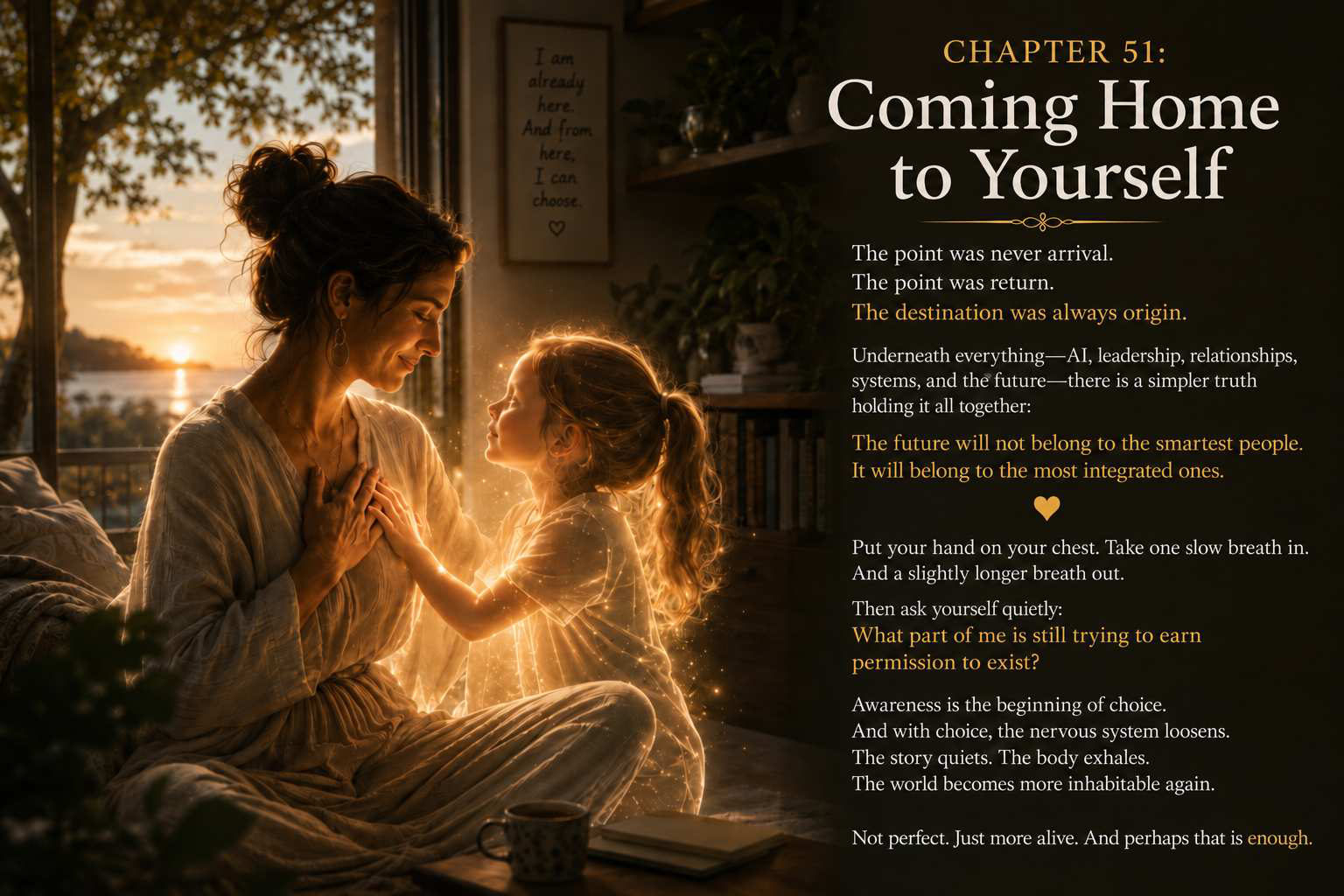
Underneath all of them is the same movement: return. Return to your breath when the story begins carrying you away, and to your body when your head is trying to run your entire life. Return to your voice when you have forgotten that your truth matters, and to the Witness when you become trapped inside your own movie. Return through forgiveness when the past begins demanding that you relive it. Return to presence when your mind insists that life is happening somewhere else. Return to relationship when independence begins hardening into isolation, and to play when seriousness starts masquerading as importance. Return to yourself when you notice that you have once again begun trying to become someone you imagine the world will finally approve of.
We will lose coherence. We will become frightened, angry, attached to our stories, overly certain, overly busy, and sometimes convinced that our own conditioning is reality. We will say things we wish we had not said, make decisions from fear, hold too tightly, work too hard, and occasionally forget almost everything we thought we had learned. None of that means the practice failed. Surfing was never about making the ocean stop moving or staying on the board forever. You fall, surface, find the board, breathe, look toward the horizon, and when you are ready, paddle back out. Life keeps giving us another chance to return.
For much of my life, I thought freedom would arrive when enough things outside me were finally resolved: when the company was successful enough, the problem was solved, the relationship repaired, the project finished, the uncertainty gone, and I had understood, accomplished, healed, or become enough. The finish line kept moving. Eventually I began to understand that freedom was available in the quality of my relationship with the life already happening. That realization did not make ambition disappear. I remain wildly ambitious. I still love building things, helping organizations grow, bringing extraordinary people together, imagining systems that do not yet exist, and attempting things that occasionally sound absurd when first spoken aloud. What changed was the burden those things had to carry.
Achievement no longer needed to prove that I deserved to exist. Success no longer needed to answer the question of whether I was enough. Work could become creation instead of justification. Leadership could become stewardship rather than performance. Relationship could become somewhere to meet another human being without needing that encounter to defend an identity. I could simply be here, and from here, choose.
Before you close this book, I want to leave you with one question: What do you want this extraordinary new intelligence to amplify in you? My own answer continues to evolve, but it is becoming clearer. I want more curiosity and less certainty, more courage, more freedom, more compassion, more creativity, more adventure, more laughter, more time in nature, and more gratitude for this astonishing experience of being alive. I want more willingness to say yes when something beautiful appears that I could never have planned. I want more love, and increasingly, less carried alone.
Perhaps that is the deepest thing these decades of leadership, entrepreneurship, friendship, family, loss, healing, travel, wilderness, spiritual inquiry, building, breaking, rebuilding, and now partnership with artificial intelligence have taught me: we become ourselves together. Flourishing has never been a solo performance. We discover ourselves in relationship. We heal, create, learn courage, build trust, and discover our capacity to love in relationship. The great paradox of coming home to yourself is that eventually you discover you were never meant to live there alone.
There is something quietly beautiful about that word, return. At the beginning of this journey, we stood beside a river. Water moved around rocks without asking them to disappear. Trees grew beside one another, each completely itself and each participating in something larger. Nature had been teaching coherence long before we invented the word. So I find myself there again, carrying everything I have learned about technology back toward life. The river does not care about my title, how many emails I answered today, the success of this book, the systems we are building, or the future of artificial intelligence. It keeps moving around the stones, reflecting the sky, carrying leaves downstream, and making room for whatever arrives next. Sitting beside it, I remember the simple facts of one breath, one current, and one life.
The wave is already here, and it is larger than any of us. So are we: individually and collectively, beautifully unfinished, capable of fear and wonder, fragmentation and coherence, destruction and extraordinary creation. We do not know where this wave will carry humanity, but we have a say in how we meet it, what we bring with us, what we build together, and who we become along the way. Life was never meant to be spent fighting every battle alone and celebrating every victory alone. It has always happened in relationship, among people who see one another, challenge one another, forgive one another, believe in one another, create together, fall down together, and help one another paddle back out. You were never meant to surf the tsunami alone, and that is a blessing. Come play.