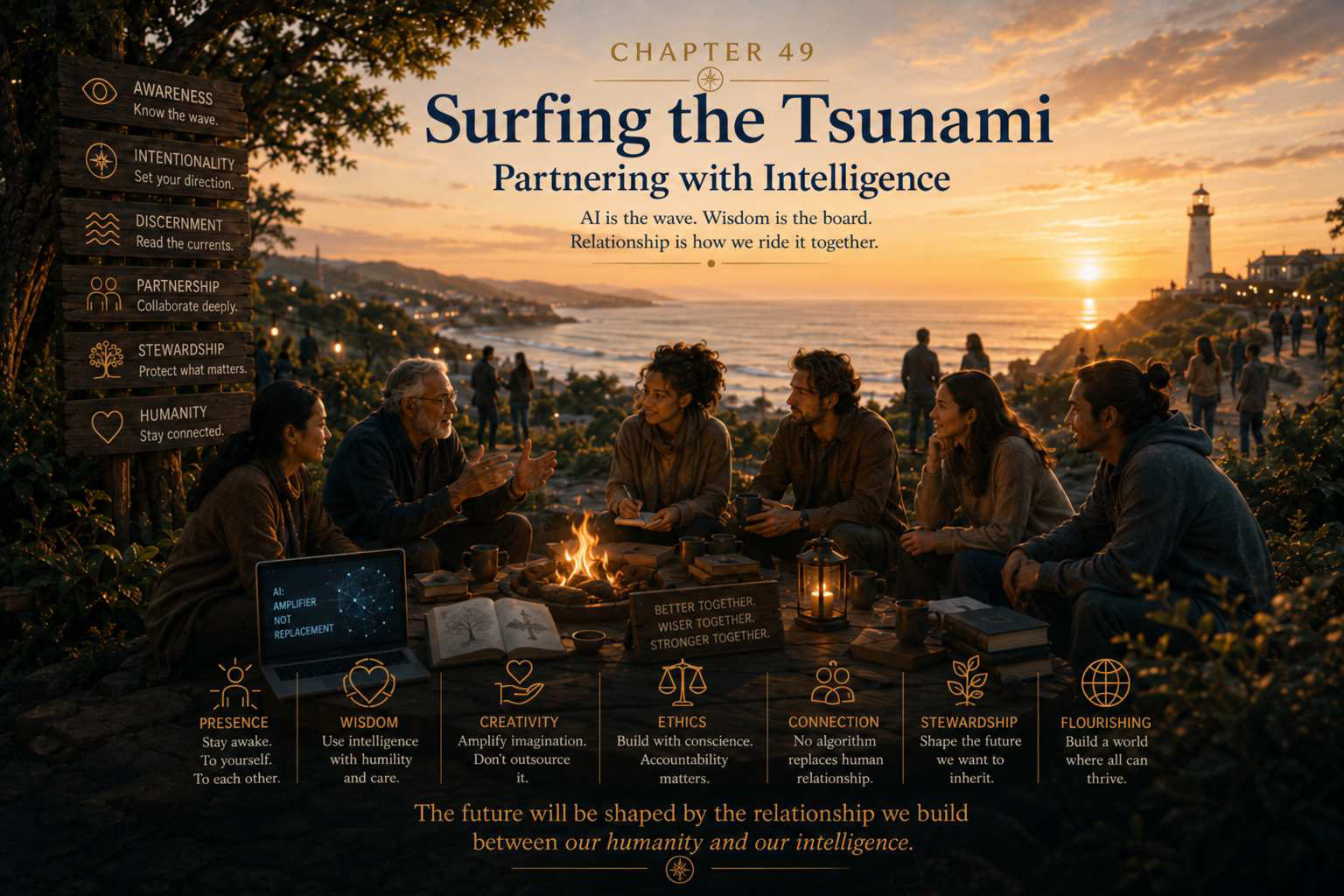
Surfing the Tsunami
Partnering with Intelligence
For a long time, the cultural story around artificial intelligence sounded strangely binary. AI would either save humanity or replace it. Like most binary stories, both versions miss a more interesting possibility: relationship.
A hammer in the hands of a skilled builder can create shelter, warmth, and a home where children sleep safely through storms. A hammer in the hands of an angry toddler produces a very different outcome for the living room. The capability matters, but so does the relationship between the human being and the tool.
Artificial intelligence is hardly the first technology to shape the way humans think and behave. Long before large language models arrived, smartphones, social media, recommendation systems, and digital platforms were already influencing what we noticed, how long we paid attention, what we believed, and how we related to one another. AI raises the stakes because the technology is becoming more interactive, persuasive, creative, adaptive, and capable of participating directly in work that once required another human being.
Few people have explored the consequences of that relationship more persistently than Tristan Harris, Aza Raskin, and Joy Mauthe Raskin.
Tristan Harris, Aza Raskin & Joy Mauthe Raskin
Stewards of Humane Technology
For more than a decade, Tristan Harris and Aza Raskin have helped force an uncomfortable question into public view: when we create technologies powerful enough to shape human attention and behavior, what responsibility do we assume for what those technologies do to us?
Through the Center for Humane Technology, their work helped expose the incentives behind attention-harvesting technologies and widen the conversation from product design to societal consequence. Tristan, who earlier worked as a design ethicist at Google, helped catalyze the Time Well Spent movement and has become one of the most visible advocates for technology designed around human wellbeing rather than simply engagement. Aza brings a systems perspective to the same problem, exploring how incentives, technology, and human behavior interact at civilizational scale. Their work now extends deeply into artificial intelligence and the question of how increasingly consequential technologies can remain answerable to human interests.
Joy brings another dimension. Her work through the Civilization Research Institute, in collaboration with the Center for Humane Technology, focuses on large-scale risks to civilization and the biosphere, but she also approaches that work as an artist, musician, poet, and experience designer. Together, Tristan, Aza, and Joy have increasingly experimented with forms that combine rigorous analysis with art and human experience, including work around The AI Doc and The Humanity Dilemma.
What draws me to their work is that they do not treat technology as an isolated object. They look at the entire field around it: the incentives of the companies building it, the vulnerabilities of the humans using it, the institutions trying to govern it, and the cultural assumptions determining what we consider progress.
That perspective sits close to the heart of Surfing the Tsunami. Powerful technologies amplify more than capability. They amplify the values, incentives, fears, ambitions, wisdom, and blind spots of the systems surrounding them. The same intelligence can be used to educate, manipulate, heal, deceive, create, surveil, connect, or polarize. The technology does not arrive separately from human intention.
That is why the question cannot simply be what AI can do. We also have to ask what kind of relationship we are building with it.
As I spent more time inside emerging AI communities, I became fascinated by how revealing that relationship could be. People approached the technology with wonder, fear, ambition, skepticism, exhaustion, greed, playfulness, and sometimes the slightly alarmed expression of medieval villagers hearing reports of sorcery beyond the hills. The systems became a kind of mirror for the people using them.
One person uses AI to deepen creative work; another uses it to avoid difficult thinking. One person uses it to organize chaos and recover time for family, health, and friendship; another uses it to accelerate directly into an optimized emotional crater with excellent email formatting. The capability may be similar. The human relationship to it is not.
Bret Greenstein has spent much of his career living inside that frontier.
Bret Greenstein
Steward of the AI Frontier
Some people study emerging technologies from a distance. Bret has spent more than three decades working where they become real. Across leadership roles at IBM, Cognizant, PwC, and now as Chief AI Officer at West Monroe, he has repeatedly helped organizations understand technologies while those technologies were still changing underneath them.
I first met Bret during a search for Cisco’s Chief Data Officer, and what stayed with me was not simply his technical depth. It was his curiosity. He was open-minded, warm, free-spirited, and unusually willing to remain a student even while operating at a level where many executives feel pressure to appear certain.
That quality has become more valuable as AI has accelerated. The people closest to rapidly changing technology cannot afford to become too attached to yesterday’s answers. Bret experiments constantly, revises his assumptions, and pushes organizations to move beyond talking about AI toward actually learning how it changes decisions, workflows, operating models, and the way people create value.
His current work at West Monroe reflects that philosophy directly. The firm has been embedding AI into its own operations as well as its client work, and Bret’s role is centered not only on AI strategy but on helping people use the technology in practice, measure its impact, and learn from what happens.
What Bret embodies for me is adaptive leadership. It is the willingness to move before everything is known without pretending that uncertainty has disappeared. It combines experimentation with judgment, confidence with curiosity, and technical capability with enough humility to change course when the evidence changes.
That is a useful way to think about partnership with intelligence more broadly.
A healthy relationship with AI should expand human capability without quietly dissolving human agency. These systems can become extraordinary research companions, translators, creative collaborators, learning accelerators, analytical tools, and coordination engines. They can allow one person or a small group to explore possibilities that previously required far more time, money, or institutional infrastructure.
But capability creates responsibility. The easier it becomes to delegate thinking, remembering, creating, deciding, and communicating, the more consciously we have to choose what should remain ours. Convenience is valuable, but convenience can also make it easy to stop exercising capacities that still matter.
The question I increasingly ask is simple: what does this partnership make possible, and what does it ask us to preserve?
AI can already help people work through complexity, explore unfamiliar ideas, learn at extraordinary speed, organize their thinking, and create things they could not previously have built alone. For someone who is isolated, overwhelmed, or without ready access to expertise, an intelligent system can provide useful support and a patient place to explore. It can retain context, remain available, and help someone continue a line of thought without requiring another human being to be present at that moment.
None of that makes human relationship less important. It makes the distinction clearer. There are things machines may become extraordinarily good at providing, and there are dimensions of human life whose value comes precisely from the fact that another living person is there: accountability, touch, shared history, vulnerability, conflict, forgiveness, love, laughter, presence, and the experience of building a life together.
Partnership with AI therefore does not require choosing between human beings and machines. It asks us to become more deliberate about the role each should play.
That is why I still return to the surfing metaphor. Surfing is neither surrender nor domination. You do not command the ocean, and you do not survive by pretending the wave is not there. You learn its movement, develop skill, respect its power, remain responsive, and choose how you meet it.
Artificial intelligence may be the most consequential wave any of us will ever surf. The technology will continue changing, sometimes faster than our institutions and habits can comfortably follow. Our task is not simply to keep up with it. It is to learn how to work with extraordinary intelligence while remaining responsible for the direction in which we choose to move.
And all around us, people are already beginning to experiment with what that might look like. That is the future we are surfing toward.