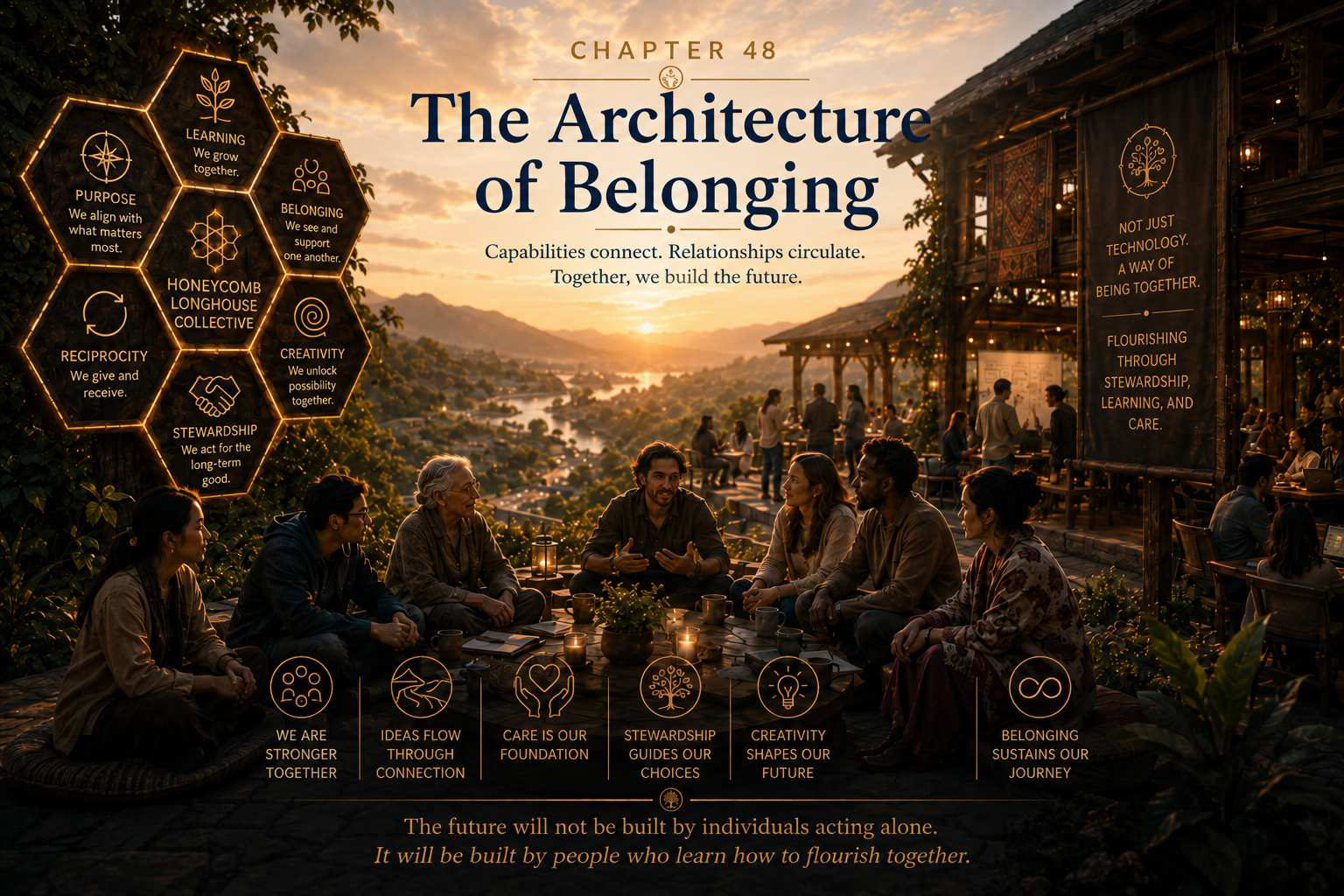
The Architecture of Belonging
At some point, nearly every conversation about artificial intelligence arrives at the same place. People understand that something significant is happening. They can feel the acceleration in technology, business, education, media, and daily life, and they sense that old assumptions are becoming less reliable even if nobody can yet see the full shape of what comes next.
Eventually the question becomes personal: What am I supposed to do about it? I found myself asking the same thing while writing this book.
Earlier this summer, at a gathering in Bali, I met Christian Acuna. Christian had become fascinated by a new generation of AI-enabled creation tools and the emergence of what people were beginning to call “vibe coding,” which was allowing people without traditional technical backgrounds to build things that previously would have required teams of engineers. After spending time together, he encouraged me to dive in.
Within days, I found myself in a remarkably creative partnership with Sri Auri, Claude, and an expanding collection of AI tools. Ideas that might once have remained sketches in a notebook could suddenly be explored, tested, challenged, and refined in real time. What began as curiosity quickly became a much larger inquiry: if these tools dramatically increase our capacity to create, what are we trying to create?
The more I sat with that question, the less interested I became in the technology by itself and the more interested I became in the conditions that allow people and communities to flourish. That exploration has gradually evolved into what we have come to call the Zaya Dojo and the Honeycomb Longhouse Collective, different expressions of a larger inquiry into how human beings might learn, create, collaborate, contribute, and grow together during a period of extraordinary change.
The names matter less than the pattern beneath them. Every generation eventually encounters moments when the future arrives faster than existing institutions, assumptions, and social structures can comfortably absorb. We are living through one of those moments now. The old maps still contain useful truths, but they increasingly cannot describe the territory on their own.
Some people naturally focus on opportunity, while others focus primarily on risk. The people who have given me the greatest hope tend to focus on responsibility. Throughout the writing of this book, I have had the privilege of speaking with founders, educators, scientists, investors, technologists, community builders, and leaders from radically different backgrounds. Their views often differ, but many share an instinct to participate thoughtfully in shaping what comes next rather than simply predicting it.
One of the people who reinforced this understanding for me was Chris Cowart, Managing Director of the Nomura-SRI (Stanford Research Institute) Innovation Center. Across many conversations, Chris and I kept returning to a deceptively simple observation: meaningful innovation rarely emerges from isolated brilliance. More often it appears when curious people create environments where
learning compounds, perspectives intersect, trust develops, and ideas are allowed to evolve together over time.
That insight reaches far beyond organizations. It applies to communities, families, classrooms, startups, and civilizations themselves. Humanity does not suffer from a shortage of ideas. The harder challenge is creating conditions in which good ideas can encounter one another, mature through relationship, and eventually become something that no individual could have created alone.
Artificial intelligence can help us accomplish remarkable things, but it cannot relieve us of the responsibility to decide what is worth accomplishing. It can accelerate movement toward a goal, while the wisdom of the goal itself still depends upon values, judgment, relationships, experience, and care.
Again and again, I have returned to the same realization: we have never had more knowledge, expertise, or technological capability available to more people. What often proves harder is helping people trust one another enough to combine those capabilities in service of something larger than themselves.
That insight sits beneath the Honeycomb metaphor. A healthy honeycomb allows capabilities to find one another. Ideas move through it. Relationships, opportunities, knowledge, and resources circulate across a larger whole rather than remaining trapped inside isolated cells.
The Longhouse emerged as a companion image. Across cultures and throughout history, human beings have created shared spaces where
they could learn, celebrate, mourn, support one another through difficulty, exchange knowledge, and contribute to something larger than any one person could sustain alone. The forms differed enormously, but the underlying human need remained remarkably persistent.
Modern life has brought extraordinary freedom, mobility, and possibility. It has also left many people carrying dimensions of life alone that earlier communities would have carried together. One of the opportunities hidden inside this period of technological disruption may therefore be the chance to rediscover forms of belonging suited to the world now emerging around us.
The Honeycomb Longhouse Collective is one experiment in that direction. It is not intended as a blueprint that everyone should adopt. It is a living inquiry into what becomes possible when people intentionally organize around flourishing, stewardship, learning, reciprocity, contribution, and care.
I hope there are thousands of experiments like it, emerging from different cultures and communities and taking forms none of us can yet imagine. Belonging should not require uniformity, and no single architecture will serve every human context.
Yet underneath all that diversity, I suspect something ancient will remain true. The future will not be built by isolated individuals acting alone; it will emerge through people learning how to build, adapt, care, and flourish together.