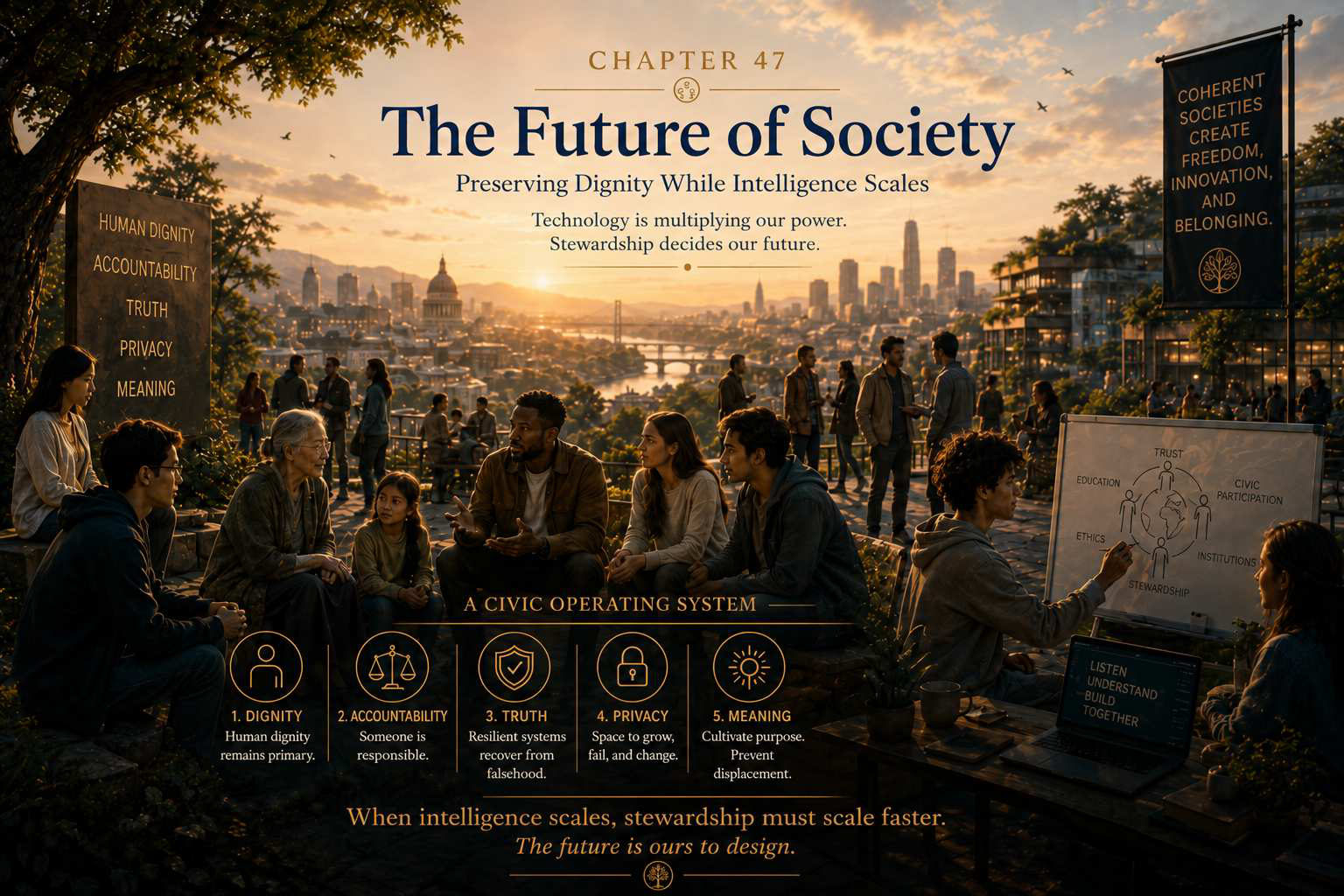
The Future of Society
Preserving Dignity While Intelligence Scales
Every major technological shift changes more than the work people do. It changes how power is distributed, how institutions function, and what societies begin expecting from their citizens. Printing broadened access to knowledge and challenged established structures of authority. Industrialization reorganized labor, families, and cities. The internet transformed how information moves and who can participate in its creation.
Artificial intelligence carries another kind of amplification because it can scale cognition, creation, influence, persuasion, and automated action at the same time. The central societal question is therefore larger than whether AI becomes more powerful. It is whether human dignity, agency, trust, and social cohesion can remain strong while that power spreads.
The Risk of Asymmetry
One of the most consequential societal risks is asymmetry. A very small number of actors can increasingly communicate with, influence, or even disrupt millions of people at negligible marginal cost; simulate expertise or intimacy; create persuasive synthetic content; analyze and respond to behavior at scale; and act faster than many institutions can respond. Deepfake technology is increasingly playing a role in how societies receive and respond to major issues and initiatives, adding another layer of uncertainty to an information
environment in which provenance and trust are already under pressure.
That matters because societies depend on more than access to information. They depend on enough confidence in the information environment, enough accountability for consequential decisions, and enough trust that participation still has meaning. When people become chronically uncertain about what is real, who is responsible, or whether institutions can keep pace with the systems shaping their lives, disagreement can harden into distrust and fragmentation. This is not an argument against powerful technology. It is an argument for taking the distribution of power around that technology seriously.
Regulation and Institutional Coherence
Law, standards, and enforcement will all matter, but societies cannot regulate their way into coherence. Institutions also have to remain credible enough to deserve trust, responsive enough to adapt, and accountable enough that citizens can understand where responsibility resides. Dignity has to remain central. People cannot gradually become data points to be optimized, risks to be scored, or units of productivity whose value rises and falls with economic usefulness.
Accountability must remain legible when AI contributes to consequential outcomes. Privacy must preserve enough unobserved space for human beings to make mistakes, grow, change their minds, and become different people without carrying a permanent algorithmic record of every earlier version of themselves. Meaning matters as well. A society can survive enormous economic transition if people continue to experience agency, contribution, and some believable path into the future. Displacement becomes particularly
destabilizing when people lose income, status, community, and the sense that they are still needed all at once.
This is why education becomes civic infrastructure. Discernment, media literacy, adaptability, ethics, and the ability to work across disagreement are no longer simply desirable personal qualities. They become part of society’s capacity to remain functional while information and capability accelerate.
Human Adaptation at Scale
Sustained fear changes the behavior of groups as surely as it changes individuals. When people believe their livelihood, identity, community, or social standing is under threat, they can become more susceptible to polarization, scapegoating, certainty, and promises of simple answers to complex problems. Society does not literally have a nervous system, but millions of nervous systems interacting inside institutions and communities can produce recognizable collective behavior.
The work ahead therefore includes helping people adapt without humiliating them, creating routes into meaningful participation as old forms of work change or disappear, and building institutions that can acknowledge uncertainty without surrendering authority. Societies will need to hold innovation alongside restraint, individual freedom alongside responsibility, and speed alongside care. That balance also changes how we think about winning.
Few people I know have explored that question more thoughtfully than Gaurav Dalmia.
Gaurav Dalmia
Steward of Integrity
Gaurav has spent his career at the intersection of business, capital, governance, investment, and long-term institution building in India and internationally. He is Chairman of Dalmia Group Holdings and has been involved across private equity, real estate, public markets, education, and public-policy institutions. Our conversations often range across economics, technology, business building, and the future of India, yet he repeatedly returns to a deceptively simple question: are there different kinds of winning?
Modern economies depend upon competition. Markets produce winners and losers. Organizations contain hierarchies. Democratic societies tolerate considerable inequality because people retain some belief that they possess agency and that the rules remain sufficiently legitimate for participation to matter. Technology can disturb that balance when rewards become increasingly concentrated and winner- take-most dynamics become stronger. The challenge is not that winning itself is wrong. It is that societies become fragile when winning loses any connection to fairness, responsibility, legitimacy, or the health of the larger system that made winning possible in the first place.
Gaurav thinks about this on a longer horizon than most business conversations allow. Quarterly earnings, election cycles, and investment returns all create powerful incentives for immediate optimization, while many of the questions surrounding artificial intelligence, climate resilience, education, institutional trust, and
social cohesion unfold across decades. Stewardship requires the ability to hold both time horizons at once.
One story Gaurav uses to illustrate this comes from tennis. During the semifinal of the 1982 French Open, seventeen-year-old Mats Wilander reached match point against José-Luis Clerc. Clerc hit a forehand that was called out, giving Wilander the match, although Wilander believed the ball had been good. Instead of accepting the victory, he asked the umpire to replay the point. The umpire agreed, and Wilander subsequently won the replayed point and the match.
The point of the story is integrity. Wilander wanted to win, but not at the price of becoming someone he did not want to be in the moment of winning. He understood that the external result and the internal result were not the same thing. A victory obtained by quietly accepting what he believed was a wrong call would still have appeared as a win on the scoreboard, but it would not have felt like one to him.
Gaurav’s interpretation goes further. Integrity is not opposed to ambition; it gives ambition a spine. The strongest competitors still want to win, but they distinguish between tactical advantage and sustainable strength, between an outcome that flatters the record and a way of operating that can be trusted over time. Wilander went on to win seven Grand Slam singles titles and become the world’s number- one ranked player. The point he gave back did not make him less competitive. It revealed the kind of competitor he wanted to be.
That distinction becomes important far beyond sport. Companies, institutions, countries, and individuals will all face moments in the AI era when short-term advantage is available at the expense of long- term trust. The temptation will be to treat every available edge as one
that should be taken. Integrity asks a harder question: even if we can win this way, what kind of system, institution, or person are we becoming by doing so?
For Gaurav, this is where stewardship and winning finally meet. Durable success depends on preserving the conditions that make future success possible: trust, legitimacy, relationships, institutional strength, and a sense that the game itself remains worth participating in. Winning that destroys those foundations eventually defeats itself.
That brings us naturally to another kind of social architecture, one built around connection and belonging.
Stan Stalnaker
Steward of Belonging
For more than two decades, Stan Stalnaker has been building environments in which unexpected human connections can occur. Long before remote work, digital nomadism, creator economies, decentralized communities, and AI-mediated networks became commonplace, he was exploring how work, community, culture, and global identity might coexist.
Stan’s path moved from Arizona to Washington, D.C., through Europe and Asia, and eventually into the global network he began building through Hub Culture. His early work at Fortune placed him close to the first great wave of globalization, but what fascinated him was less the institutions themselves than the people moving between them: connectors, explorers, bridge-builders, and people whose lives
no longer fit neatly inside traditional categories of nation, profession, or community.
That insight became Hub Culture, a network designed to blend online connection with physical gathering. Over the years, its spaces and gatherings have brought people together across cities, conferences, industries, and cultural settings in ways that conventional institutions rarely make possible. Stan has often described the work in expansive language, but one of the simplest ways I understand it is that he creates conditions for serendipity.
That is more consequential than it sounds. Innovation rarely emerges in isolation. It grows through relationships, collisions of ideas, trust, and conversations that would never have occurred without environments that make those encounters possible. As artificial intelligence makes digital interaction easier and more abundant, the quality of human connection around that technology becomes even more important.
Stan’s work reminds me that belonging can be designed for without being engineered into sameness. Good social architecture increases the probability that people who might strengthen one another actually meet, while leaving room for surprise, difference, and emergence. It gives people places to participate rather than merely observe and creates enough continuity for relationships to become more than transactions.
The future of society will be shaped partly by laws, institutions, and technologies, but also by the spaces in which people learn to trust, cooperate, disagree, create, and belong. That brings us to the next question in the book: if belonging is infrastructure, what does it look like when we begin designing for it intentionally?