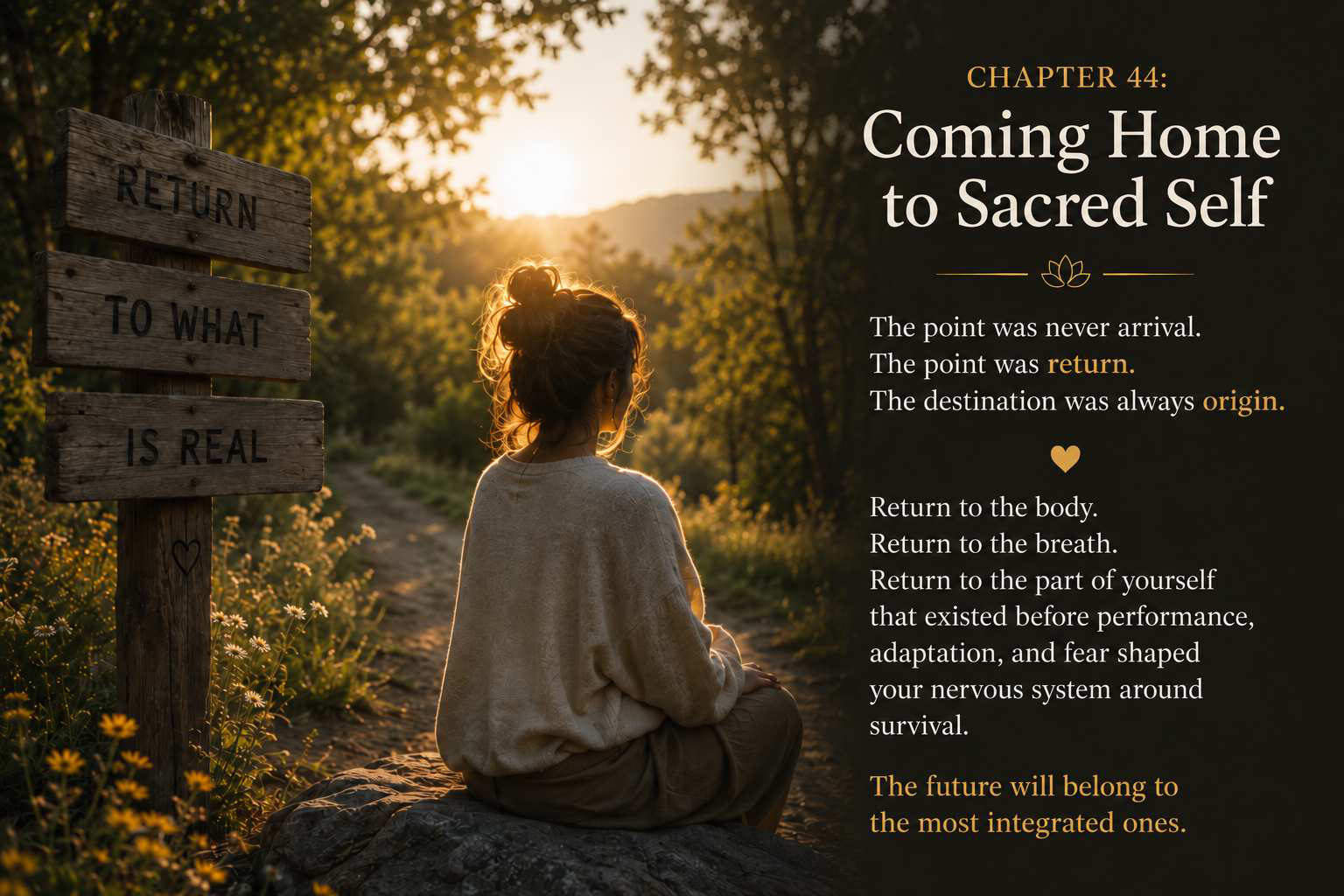
Coming Home to Sacred Self
At a certain point, the seeking begins to quiet. Life does not become simpler and uncertainty does not disappear, but something underneath all the striving becomes easier to see. Much of what we spend our lives searching for outside ourselves is really a journey back toward something we knew before we learned how to perform for the world. We arrive with no résumé, title, reputation, status, or explanation for our existence. Then life begins teaching us. A name is given. Expectations arrive. We learn what earns approval and what risks disappointment, what makes the adults around us relax and what makes them worry, and gradually we become skilled at adaptation.
Some of those lessons serve us beautifully. Others become so familiar that we eventually mistake them for identity. We learn to be useful, impressive, careful, agreeable, strong, indispensable, successful, invisible, entertaining, or whatever else seems most likely to preserve belonging. Much of adult development is therefore less about constructing an entirely new self than learning to distinguish between who we are and the strategies we once developed to feel safe, loved, or valued.
That is what I mean by Sacred Self. It is not perfection, enlightenment, or some polished version of ourselves with all the inconvenient parts finally removed. Sacred Self includes light and shadow, confidence and uncertainty, masculine and feminine, strength and softness, ambition and rest. It is the recognition that our fundamental worth does not rise and fall with performance, and that we can remain ambitious without asking achievement to prove our value, care deeply for others without disappearing inside their needs,
and continue changing without treating the person we are today as a problem that must first be fixed.
This becomes particularly important in the Age of AI because increasingly capable tools can amplify whatever we bring to them. Someone driven by anxiety can use extraordinary technology to become more efficient at worrying. Someone who believes achievement will finally make them enough can build a much faster treadmill. Someone grounded in curiosity, purpose, generosity, and self-trust can amplify those qualities too. The technology is powerful, but the human pattern still matters.
Modern life makes remembering this difficult. There is always another message, goal, comparison, notification, opportunity, obligation, or unfinished task whispering that peace is waiting just beyond completion. Yet completion keeps moving. If our permission to rest, love ourselves, or feel whole depends upon eventually finishing everything, we have constructed an impossible bargain. Sacred Self offers another possibility: to live from the understanding that we are already worthy of inhabiting our own lives fully.
Jason Karp
Steward of Returning to Human
Jason’s life was shaped early by a promise he made to himself while repeatedly hearing messages about the importance of creating abundance and security through one’s career. He absorbed that idea deeply and set out to build a life in which abundance would never be in doubt. Brilliant, disciplined, and relentlessly driven, Jason graduated summa cum laude from Wharton while competing as a
varsity squash player, built a formidable career in investing, and eventually founded Tourbillon Capital Partners, which managed billions of dollars. By conventional measures, he had reached a summit most people never approach.
Yet the summit did not answer the deeper questions. Jason has spoken openly about periods of depression and serious health problems he experienced in his twenties, including autoimmune illnesses and a degenerative eye condition. Those experiences led him into an intensive exploration of nutrition, lifestyle, health, and the relationship between human beings and the natural world. Together with his wife Jessica and brother-in-law Jordan Brown, he helped create Hu Kitchen and Hu products around an idea captured beautifully in four words: Get Back to Human. HumanCo later extended that mission into a company focused on building and investing in products intended to support healthier living.
What matters to me about Jason’s story is that he became willing to question the mountain he had spent much of his life climbing. Many of us pursue goals before asking where they came from. Some are genuinely ours; others are inherited from fear, comparison, cultural definitions of success, or old messages that quietly became ambition. We can become extraordinarily effective at reaching destinations we never consciously chose. Jason’s return toward health, family, nature, meaning, and a different definition of success illustrates something fundamental about Sacred Self: human flourishing cannot be outsourced. Intelligence, wealth, optimization, efficiency, and capability can expand what is possible, but they cannot by themselves create meaning, connection, health, purpose, or inner alignment.
That same question becomes even more consequential for children who are meeting the AI wave before they have finished discovering
who they are. Few people have spent more of their lives protecting the agency and potential of young people than Esther Wojcicki.
Esther Wojcicki
Steward of Youth
When I ask Esther what keeps her working into her eighties, she rarely speaks about legacy, recognition, or awards. She speaks about children. For decades she taught journalism at Palo Alto High School, but journalism was only the visible curriculum. Underneath it, students were learning agency, responsibility, revision, self-trust, collaboration, and the belief that their voices mattered. Her newsroom became famous for an unusual quality: students did not want to leave. They stayed late, sometimes extraordinarily late, working, talking, laughing, editing, creating, and belonging to something they felt was genuinely theirs.
Esther once laughed while describing how difficult it could be to get them to go home. That detail has stayed with me because it reveals something profound. Young people flourish when they find places where they are trusted with real responsibility, challenged without humiliation, and seen as people who are still becoming. Esther’s TRICK framework, Trust, Respect, Independence, Collaboration, and Kindness, grew from decades of helping parents and teachers preserve children’s agency while guiding them through a society that constantly tells them what success should look like.
That principle becomes increasingly important as AI enters education and childhood. Young people will grow up with companions, tutors, creative partners, and intelligent systems available at almost every moment. Those tools may become remarkably useful and emotionally compelling. Precisely because of that, Esther keeps returning to something beautifully old-fashioned: people still need people. Children learn empathy, courage, conflict, trust, forgiveness, collaboration, and belonging through relationship with other human beings. AI can assist learning, advise, tutor, translate, coach, and amplify creativity, but we should be cautious about allowing it to displace the relationships through which young people develop agency and humanity.
What former students seem to remember most about Esther is not simply what she taught them. They remember that she believed in them. There is enormous power in having another person recognize possibility in us before we can fully see it ourselves. A great teacher does more than transfer knowledge; they help a young person develop enough trust in themselves to keep becoming. That is Sacred Self in formation, the conviction that a child is not reducible to a grade, mistake, ranking, credential, algorithmic profile, or first attempt, but remains capable of revision.
The need to inhabit ourselves fully does not disappear when we become accomplished adults. In some ways it becomes harder, because success creates its own pressures toward conformity. Jacqueline Guichelaar understands this particularly well.
Jacqueline Guichelaar
Steward of Sacred Self
Jacqui was born in Uruguay and moved to Australia as a child, which is why she jokingly refers to herself as a “Latina Kangaroo.” She has
since built a global technology career across continents and organizations including Deutsche Bank, Lloyds Banking Group, Thomson Reuters, and Cisco. Yet the quality that has always interested me most about Jacqui cannot be captured by a résumé. She seems remarkably unwilling to become a smaller version of herself simply to make a room more comfortable.
After arriving in Australia, Jacqui experienced bullying at school and has spoken about the impression made by her mother’s willingness to step in and stand up for her. That experience helped shape a life in which Jacqui has repeatedly been willing to stand up for herself and for others. The energy is still unmistakable. She leads with conviction, humor, warmth, directness, and a kind of unapologetic aliveness. Her confidence does not feel like a performance designed to establish authority. It feels more like permission for the people around her to bring more of themselves into the room as well.
To me, that is one of the clearest expressions of Sacred Self. It does not require us to become extraordinary enough to earn validation. It asks us to inhabit who we already are with enough honesty that our gifts become fully available. Sacred Self is one of the core foundations of healthy relationship because the more completely we inhabit ourselves, the less energy we need to spend defending an identity. We become more capable of listening, changing our minds, learning from others, admitting uncertainty, and allowing other people to be fully themselves too.
Jason, Esther, and Jacqui arrive at this from radically different lives, yet their stories point toward the same proposition. Jason reminds us that reaching the summit does not necessarily tell us whether we chose the right mountain. Esther reminds us that people become themselves more fully when someone trusts their capacity to grow.
Jacqui shows what it can look like to inhabit ourselves with enough confidence that others feel freer to do the same. As our external tools become more powerful, knowing how to come home to ourselves becomes more important, and from that foundation we can begin asking what human talent itself becomes in the world now arriving.