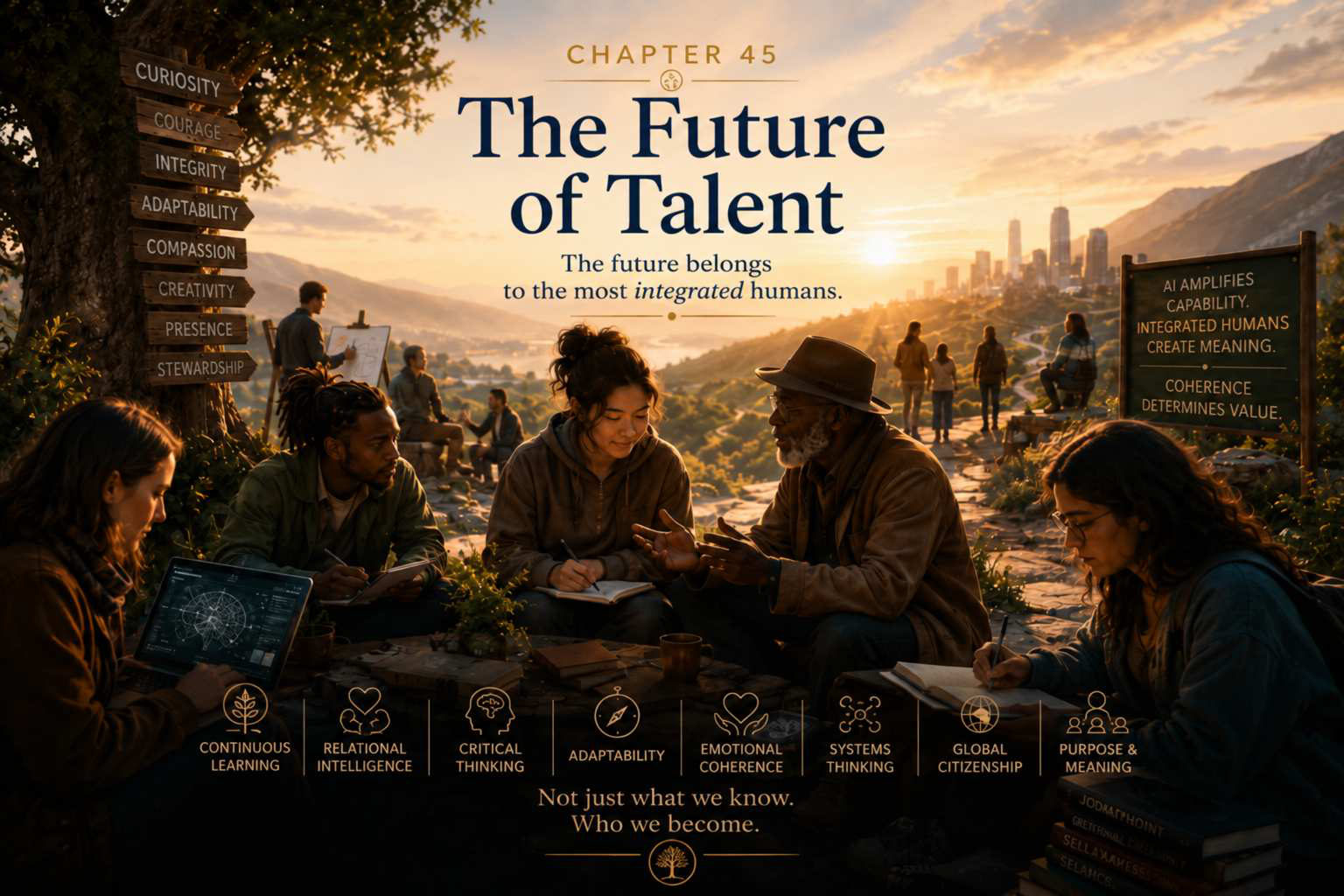
The Future of Talent
The future of talent will be shaped as much by human development as by technology. Artificial intelligence is already changing how work gets done, but the deeper shift is in how people learn, demonstrate capability, adapt, collaborate, and remain useful as the nature of work keeps changing around them.
For much of the last century, education was front-loaded: learn first, work later. That model is already becoming more fluid. AI shortens the distance between learning and application because people can increasingly acquire knowledge, practice skills, and solve problems while doing the work itself. Degrees and credentials will remain important in many fields, but they are likely to coexist with more direct evidence of capability: portfolios, simulations, apprenticeships, demonstrated judgment, and the ability to learn quickly in unfamiliar situations.
As machine intelligence becomes more capable, the human capacities around it become more visible. Judgment, discernment, imagination, originality, ethical responsibility, relational intelligence, trust, contextual awareness, and the ability to make sense of ambiguity all become more valuable when routine analysis, retrieval, coordination, and procedural work can be increasingly automated or augmented. The question is no longer simply how much someone knows. It is how they think, learn, decide, relate, and respond when the answer is not obvious.
This changes reskilling as well. People can learn extraordinary things throughout their lives, but learning becomes much harder when every mistake feels like evidence that they are becoming obsolete. Fear of irrelevance, humiliation, lost status, or starting again can block curiosity long before ability becomes the problem. The best learning environments therefore give people room to be imperfect while acquiring new capabilities, and leaders help by demonstrating that uncertainty and continued learning are part of competence rather than evidence of its absence.
Recruitment will evolve in a similar direction. Traditional hiring has depended heavily on signals of capability such as educational pedigree, previous quantitative career accomplishment, titles, brands, polish, and the ability to connect effectively with hiring managers. AI and increasingly sophisticated assessment tools will make it easier to see more of the person behind those signals, even as some traditional signals become less dependable. Learning, adapting, innovating, and managing through ambiguity will become much more critical. Empathy, compassion, presence, and the ability to inspire, innovate, and hold relationships effectively will become more powerful as well. Fluency in operating within an AI-driven environment will increasingly become a critical factor at most levels of work.
Retention changes when learning becomes continuous too. Compensation will always matter, but people also stay where they can grow without being diminished, where autonomy comes with support, where belonging does not demand conformity, and where the work retains some connection to meaning. An organization can keep people physically present long after their curiosity, trust, and emotional commitment have quietly left the building. The organizations that adapt best will increasingly behave like learning communities: clear about direction, willing to experiment, honest about limits, and able to help people develop as the work itself changes.
At that point talent strategy becomes much larger than an HR function. How societies educate, retrain, include, dignify, and create pathways for people through periods of technological transition will influence economic mobility, social trust, institutional legitimacy, and political stability. The question is not simply how to produce more skilled workers. It is how to help human beings remain capable of learning, contributing, and finding meaningful participation while the definition of useful work changes around them.
Cultural intelligence is a refined sensitivity to the signals, values, behaviors, narratives, and assumptions that shape both major cultures and the many microcultures within them. In the workplace, cultural intelligence helps determine what achievement looks like, which forms of intelligence receive recognition, whose voices carry weight, whether failure is survivable, and whether curiosity is rewarded or punished. Talent develops inside these cultural fields long before it ever appears on a résumé.
Few people I know think more deeply about the evolution of cultural intelligence than Raamayan Ananda.
Raamayan Ananda
Steward of Culture
Raamayan’s life resists easy categorization. He is an entrepreneur, investor, community builder, musician, systems thinker, and spiritual practitioner who has lived across cultures and continents. A conversation with him can move effortlessly from artificial intelligence and media to meditation, Bhakti Yoga, social movements, capital, consciousness, and the future of civilization. Beneath that
range is a consistent preoccupation with one question: how do ideas, values, and experiences move through culture strongly enough to change how people see themselves and one another?
As a practitioner of Bhakti Yoga and a student of Amma, the Hugging Saint, Raam carries a devotional orientation into work that might otherwise appear purely technological. He has long been interested in collective experience and in whether people separated by geography, religion, politics, and culture can still experience themselves as participants in something larger. That impulse helped lead him to co- found UNIFY, which has organized global synchronized meditation, peace, and compassion initiatives involving communities around the world.
The experience opened another line of inquiry for him. If meditation, music, symbols, stories, and shared intention can travel through societies, what determines which ideas spread, which disappear, and which eventually become part of culture? Raam began looking more closely at the mechanisms through which narratives move and at the increasingly powerful role of digital networks in shaping what people notice, value, repeat, and ultimately normalize.
That exploration eventually extended into Veme and CultureAI. CultureAI is building tools designed to make cultural signals in digital media more legible: what narratives are gaining traction, what audiences are responding to, and how patterns move across communities and markets. The commercial applications are obvious, but Raam’s fascination reaches beyond marketing. He is interested in whether a deeper understanding of cultural movement can help people communicate across differences rather than simply become better at capturing attention.
Raam’s perspective is useful because technology never enters an empty room. The same tool can be embraced, rejected, distorted, celebrated, feared, or transformed depending on the culture receiving it. Culture shapes what people aspire toward, what they trust, what they consider acceptable, and which behaviors receive status and reinforcement. AI may provide extraordinary new capabilities, but culture will help determine what societies choose to do with them.
That returns us to talent. The people who flourish in the coming era will develop inside families, schools, companies, communities, and cultures that are constantly signaling what kinds of human beings they should become. If those environments reward only speed, output, conformity, or technical brilliance, we will get one kind of future. If they also cultivate judgment, curiosity, courage, compassion, originality, responsibility, and the ability to work well with others, we create a much richer field of possibility.
Raamayan’s work reminds me that culture is not background scenery. It is one of the places where human possibility is continually being shaped. As AI changes the capabilities available to almost everyone, the cultures we create around those capabilities may become every bit as consequential as the technologies themselves.