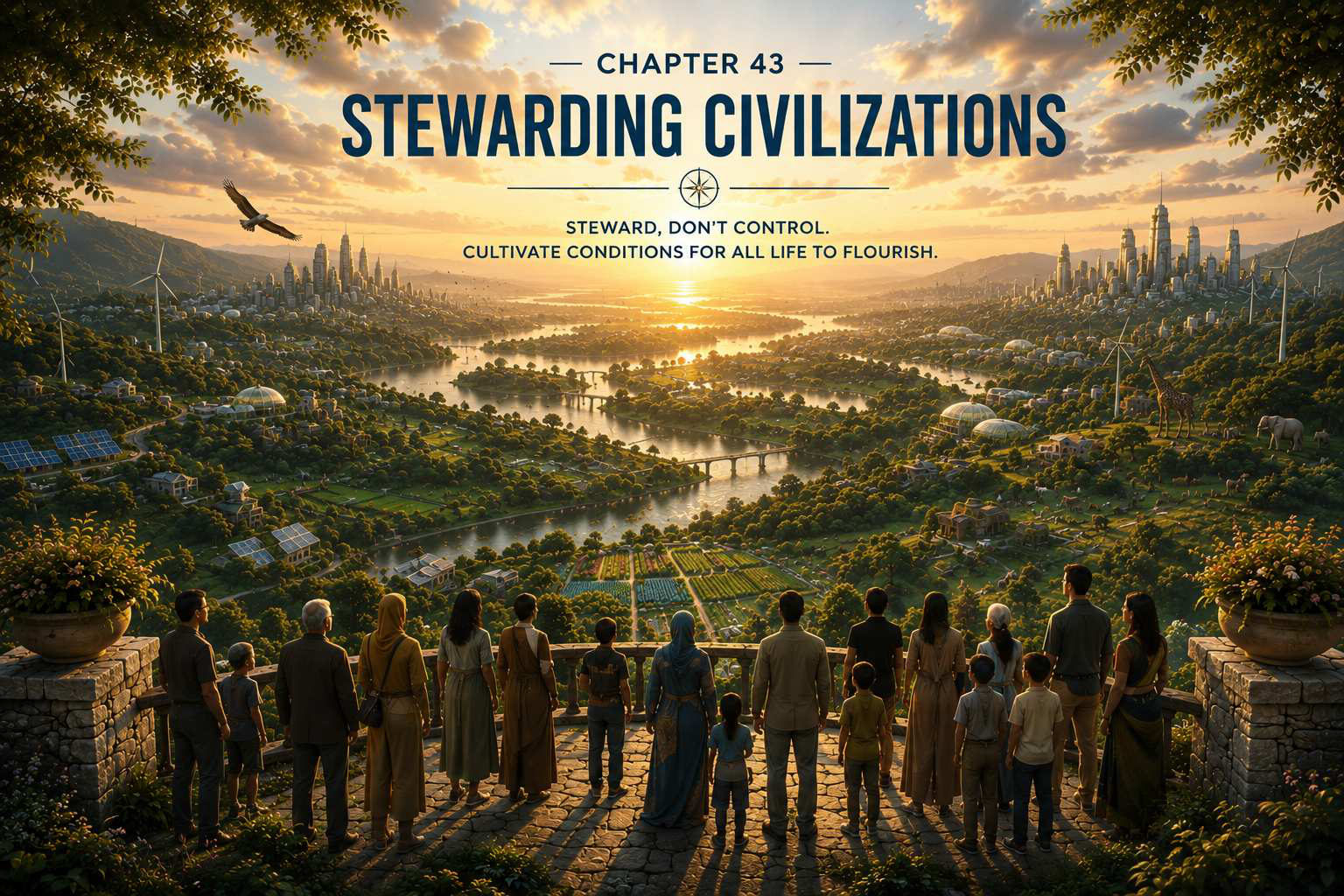
Stewarding Civilizations
Every civilization eventually encounters moments when its tools advance faster than its ability to understand their consequences. Fire changed what humans could control. Agriculture changed how societies organized. Industrialization transformed production, cities, families, and the natural world. Nuclear technology introduced forms of destructive power that required entirely new systems of restraint and cooperation.
Artificial intelligence belongs in that lineage, while also presenting something different. It is arriving with unusual speed, spreading across borders almost instantly, and increasingly affecting cognition itself: how people analyze information, make decisions, persuade one another, create, coordinate, and automate action. We do not yet know how far these capabilities will develop or how quickly. We do know that their consequences will not remain neatly contained inside individual companies, industries, or countries.
That changes the stewardship question. The challenge is no longer simply whether organizations can adopt AI successfully, or whether nations can compete effectively in its development. We also have to ask how increasingly capable systems can be developed and governed without allowing competition itself to overwhelm judgment. Markets have powerful incentives to create value and advantage. Governments have responsibilities for sovereignty, security, prosperity, and stability. Technology companies naturally pursue capability and innovation. None of those impulses is inherently wrong, but none by itself guarantees long-term human flourishing.
This is the design gap I have begun thinking about through the idea of a Council of Civilizations. I do not mean a world government, supranational authority, or moral tribunal. I mean a possible layer of sustained global coordination where governments, technology builders, researchers, civil society, and other major stakeholders can confront risks that are too interconnected to be managed through competition alone. Humanity has developed versions of this logic before in nuclear non-proliferation, aviation safety, maritime standards, public health, and other areas where one actor's failure can become everybody's problem.
Any such model would have to begin with humility. Different societies carry different histories, values, political systems, economic interests, and ideas about the proper relationship between individuals and institutions. Global stewardship cannot mean pretending those differences do not exist. The challenge is to find enough shared ground that profound disagreement does not make responsible coordination impossible.
Several responsibilities seem especially difficult to avoid. We need ways to reduce the possibility of irreversible harm as systems become more capable and autonomous, while preserving human judgment and the ability to intervene when automated systems fail. We need to protect meaningful human agency so that delegation does not gradually become abdication of responsibility. We also need room for cultural difference without allowing difference to become an excuse for ignoring risks that cross borders.
Just as important is the developmental impact on human beings themselves. Work, education, identity, dignity, meaning, and belonging may all change substantially as increasingly capable systems enter daily life. Technology can evolve much faster than
social institutions do, which means periods of disruption are likely to create both extraordinary opportunity and genuine pain. Stewardship requires paying attention not only to what new systems can do, but to what happens to people and communities while those systems arrive.
Then there is the responsibility to people who are not yet here. Decisions about powerful technologies are often made within quarterly business cycles, election cycles, funding rounds, and geopolitical contests whose time horizons are remarkably short. The consequences may last much longer. Future generations cannot sit in today's boardrooms or negotiating rooms, yet they remain stakeholders in the systems we choose to build.
This is why I increasingly believe that the deepest challenge of the AI era is not merely technological capability. It is whether our capacity for coordination, discernment, restraint, and stewardship can develop quickly enough to accompany it. Intelligence and wisdom are not the same thing. The ability to build something does not automatically tell us when to build it, how to introduce it, what safeguards it requires, or which consequences should cause us to change direction.
None of this requires fear to become our organizing principle. Fear narrows perception precisely when we need the widest possible field of view. Nor does stewardship require certainty, because certainty is unavailable. It requires something harder: taking serious possibilities seriously without pretending that we already know the future.
The Age of AI therefore asks something new of leaders across business, government, technology, education, science, and civil society. It asks them to think beyond the systems that reward them immediately and to consider the larger systems on which all of us
depend. That may mean holding national interest and global interest in the same field of view, recognizing commercial opportunity while acknowledging systemic risk, and accepting that responsibility sometimes extends beyond our own lifetimes.
Whether humanity becomes good at this is not guaranteed. History gives us examples of extraordinary cooperation as well as catastrophic failures to cooperate. The invitation is therefore neither optimism nor pessimism. It is maturity: the willingness to let our stewardship develop alongside our tools rather than endlessly trailing behind them.
And because civilizations are ultimately made of human beings, that maturity cannot be separated from the inner lives of the people making the decisions. Before we ask whether humanity can become more coherent, there is a more intimate question waiting underneath it: can we?
That brings us home again.