Coherent Flourishing in Relationships
Relational Literacy is the capacity to cultivate healthy, life-giving relationships with ourselves, one another, our organizations, our communities, society, intelligent systems, and nature. Eventually, every human being moving sincerely toward coherence discovers the same uncomfortable truth:
Relationships reveal exactly where coherence still disappears under pressure. You can spend ten days meditating beside a river, breathing deeply, journaling profound insights about consciousness, feeling like a beautifully regulated forest monk… and then somebody you love says, “We need to talk,” and suddenly your nervous system is running emotional soft ware last updated sometime around 1997.
Relationships are where Relational Literacy becomes visible. That matters enormously in the Age of AI, because as technology accelerates, human connection itself becomes increasingly precious. Attention becomes precious; presence becomes precious; time becomes precious. Even simple undistracted conversation starts feeling rare.
And at exactly the same moment, relationships are under extraordinary pressure. Many people are overstimulated, overworked, emotionally saturated, cognitively fragmented, and carrying far more stress than they realize. Many couples now spend entire evenings physically beside one another while psychologically dispersed across emails, notifications, unfinished tasks, financial anxiety, social media, low-grade nervous system exhaustion - and the strange feeling that modern life somehow became too fast for the human heart to metabolize cleanly. The body notices this long before the mind fully does - nervous systems always notice.
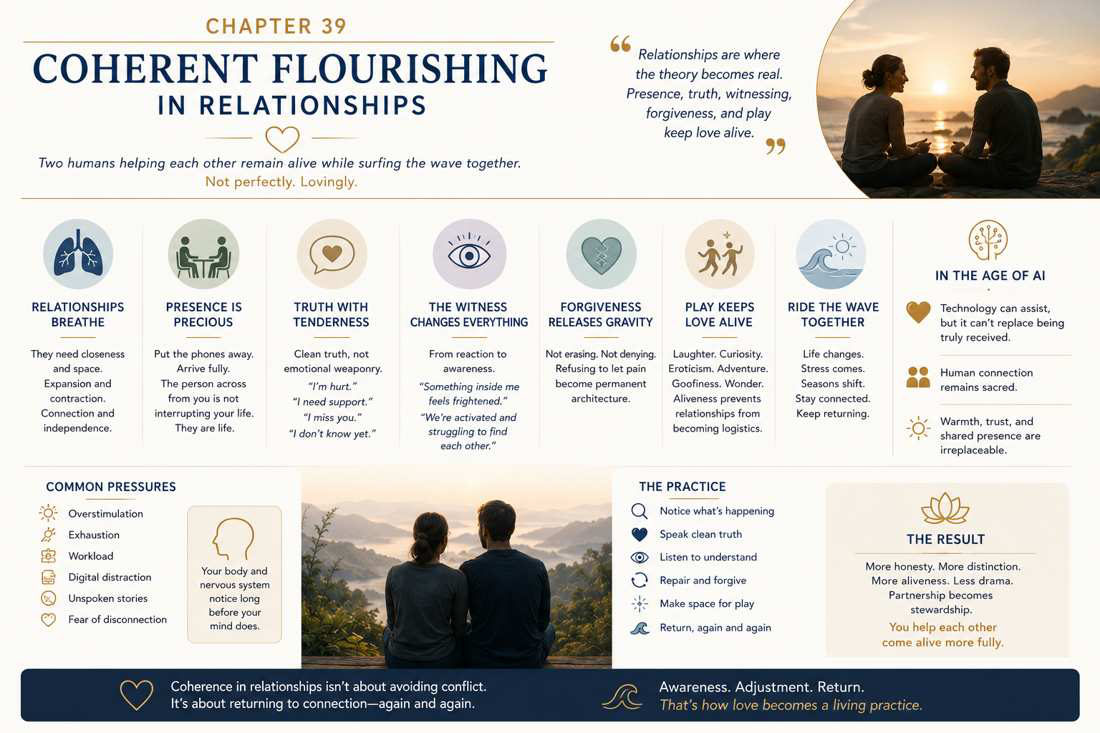
One of the first things I began understanding more clearly through all this work is that relationships are not productivity systems. They are living systems. And living systems need rhythm. They need periods of closeness and periods of individuality. They need movement, repair, rest, spontaneity, silence, laughter, breathing room, and the ability to adapt as life changes shape around them.
Many people become frightened the moment a relationship shifts slightly. One partner becomes quiet. Someone needs space. Work intensifies. Children arrive. Exhaustion enters. Stress accumulates. And almost immediately the nervous system starts asking existential questions: Are we okay? Is something wrong? Are we drifting? Are they leaving?
But healthy relationships breathe. There are moments of expansion and moments of contraction, just as lungs expand and contract. Relationships suffocate without space, but they also weaken without genuine connection. Coherence lives somewhere inside that movement.
And then there is presence, which may be one of the most overlooked forms of love left in modern life.
So many people no longer feel fully received by one another. They speak while half-working. Listen while checking phones. Touch while distracted. Sit together while mentally scattered across six different realities at once. The conversation continues, but the feeling of arrival quietly disappears.
The tragedy is that most people don’t need perfection from one another nearly as much as they need presence.
Sometimes coherent flourishing in relationships looks profound. Sometimes it simply means putting the phones in another room and remembering that the person sitting across from you is not interrupting your life. They are a significant part of your life.
Truth matters too, though not in the performative way modern culture sometimes frames it. Real relationships cannot survive indefinitely without honest communication, but honesty without tenderness quickly becomes emotional weaponry. Coherence requires something more difficult: clean truth. The kind that says:“I’m hurt.” “I’m scared.” “I miss you.” “I don’t know how to explain this well yet.” “I think I’ve been disappearing lately.” “I need support.” “I need a little space.” “I want us to find each other again.”
Those moments are particularly meaningful because silence has a strange way of hardening into story, and story hardens into distance surprisingly fast.
Then comes witnessing, which changes almost everything. A great deal of relational conflict escalates because human beings fully merge with the emotional storm moving through them. The nervous system activates, the story takes over, and suddenly two frightened children are trying to negotiate through adult bodies.
The Witness interrupts the spell.
Instead of “You always do this,” something softer and more honest becomes possible: “Something inside me feels frightened right now.”
Instead of “This relationship is failing,” there is enough space to notice: “We’re activated and struggling to find each other at the moment.” That shift sounds small until you experience it in real life. Then you realize it changes the entire emotional geometry of repair.
And eventually every long-term relationship arrives at the same sacred threshold sooner or later: Forgiveness.
Not because humans are terrible, but because humans are human. We misunderstand each other. We project old wounds into new moments. We become exhausted. Defensive. Frightened. Distracted. We fail to communicate clearly. We react poorly under stress. We forget tenderness while trying to survive the strange intensity of modern civilization with what feels like twelve thousand browser tabs permanently open somewhere in the background of the mind.
No meaningful relationship survives without forgiveness, because no meaningful relationship occurs without imperfection. To be human is to be imperfect - categorically.
And forgiveness, in relationships, is not pretending pain never happened. It is refusing to let pain become permanent architecture.
Relationships cannot flourish if every mistake remains emotionally alive forever. Somewhere along the way, healthy relationships learn how to release accumulated emotional gravity instead of endlessly rehearsing it. Neither erasing memory, nor denying accountability. Simply returning, again and again, to this moment, this breath, this version of one another instead of remaining trapped inside emotional archaeology. Then over time, something beautiful begins emerging from that kind of practice: Two people remain connected without disappearing into one another. They stop shape-shifting constantly for approval. They become more honest, more distinct, more alive. Partnership stops being ownership, and starts becoming stewardship. The relationship becomes less about controlling one another, and more about helping one another come alive more fully.
And then, quietly, play returns. This is far more important than many adults realize. For the most part, relationships do not collapse because love disappears. They collapse because aliveness disappears. Everything becomes logistics, management, scheduling, childcare, stress navigation, financial coordination, and emotional administration. Two people slowly stop surprising each other; they stop dancing; they stop flirting with life itself.
Play restores movement to this relational field.
Laughter. Curiosity. Eroticism. Adventure. Goofiness. Wonder.
Wonder is incredibly powerful not because it brings a childish energy; but because being in a state of wonder is a sign that the nervous system still feels sufficiently safe to remain open. That is why we strongly benefit from leading others through wonder, not fear.
Wonder opens others to expand into possibility in the present, while fear triggers others into contracting from the past and the future.
And all of this becomes even more important as artificial intelligence becomes increasingly woven into human life.
Technology will help us organize, optimize, analyze, communicate, translate, and automate countless parts of existence. It may even help humans understand themselves more clearly. But technology cannot replace the feeling of being truly received by another human being. It cannot replicate the warmth of shared presence, the softness of trust, or the feeling of laughing so hard with someone you love that both of you temporarily forget what year it is - that remains sacred territory.
Which is why coherent flourishing inside relationships ultimately becomes very simple: Two (or more) humans helping each other remain alive, present, and in a state of wonder, while surfing the wave together. Not perfectly. Lovingly.
Innovation only changes the world when people choose to embrace it. Technology may create new possibilities, but it is human connection that determines whether those possibilities become lasting change. Few people understand that intersection better than Carolyn Everson.
Carolyn Everson
Steward of Connection
One of the things I enjoy most about speaking with Carolyn Everson is that she has very little patience for unnecessary complexity. This is understandable as she sits on the Boards of Disney and Coca-Cola amongst others, led Instacart as President, and led sales at Facebook.
You can bring her the biggest technological shift in a generation, and within a few minutes she'll cut straight to the human implications.
When we spoke, artificial intelligence was then, as it is now, moving at breakneck speed. New models were arriving almost weekly. Entire industries were trying to figure out what was happening. Boards were scrambling. Executives were scrambling. Founders were scrambling.
Carolyn wasn't dismissing any of it. She sees the wave clearly. What interested her was something else.
What happens to people?
I remember her saying, almost in passing, "The technology is easy. Human rewiring is the challenge." The more I thought about it, the more I realized she was pointing at the heart of the issue.
Most organizations can eventually buy the technology. They can hire consultants. They can deploy software. They can build agents.
The harder question is what happens when thousands of people suddenly realize the way they've worked for twenty, thirty, or forty years may no longer be the way work gets done.
That's not a technology problem - its a human problem.
Carolyn has spent her career helping organizations navigate exactly those kinds of transitions. Not this specific one, perhaps - none of us have seen this before. But she understands what happens when uncertainty enters a system; whe understands culture; she understands leadership; and he understands what people need when the ground beneath them begins to move.
One of the things that struck me during our conversations was how quickly we arrived at the loneliness of leadership.
She didn't need much explanation. She knew exactly what I meant.
Leaders spend enormous amounts of time carrying things they cannot fully share: They filter information. They absorb anxiety. They make decisions with incomplete data. They hold the concerns of employees, customers, investors, boards, partners, and families all at the same time.
At some point, the conversation drifted toward a question that has become increasingly important to me: Who holds the holders?
Carolyn immediately understood why that question matters. Not theoretically = practically.
Because leadership can be lonely. Not always, but often. Especially during periods of profound change.
Another thing I appreciated was her realism. There was no hype. No panic. No handwaving or grand declarations.
At one point she observed that some of this transformation is simply going to happen to people. That feels true - whether we welcome it or resist it, AI is arriving in organizations. Jobs will change. Teams will change. Expectations will change. The pace of change will continue to accelerate.
The question isn't whether that's happening. It is how we help people move through it.
Interestingly, Carolyn believes some of the most important leaders of the next decade may come from places that organizations have historically underestimated. The people who understand culture. The people who understand change. The people who understand how humans respond under pressure; and who know how to help others navigate uncertainty without becoming consumed by it themselves.
In many ways, that's what stewardship looks like: Not standing above the storm. Walking beside people through it.
Over and over, that's what I felt in Carolyn's presence. Not prediction. Not performance. Steadiness.
Carolyn reminds me that every meaningful transformation is ultimately a human one.
Technologies evolve. Markets change. Organizations reinvent themselves.
But trust, generosity, curiosity, and genuine connection remain remarkably constant. And once people begin to connect in new ways, another question quietly appears: How do we continue reinventing ourselves long after success has arrived? Chip Conley has spent much of his life exploring exactly that question.