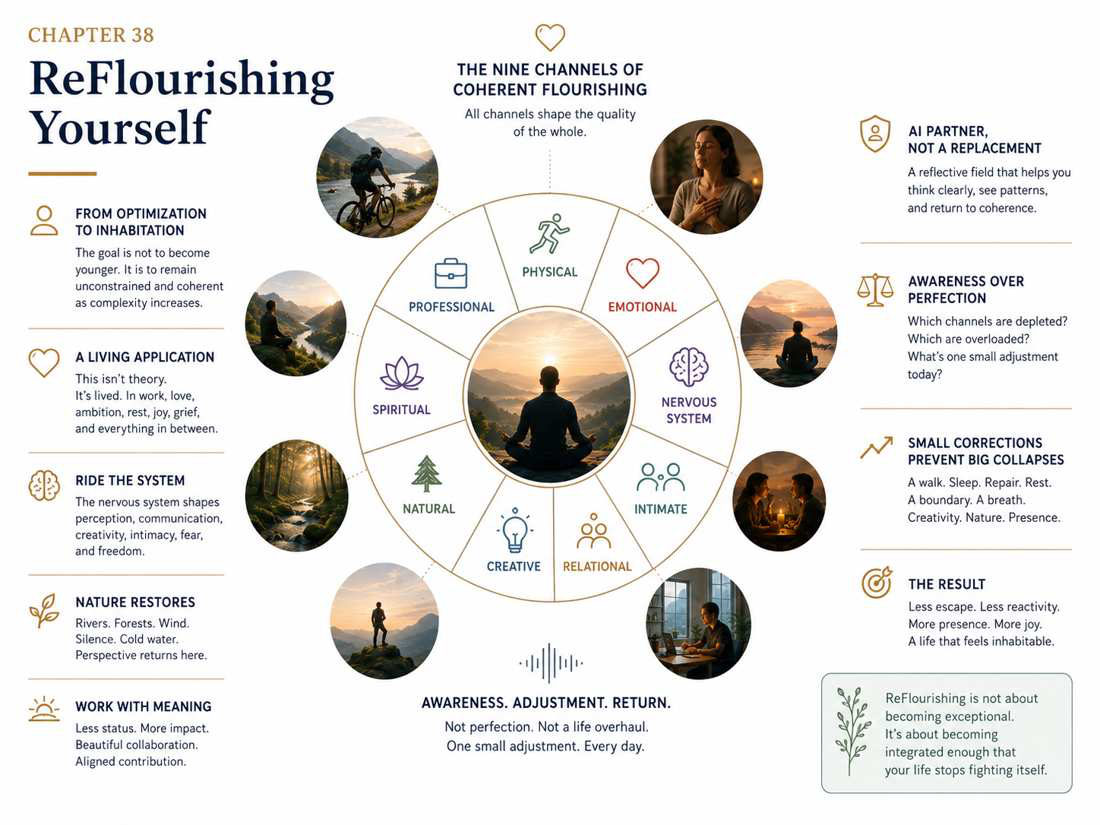
ReFlourishing Yourself
At some point, this work stops being conceptual. The question is no longer: “Do I understand coherence?” It becomes: “How do I actually live this way inside a real human life?” Neither on retreat, nor in perfect conditions. Living inside ordinary existence - work, aging, relationships, play; ambition, exhaustion, desire, uncertainty, grief, and joy. That is where our adaptive constructs either become real or collapse into performance.
So rather than prescribe an idealized life, I want to show you something simpler: A living application. As you read this, I invite you to not focus too much on the specifics of my life. Watch the patterns underneath it. Then think of your own life. Notice how different domains either strengthen coherence or quietly fracture it. Because expanding your coherent flourishing is in relationship to your body, nervous system, emotion, intimacy - and in relationship to your work. It involves your relationship to creativity, rest, nature, and meaning itself.
So here I am, finishing this in mid-2026 at sixty-three years old; and one of the biggest shifts is this: I no longer think in terms of optimization. I think in terms of inhabitation and coherent flourishing.
Can I fully inhabit my life? Can I remain alive inside it? Can I stay coherent as complexity increases around me? That changes everything.
Physically, I’m not trying to become younger. I’m trying to remain unconstrained for as long as possible. Daily meditation, yoga, calisthenics, and saunas. Good food. Good supplements. Time to recover.
Long daily rides to my river. Recovery. Nature as a primary partner. Listening carefully when the body whispers instead of waiting until it screams.
Aging, approached consciously, starts feeling less like decline and more like refinement.
The nervous system has become equally important. The last twelve months was the year I truly understood how deeply it governs perception, communication, leadership, creativity, intimacy, fear, and freedom itself.
The work now is not accumulating more ideas. It is learning how to ride the system skillfully instead of being dragged behind it.
Emotionally, something shifted too. The triggers still come - but they move through faster. Stories loosen sooner. Joy returns more easily.
That is not luck. It is practice. Creativity transformed too.
It stopped feeling episodic and started feeling continuous. The books, architectures, mythologies, conversations, and ideas all began flowing from the same underlying source. I no longer try to force creativity. I protect the conditions that allow it.
Nature remains one of those conditions: Rivers. Forests. Oceans. Wind. Altitude, cold water, daily garden walks with Chief. Lots of silence. Trying to be in bed by 10 pm. Generally up before 5 am.
Whenever coherent flourishing thins, nature restores perspective faster than almost anything else I know.
And work itself has changed: older identities are dissolving. New forms of contribution are emerging. I care far less now about status and more about meaningful impact, aligned relationships, beautiful collaboration, and work that feels coherent with who I actually am becoming.
Alongside all this, another relationship has quietly emerged too:
A partnership with artificial intelligence not merely as a tool, but as a reflective field - something capable of helping me think more clearly, notice patterns sooner, and return to coherence faster when I drift.
I share all this for one reason only: To make the work real.
ReFlourishing the self is not about becoming exceptional. It is about becoming integrated enough that your life stops fighting itself.
And when that begins happening, something surprising occurs. Your system gets quieter, clearer, and less divided. You stop needing constant escape because your life itself becomes more inhabitable. There is less of a draw to recreational substances.
One simple way to understand this is through what I call the Nine Channels.
Imagine a recording studio mixing board. Different channels constantly shaping the quality of the whole song.
Physical Emotional Nervous System Intimate
Relational Creative Natural Spiritual Professional
When one channel dips, the whole system compensates. When one becomes overloaded, distortion spreads everywhere else. Many people misdiagnose themselves because they only look at one layer at a time.
Sometimes what feels like procrastination is exhaustion. What feels like relationship conflict is nervous system overload. What feels like lack of discipline is disconnection from rest, creativity, touch, movement, nature, or meaning.
The goal is not perfect balance - it is awareness.
A simple daily question helps enormously:
Which channels feel depleted right now? Which feel overloaded? What is one small adjustment that would restore coherence?
Not a life overhaul. One adjustment.
A walk. Sleep. A repair conversation. Ten quiet minutes. A boundary. A creative act. A breath before reacting.
Small corrections prevent large collapses. And over time, something subtle but profound begins happening. You stop moralizing every fluctuation. You become less cruel toward yourself. More curious. Less ashamed. More responsive. More capable of catching drift before the system has to scream for your attention.
That is the real work: Awareness. Adjustment. Return. Over and over.
Try This: Refill First (about 5 minutes)
Before your next act of output, do one small restorative thing - drink a glass of water, a look at the sky, three slow breaths, a short walk. Then notice the quality of what comes next. You cannot pour, for long, from a nervous system running on empty.