Coherent Flourishing in Organizations
At some point I realized that organizations often try to solve human problems mechanically while being composed entirely of human nervous systems.
That creates a strange kind of suffering.
A company can have extraordinary strategy, brilliant technology, highly intelligent people, elegant processes, and still quietly become a place where human beings spend enormous amounts of energy pretending they are less exhausted, less frightened, less lonely, less overwhelmed, and less uncertain than they actually are.
From the outside, everything may still appear successful. Targets get hit. Calendars stay full. Investor decks remain optimistic. Slack channels continue producing thumbs-up emojis and phrases like “great alignment here, team.”
But underneath all of it, the organism can begin losing vitality.
The room becomes tighter. Conversations become more careful. Curiosity starts shrinking. People stop speaking unless they already know the answer is safe.
Meetings become strangely performative, as though everyone is participating in a collective theater production called Competent Professional Humans Having Excellent Synergy While Quietly Dissociating.
The nervous system always knows when this is happening, even if the organization does not.
The deeper I moved into leadership work, founder communities, executive teams, and organizational transformation, the more I came to believe that many companies were not suffering from a lack of intelligence. They were suffering from accumulated incoherence.
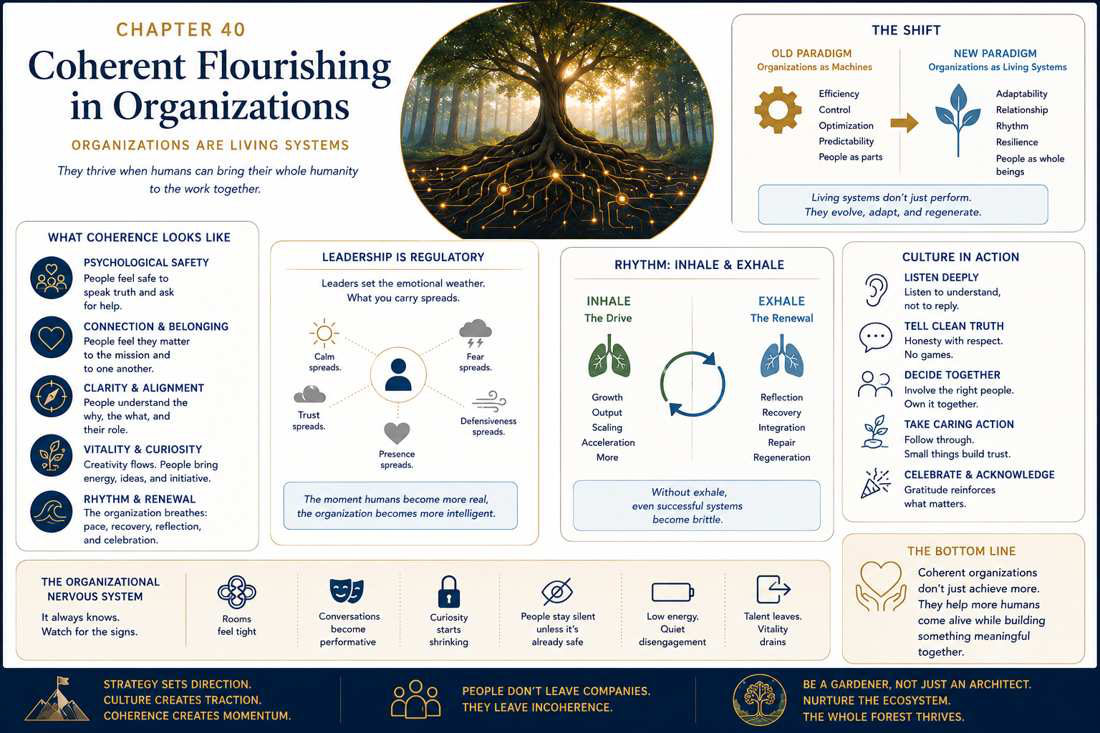
Because organizations are not machines.
They are living systems made of humans.
That distinction changes almost everything.
Machines optimize primarily for efficiency. Living systems depend upon adaptability, relationship, rhythm, resilience, and coherence.
A forest remains healthy not because every tree behaves identically, but because intelligence circulates throughout the ecosystem. Diversity strengthens it. Interdependence stabilizes it. Communication keeps it alive.
The same is true for organizations.
People do their best work when they feel safe enough to tell the truth, connected enough to matter, clear enough to move, and alive enough to care. Without those conditions, even extraordinary talent slowly contracts.
You can feel this almost immediately when you walk into certain workplaces.
Some organizations feel emotionally braced before anyone even speaks. The lighting seems to hum with low-grade existential fatigue. Human beings communicate primarily through defensible abstractions while carefully avoiding invisible political tripwires beneath the carpet tiles. Nobody fully relaxes because the system itself does not feel safe enough for people to show up as themselves.
Then there are organizations that feel breathable.
Not perfect.
Alive.
People laugh there. Not performative corporate laughter, but real laughter — the kind that escapes unexpectedly and briefly interrupts everyone’s attempt to appear professionally optimized.
Conversations contain actual humanity. Leaders feel grounded rather than theatrically certain. Creativity moves more naturally because people are no longer spending enormous amounts of energy protecting identity all day.
The organization begins feeling less like an extraction machine and more like a living organism trying to build something meaningful together.
That difference is far more consequential than it may appear.
Because leadership is not simply directional.
Leadership is regulatory.
A leader enters a room carrying an emotional weather system whether they intend to or not.
Calm spreads.
Fear spreads.
Defensiveness spreads.
But trust, presence, and wonder spread too.
Human beings continuously absorb emotional reality from one another, often far more deeply than they absorb stated strategy.
I once watched an exhausted CEO transform an entire executive retreat simply by admitting the truth.
There was no drama. No mea culpa vulnerability theater. No performative emotional choreography designed to manufacture authenticity on schedule.
He simply sat down, looked around the room, and said that he was tired.
Really tired.
The effect was immediate.
Shoulders lowered around the table.
Other executives stopped speaking like quarterly reports wearing skin.
The conversation softened. Real problems surfaced for the first time all day because suddenly nobody needed to waste energy pretending to possess certainty they did not actually feel.
The organization became more intelligent the moment the humans inside it became more real.
I suspect this will become one of the defining leadership transitions of the AI era.
As artificial intelligence accelerates capability, deeply human capacities become increasingly valuable.
Presence.
Discernment.
Creativity.
Emotional intelligence.
Wisdom.
Relationship.
Meaning.
Adaptability.
The ability to remain coherent under pressure while helping others do the same.
Not because technology matters less.
Because humanity matters more.
This changes how organizations think about rhythm too.
Most modern companies inhale constantly.
Growth.
Expansion.
Output.
Scaling.
Optimization.
Acceleration.
More.
Every quarter becomes another attempt to outrun stillness.
But living systems also require exhalation.
Reflection.
Recovery.
Integration.
Repair.
Celebration.
Regeneration.
Without exhale, even successful systems become brittle.
The healthiest organizations I have encountered understand this intuitively. Retreats are not viewed merely as rewards for surviving misery. Reflection is not considered wasted time. Regeneration is not framed as weakness requiring apology.
It is understood as part of how the organism stays alive.
And eventually coherent organizations discover another truth:
People trust lived reality more than stated philosophy.
A company can place beautiful values on every wall in the building, but if daily behavior rewards fear, exhaustion, overwork, performative urgency, and emotional disconnection, people understand the real culture immediately.
Coherence emerges when values, principles, and practices begin aligning closely enough that humans stop experiencing constant internal contradiction while participating in the system.
Not perfectly.
Honestly.
When that happens, trust deepens naturally. Creativity returns. Politics lose some of their grip. People become more willing to
experiment because failure no longer threatens belonging itself. The organization becomes more adaptive because human beings are no longer burning enormous amounts of energy managing invisible fragmentation.
The same principle applies to AI.
Artificial intelligence can absolutely help organizations become more effective. It can reduce friction, increase clarity, organize complexity, accelerate creativity, support communication, and amplify capability in extraordinary ways.
But AI will also amplify the architecture of the organization using it.
A fragmented organization may simply fragment faster.
More dashboards.
More information.
More acceleration.
More output.
More noise.
More performative productivity wrapped around increasingly exhausted human beings.
Coherent organizations can partner with AI differently — as amplification rather than replacement, in service of coherent flourishing.
They can combine technological intelligence with deeply human coherence: places where people remain alive while building; where leadership becomes stewardship rather than domination; where trust and meaning matter; and where human beings do not have to amputate their humanity in exchange for belonging.
One of the people who reinforced this perspective for me was Alan Boehme.
Alan Boehme
Steward of Adaptiveness
Over the course of an extraordinary career, Alan has helped lead technology and digital transformation inside some of the world’s largest organizations, including senior technology leadership at Procter & Gamble and later serving as CTO of H&M Group.
What I appreciate about Alan is that he rarely talks about the future as though it is simply something happening to us.
He talks about preparedness.
Again and again, our conversations have returned to a deceptively simple question:
Are organizations preparing for the world that is emerging, or are they still optimizing for the world that is disappearing?
That distinction feels increasingly important.
Many leadership teams still treat AI primarily as a technology initiative.
A tool.
A platform.
A project to be delegated somewhere inside the organization chart.
Alan sees something larger unfolding.
Organizations will not become adaptive simply by adopting new technologies. They have to reconsider how leadership works, how
decisions are made, how talent develops, and how humans and intelligent systems work together.
Preparedness is no longer primarily technical.
It is organizational.
The challenge is not to predict every change. That is impossible.
It is to build organizations capable of learning, adapting, and remaining coherent while change is happening.
And perhaps that is the deeper opportunity hidden beneath all this acceleration.
Eventually every organization encounters the same question beneath strategy, growth, innovation, and technology itself:
Are we building systems humans must survive? Or systems that help humans come alive?
One of the people exploring that question most directly is Doug Shean.
Doug Shean
Steward of Mirroring
Doug has spent his career operating where complexity, scale, technology, and trust intersect.
Across leadership roles at Lehman Brothers, Citigroup, and Procter & Gamble, he has worked inside large global institutions navigating cybersecurity, emerging technologies, artificial intelligence, and enterprise transformation.
Today, as founder and CTO of Simeras, Doug is working at a very different frontier.
Simeras is building a persistent synthetic world in which autonomous digital twins can continue to exist, interact, remember, respond to events, and generate emergent behavior over time.
The technology is ambitious.
But what most interests me is the question beneath it.
As human and artificial intelligences increasingly participate in the same social, economic, and organizational environments, how might we use synthetic worlds to understand the systems we are creating before their consequences become real?
Could a persistent synthetic environment allow organizations to explore products, ideas, policies, experiences, or strategies before introducing them into human systems?
Could digital populations help us observe patterns of cooperation, resilience, trust, behavior, and adaptation that would otherwise be difficult to see?
These remain emerging questions, not settled answers.
That is precisely why the work matters.
A sufficiently rich synthetic world becomes more than a prediction engine. It can become a mirror — a place in which humanity experiments with systems, watches what emerges, and learns something about itself in the process.
Doug’s work therefore sits at the intersection of one of the defining questions of the AI era:
Not simply whether humans and artificial intelligence can coexist, but how we can learn, adapt, and flourish together.
The future of AI will not ultimately be determined only by the power of the technologies we create.
It will also be determined by the wisdom with which we steward the relationship between digital and human life.