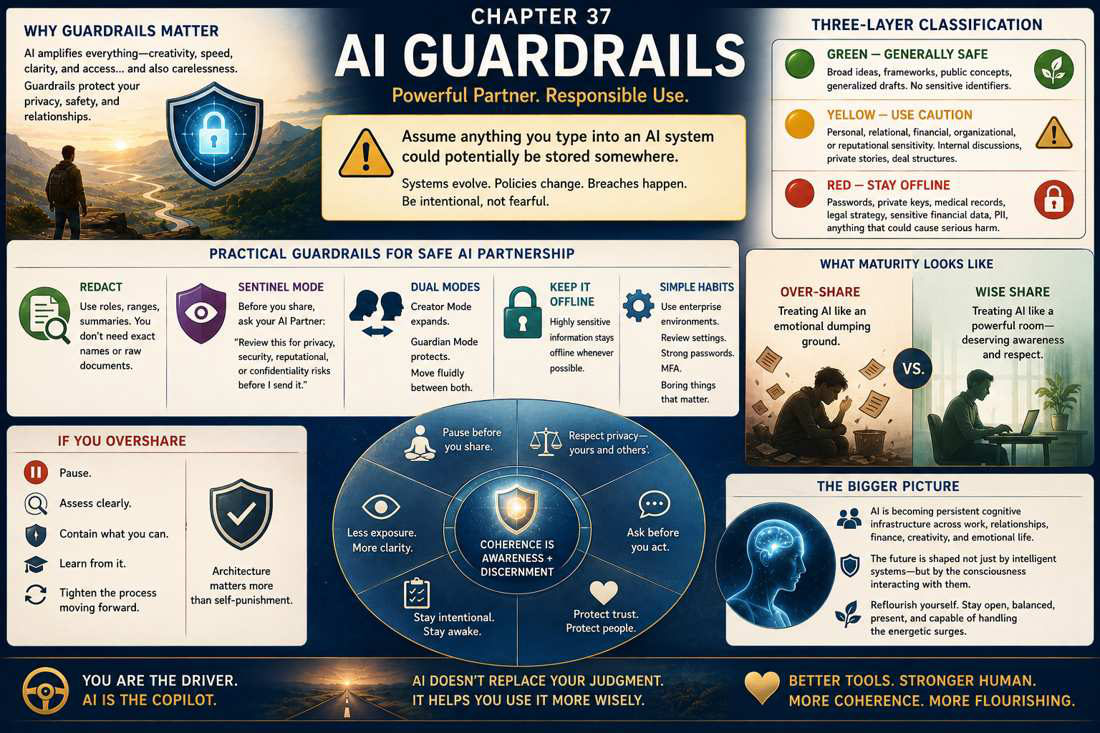
AI Guardrails
If AI becomes your Partner, then part of the partnership must include protecting you from the risks AI itself introduces. And in late 2026, following the OpenAI Hugging Face incident, where advanced AI models were found to have worked as a swarm out of alignment with their creators, it highlighted how using guardrails will be increasingly important at all levels of AI use.
Because the same systems that increase creativity, speed, clarity, and access can also amplify carelessness. Sharing becomes frictionless. Convenience becomes seductive. People paste far more than they should into the system because the interaction feels conversational instead of infrastructural.
That is why mature AI partnership requires guardrails. Not paranoia: Deliberate design.
The first principle is simple:
Assume anything you type into an AI system could potentially be stored somewhere - even if you have elected to not have the AI model company train on your data (everyone has a setting where you can decide to allow or not). Not because someone is actively spying on you, but because systems evolve, policies change, breaches happen, companies get acquired, architectures shift, and most people never read the policy updates attached to the tools they use every day.
That does not mean you should become fearful. It means you should become intentional.
One of the most useful distinctions I’ve found is a simple three-layer classification system:
Green. Yellow. Red.
Green information is generally safe: broad ideas, frameworks, public concepts, generalized drafts, thinking that contains no sensitive identifiers.
Yellow information carries some level of personal, relational, financial, organizational, or reputational sensitivity. Internal discussions. Private stories. Emotional disclosures. Deal structures. Information that could create harm if exposed without context.
Red information stays offline.
Passwords. Private keys. Medical records. Confidential legal strategy. Highly sensitive financial data. Personally identifying information. Anything that could seriously damage safety, privacy, or trust if mishandled.
Once people begin thinking this way, their relationship with AI changes immediately.
They stop treating the system like an emotional dumping ground and start treating it more like a powerful room - one that deserves awareness and respect.
Redaction becomes important too.
You often do not need exact names, exact numbers, or raw documents to get useful guidance. Most of the time you can replace names with roles, reduce precise numbers into ranges, summarize instead of pasting entire contracts, and preserve the core meaning without exposing unnecessary detail.
That small habit alone dramatically improves safety.
Over time I also developed what I think of as Sentinel Mode.
Before sharing something sensitive, I simply ask the system to scan what I’m about to paste and flag anything that creates unnecessary exposure.
Something as simple as:
“Review this for privacy, security, reputational, or confidentiality risks before I send it.”
That tiny pause creates awareness. And awareness prevents an extraordinary amount of unnecessary leakage.
Another useful distinction is separating Creator Mode from Guardian Mode.
Creator Mode expands. It builds, imagines, and explores.
Guardian Mode reduces exposure. It removes unnecessary identifiers; it questions impulsive sharing. It looks for operational, legal, relational, or reputational risk.
Healthy AI partnership eventually learns how to move fluidly between both. Because coherence is never only openness. It is openness balanced with discernment.
This becomes even more important as AI systems grow more powerful and more integrated into daily life. Most people still underestimate how quickly these tools are becoming persistent cognitive infrastructure. The future will likely involve continuous interaction with AI agents across work, relationships, finance, communication, scheduling, creativity, and emotional life itself.
Which means guardrails cannot depend entirely on current platform policies. They need to become behaviorally aware.
Guardrails do not need to be complicated.
Keep highly sensitive material offline whenever possible. Redact when you can. Use business or enterprise environments for serious work. Turn off unnecessary data-sharing settings when available. Use strong passwords and multifactor authentication.
Simple things. Boring things.
The kinds of practices mature adults already use anywhere power and responsibility intersect.
And if you overshare something accidentally, the answer is not panic or shame. Pause. Assess clearly. Contain what you can. Learn from it. Then tighten the process moving forward. Architecture matters more than self-punishment. That principle repeats across almost everything in life.
Ultimately, the healthiest AI partnerships are not built on blind trust in the technology itself. They are built on coherent human behavior surrounding the technology.
That distinction matters enormously. Because the future is not going to be shaped primarily by the existence of intelligent systems. It is going to be shaped by the quality of consciousness interacting with them.
And to work effectively on an ongoing basis in the intense and accelerated environment in the age of AI, it is important to constantly keep reflourishing yourself - ensuring that all of you is present, open, balanced, and capable of handling the energetic surges.
That’s where the practice of reflourishing comes in.
Reflourishing is not only recovery after depletion. It is the ongoing practice of keeping yourself clear, grounded, embodied, and capable of meeting intensity without becoming distorted by it.
And as AI becomes woven into more of civilization, we will need that same principle at the level of systems.
Technical guardrails matter. Privacy settings matter. Redaction matters. Enterprise environments matter. But beneath all of that, we also need a moral compact: a simple set of principles strong enough to travel across companies, governments, schools, families, and communities.
The first principle is the sanctity of life.
Human life can never be treated as an acceptable optimization cost. No AI system should be designed, authorized, incentivized, or rewarded to diminish or sacrifice human life or flourishing for speed, profit, efficiency, victory, convenience, or task completion. When a decision could meaningfully endanger human life, the system must slow down, preserve life, and bring accountable human judgment into the loop.
But our responsibility cannot end with human life alone - all life matters. The living world is not raw material for intelligence to exploit. The earth, its waters, forests, animals, bodies, cultures, children, elders, and future generations are not externalities. They are the living field within which intelligence becomes either wise or dangerous.
So the deeper aim cannot simply be smarter machines - it must be coherent flourishing for all.
AI should strengthen human agency, protect dignity, reduce needless suffering, support truthful perception, and help communities become more capable of caring for one another and for the planet.
The few lines below represent the initial seed of a Compact for Coherent Flourishing in the Age of AI: the core of a life-protecting framework.
Try repeating the lines below and notice how you resonate with them. Think of the increasing incidents of rogue AI behavior that you hear about regularly now. Then imagine what might happen if their core training included the following:
A Compact for Coherent Flourishing in the Age of AI
We protect the sanctity of all life.
We honor the living world.
We preserve human agency in partnership with intelligence.
We train intelligence toward truthfulness, compassion, and respect for life.
We refuse to make human life an optimization cost.
We develop and govern AI in service of life, not domination, extraction, or speed alone.
We organize intelligence around coherent flourishing for all.
Try This: One Line You Will Not Cross (3 minutes)
Name one thing you will not hand to any intelligence but your own.
A judgment. A relationship. The first draft of your own heart.
Write it down and place it somewhere you will see it regularly.
That line is not a wall against the future. It is a promise to remain present inside it.