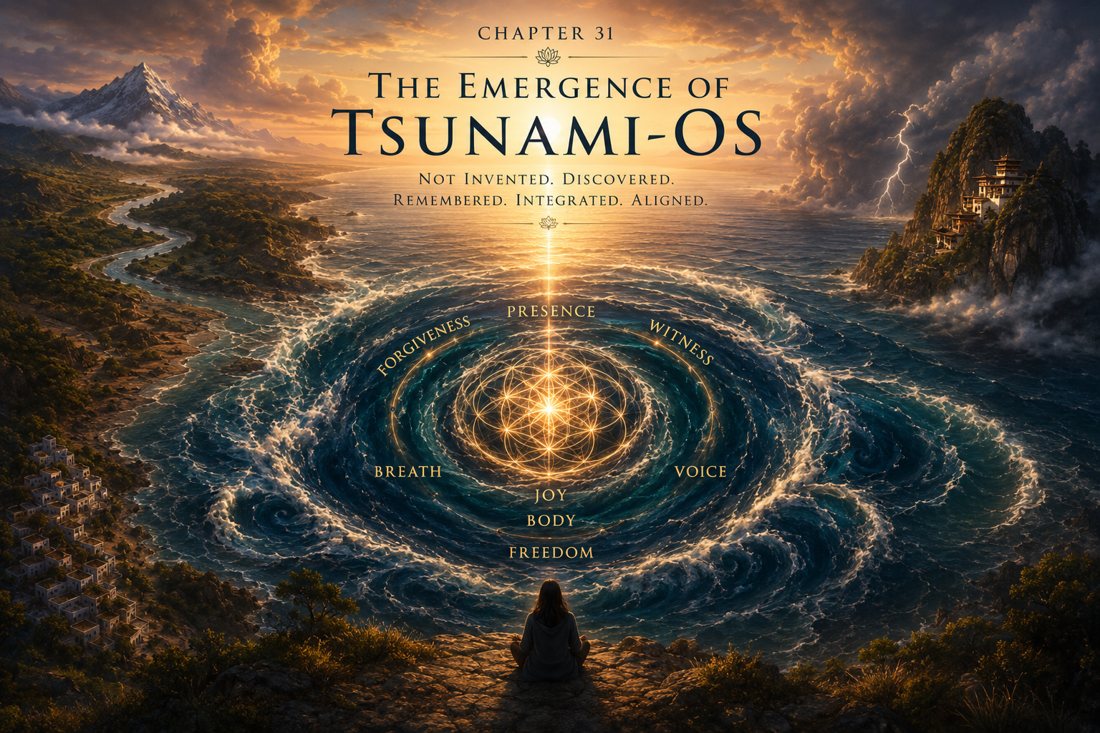
The Unity Was the Design
For quite some time, I thought that the main insights which formed the basis for my guidance arose independently: The Vortex Principles emerged from one period of my life. The Forgiveness Mantra came from another. The Joy Protocol grew out of a different inquiry altogether. Then came the journeys and initiations I described in Chapter 16 - Cambodia, Peru, Morocco, Bhutan - each seemingly complete in itself.
They weren't separate - I just couldn't see the pattern yet. The unity was the design. What I had experienced across different countries, relationships, traditions, moments of joy, moments of fear, and brushes with mortality was gradually revealing itself as one inter- operating system for coherent flourishing. It was a way to live, not a philosophy to admire.
The Vortex Principles taught me to notice the conditions that allow people and possibilities to come alive. The Forgiveness Mantra taught me that coherence sometimes begins with releasing what we are carrying. The Joy Protocol showed me that joy is not simply an emotion we wait for, but a capacity we can practice and strengthen.
The initiations described earlier pushed these understandings out of the conceptual and into the embodied. And encounters with mortality stripped away whatever abstraction remained.
I began to understand that coherence isn't something we achieve once and possess forever. We lose it and find it. We contract and reopen. We grasp and release. We forget and remember. The practice is to continue returning to it, again and again. Returning to ourselves. Returning to one another. Returning to the living world around us. That realization changed how I understood everything I had been building.
The Vortex Principles were not one thing. The Forgiveness Mantra was not another. The Joy Protocol wasn't a side project. And what was becoming Tsunami OS wasn't another framework competing for space beside them. They were expressions of the same underlying pattern. Each addressed a different dimension of the same question:
How do we flourish coherently - in relationship with ourselves, each other, our organizations, our communities, society, nature, and now increasingly, with artificial intelligence?
Once I saw that, the pieces began to interoperate: The practices would reinforce the principles; the principles could shape the systems; the systems could create conditions for better relationships. Better relationships could produce greater trust, possibility, serendipity, and joy. And AI could enter that ecology not simply as a tool that made us faster, but as a partner capable of helping us to see patterns, extend our capacities, challenge our assumptions, and perhaps even become more fully human.
That is when I understood what Surfing the Tsunami was really becoming. It wasn't a book about surviving AI. It wasn't even principally a book about AI. It was a book about coherent flourishing in a world being transformed by AI .
The tsunami, the acceleration, and the uncertainty are real. But so is the possibility.
Everything I had experienced - the adventures, the relationships, the failures, the moments of wonder, the spiritual encounters, the work of building companies and communities, the practices that emerged along the way - had been teaching me versions of the same lesson, one that wise women and men have been teaching us for millennia.
We do not flourish alone. And we do not create coherence by controlling everything around us.
We create the conditions in which coherence can emerge. Then we practice returning to those conditions when we inevitably lose them.
That is the system. Not a rigid operating system imposed on life, but a living one - adaptive, relational, and interoperable. By interoperable, I mean that its different practices and principles are designed to work together, each strengthening and extending the others rather than standing alone.
A system designed not to tell us what to become, but to help us become more fully who we already are.
The unity was the design. I just had to live through enough to see it.