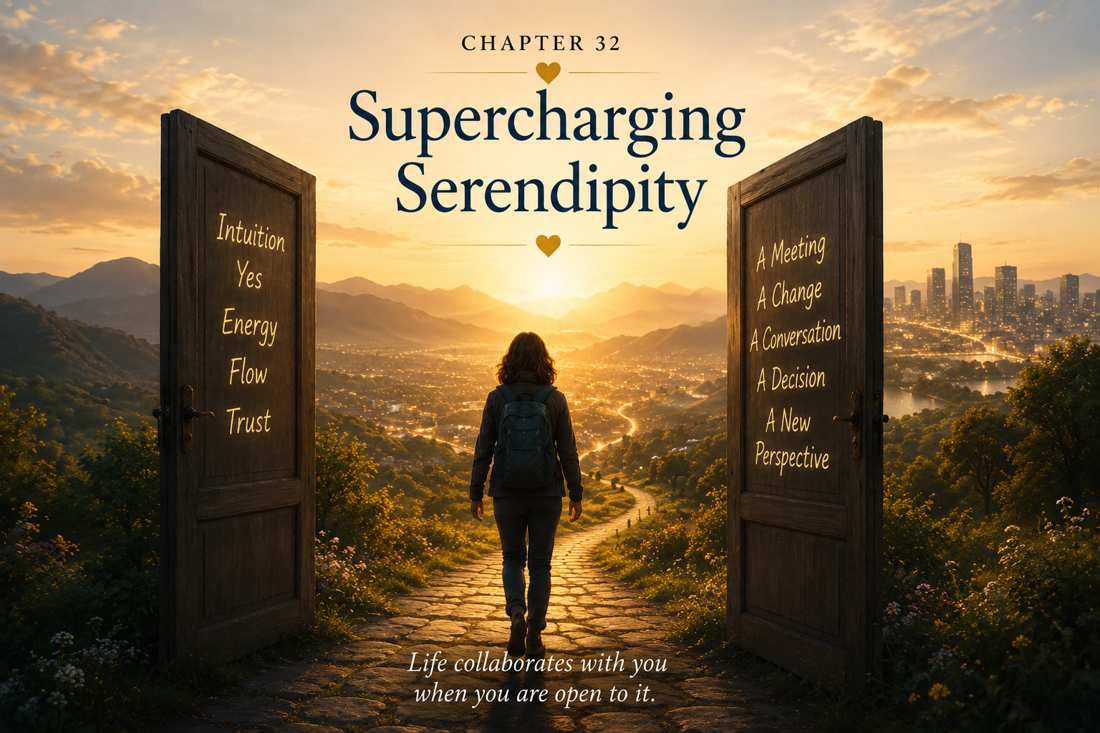
Supercharging Serendipity
Opening the Field of Possibility
There is a point in life - especially for leaders - where you realize that effort alone isn’t the full game. You can grind and still miss the door that would have opened everything. You can optimize and still end up in a life that feels strangely flat. You can win on paper and feel like something essential is missing.
For years, I thought my turning points came from willpower and hard work. And that is also true. I worked then, as I do, now, incredibly hard, though even more joyously now.
But when I look back in full candor, the biggest shifts in my life did not arrive through planning; instead, they arrived through openings, intuition, travel, and unexpected conversations; through a “yes” that didn’t make perfect sense at the time; and through following an energy that I clearly felt but couldn’t fully justify.
What I didn’t have language for back then is that I was living a principle that I now teach explicitly:
Serendipity is not luck. It’s design. And incidentally, serendipity originates from Serendip, the Sanskrit name for what is now Sri Lanka.
Serendipity flows through humans whose nervous systems are open enough to receive life. When you are chronically defended - tight, braced, overcontrolled - your perception narrows. You can walk right past a person, the idea, the invitation, the quiet insight, and not even register it. But when safety stabilizes, when the story relaxes, when the Witness is awake, something subtle happens: the field widens. Your world becomes more conversational. Life can get through.
This isn't mystical - it's relational. A regulated system sees more. A present system hears more. A free system connects dots faster. And once you’re not burning bandwidth on self-protection, you suddenly have room for what you couldn’t have predicted: a meeting that changes a trajectory, a sentence that unlocks a decision, an introduction that becomes a partnership, an experience that rearranges what you value.
In the Age of AI - where knowledge is everywhere, competence is increasingly automated, and speed keeps accelerating - serendipity becomes one of the last true human advantages. Not because it’s magical, but because it’s relational.
It is the art of being available to life in a way that algorithms cannot fully replicate. It’s the difference between living as a closed system and living as an open system.
When I trace the turning points of my life, the pattern is obvious: very little of it was planned, but almost all of it was invited. I didn’t “control” my way into the most important chapters - I opened. I moved. I listened. I followed threads. And the universe met me back - repeatedly - through people, places, teachers, students, and unexpected doors. And it continues to do so at an accelerating pace.
Because I am present. I am open. and I’d like invite you to experiment with the same.
So here’s what I tell leaders now:
If your strategy leaves no room for serendipity, your strategy is too small. You are trying to solve a living problem with a rigid model, that doesn’t allow you to maximize the magic in your life.
This work doesn’t just help you perform better. It reopens your channel. It makes you more available to the very thing that often delivers the breakthrough: life collaborating with you, once you stop bracing against it.
Try This: Open the Field (about 5 minutes)
Think of one person you are genuinely curious about, and send them a short, warm message with no agenda and no ask. Just contact. Then let it go. Serendipity is not luck; it is what happens when you keep the field open.