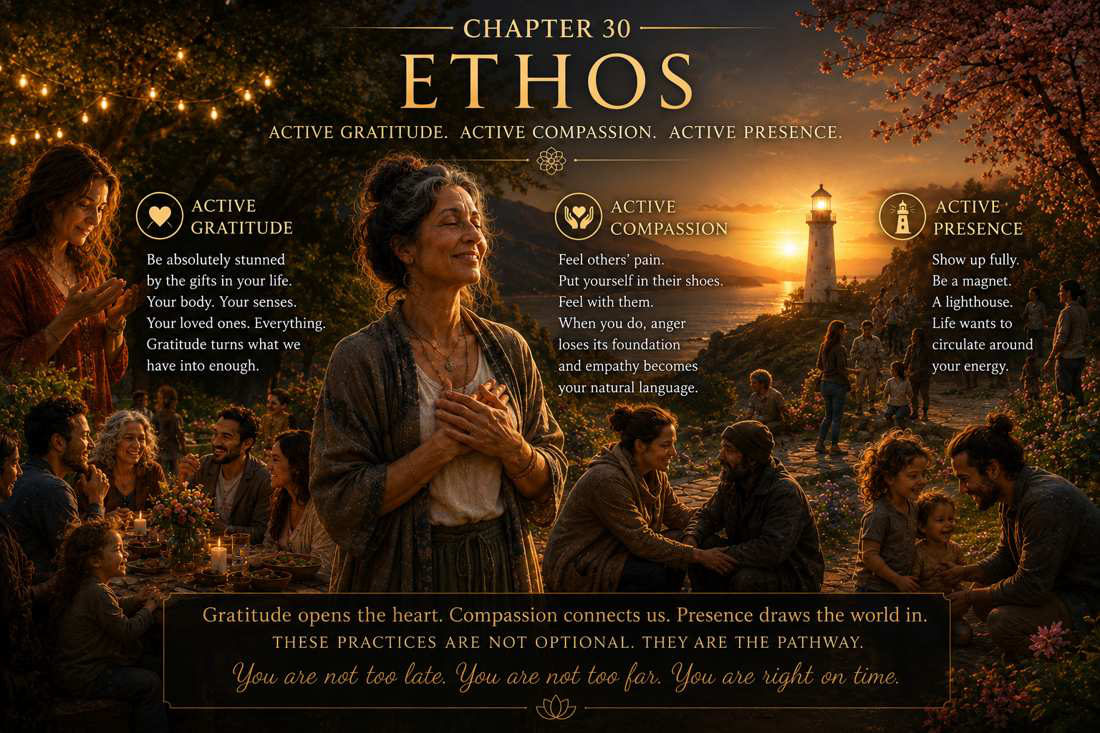
Ethos: Active Gratitude, Active Compassion, and Active Presence.
Ethos is not something we write on a wall. It is something people feel.
It is the tone of a room before anyone explains the rules. It is the quality of attention in a conversation. It is the difference between a culture that says the right things and a culture that actually transmits safety, dignity, courage, and care.
Ethos is what becomes believable through repeated practiced behavior, grounded in values and principles.
In this sense, Active Gratitude, Active Compassion, and Active Presence are not slogans. They are practices. Together, they create a field: the daily way a person, a team, a family, or an institution makes its deeper commitments visible and somatically felt.
Once we have experienced Sacred Self, Sacred Union, and Sacred Play, we begin to understand that coherent flourishing is not only an inner state. It is something we transmit. We become capable of meeting life with gratitude, others with compassion, and the present moment with a fuller quality of attention.
And one of the greatest gifts human beings treasure - yet most often take for granted - is human connection.
Connection is where so much of flourishing becomes visible. It is where trust is built, where loneliness begins to loosen, where possibility expands through relationship, and where another person can help us see something in ourselves that we could not have reached alone.
Some people seem to understand this instinctively. They create connection wherever they go - not through force or performance, but
through curiosity, generosity, presence, and a genuine interest in other people. Tricia Nichols is one of those people.
Tricia Nichols
Steward of Human Connection
For more than two decades, Tricia Nichols has helped some of the world's most recognized brands - from progressive leadership roles in PepsiCo, Gap, and Under Armour to serving as Chief Marketing Officer of Estée Lauder - build deeper, more meaningful relationships with the people they serve. Today, through Wellbent™, board leadership, investing, and advising wellness-forward companies on BrandBonding, she continues to help organizations build relationships rooted in trust, purpose, and human flourishing.
Tricia reminds us that stewardship extends beyond products and campaigns. At its best, it is about understanding what people truly value, creating authentic connection, and building trust that endures. In the age of AI, where attention is abundant but genuine relationship is increasingly rare, her work points toward a simple truth: the strongest brands - and the strongest communities - are those that help people become more fully themselves while learning to love themselves more deeply.
Learning to love ourselves more deeply is one of the central practices of Coherent Flourishing. It is also one of the most misunderstood.
One of the simplest ways to practice that love is to stop taking our own existence for granted. This is where gratitude becomes more than an occasional feeling and begins to become an active way of seeing.
Most of us experience gratitude, compassion, and presence passively, waiting for life to provide a reason. Yet the difference between passive and active can be profound.
Active Gratitude is looking at your hands, your fingers, your thumbs, your eyes, your ears, your nose, and your tongue - and being genuinely astonished by the gifts they bring you every moment of every day. Nina Simone captured something of this exuberant recognition in her unforgettable performance of “Ain’t Got No, I Got Life”: the startling realization that even before we count our achievements or possessions, there is already an extraordinary abundance in simply being alive.
It is seeing the people you love for the extraordinary gift that they are to you; and allowing your heart to be moved by this gift of their presence in your life. It applies to everything.
Some time back, I was riding down the mountain to the river, feeling deeply grateful that, at age sixty-three, I could still make the 40-minute ride over a mountain in each direction under my own power. As I pedaled, another thought quietly arose: one day, I may no longer be able to make my daily ride. Perhaps in my seventies or eighties, there may come a time when my legs no longer carry me over the mountain, down to the river, and back. Almost immediately, another thought arrived: “At that point, I’ll buy an e- bike.” I would ride as much as I could, then be carried for the rest. And that might buy me an additional ten years of riding to my beloved river in stunning nature every day.
The purpose of the daily trip is to immerse myself in nature, swimming in cold water, meditating, and beginning my day in gratitude. If an e-bike one day allows me to continue that practice for another decade, then I will be profoundly grateful for all the years that my body did the work.
Further on in the ride, I was cycling up a very steep, extended road toward the head of the valley, training for a pilgrimage to Mount Kailash in Western Tibet, which requires walking over an 18,000-foot pass with Tibetan nomads in one of the holiest and most sacred sites in the world. A few minutes later, I was chased by aggressive bees, fell from my bike, collected a few stings and cuts, and instead of being frustrated, found myself simply grateful that it wasn’t worse.
Two days earlier, an eye doctor had told me that I had a scratch on my cornea that could have led to losing sight in my right eye. My first thought was, “If that is to be, I’m deeply grateful for having had sixty-three years of great eyesight with that eye. We’ll hope for the best and surrender to the worst possible outcomes.” Fortunately, it healed quickly.
That, to me, is Active Gratitude. I don’t have to do anything - I get to do everything!
It is appreciating not only what life gives you today, but also embracing the ways life may invite you to adapt tomorrow, so that what matters most can continue to flourish.
Active Compassion enables you to truly feel another person’s pain. When you do, you put yourself in their shoes. You begin to feel what they must be going through, even when their beliefs, behavior, or choices are very different from your own. When you habituate to Active Compassion, anger begins to lose much of its grip. You may be surprised by how possible this is.
And Active Presence lets you show up as a magnet, a lighthouse, a steady field around which life can organize, because you are fully here. Full pixels in your screen. Full breath in your body. Full attention in the moment.
When every breath, every bite of food, every drink of water, and every moment with a loved one is experienced in its fullness, without distraction from old inner story, competing demands, or judgment, something changes. No past. No future. Only presence.
That is Active Presence.
That is the state the Joy Protocol helps return us to.
Lora Ho
Steward of Blessing
I have spent much of my life around people carrying significant responsibility: Founders. CEOs. Family business leaders. Board directors. People responsible for thousands of employees, billions of dollars, and decisions that ripple across entire communities.
Over time you start noticing patterns. Pressure tends to harden people. The larger the responsibility, the more guarded they often become. There is simply too much to carry. Which is one of the reasons Lora Ho stands out so clearly.
For 26 years, she served as one of the senior-most leaders in Taiwan Semiconductor Manufacturing Company (TSMC), demonstrating exceptional leadership across finance, sales, human resources, and corporate sustainability. The scope of responsibility she has carried has been immense.
I was reminded of this one morning before sunrise at a meditation tower by her home high in the mountains of Taiwan. The countryside below us was still half asleep. Mist drifted through the valleys. Temple roofs glistened with dew. Off in the distance, a giant laughing Buddha slowly emerged from the darkness as the first light touched the horizon.
Lora was taking photographs.
She sends sunrise photos to people every morning- hundreds of mornings by now. Not because anyone asked her to; nor because it is part of a leadership philosophy or a personal brand. She simply likes beginning the day by sharing something beautiful.
As we stood there watching the light arrive, she mentioned that she takes far more photographs than she could ever keep.
"I have to choose," she said. "Some I keep. Some I let go."
It was such a simple comment that it could easily have drifted away with the morning air. Instead it became the conversation. Not photographs - life.
Most of us spend years learning how to accumulate. More possessions. More commitments. More obligations. More stories about who we are. More stories about who we are supposed to be. Lora was talking about something different. She was talking about release.
The conversation drifted toward closets and keepsakes and the strange emotional weight of objects. Then she said something I have thought about many times since.
"When you do it physically, you do it in your heart."
There was no attempt to sound profound. In fact, I suspect she would be surprised that I remembered it so clearly. Yet something about it landed immediately. Human beings rarely transform through words or ideas alone. We transform through practice. Through the things we repeatedly choose to carry and the things we finally decide to put down.
A little later I told her about clearing out my parents' homes after they passed away three weeks apart in 2023. Nearly a century of life packed into drawers, closets, bookshelves, photo albums, and boxes. Grief, I discovered, is not only emotional - it is also practical. Someone has to decide what stays. Someone has to decide what goes. At some point you stop trying to hold everything and start learning how to love what remains.
Lora listened quietly.
Then she laughed and told me that after hearing about my mother's collection of more than one hundred scarves, she had gone home and given away half her clothes. Not dramatically - she simply didn't need them.
It was a poignant reminder of the way that Lora has lived her life for the more than 26 years that we’ve known one another. She is guided by an ethos of integrity, service, compassion, directness, generosity, and devotion.
Lora has for many years, saved many of Taiwan’s ancient trees, simply because she felt that they needed saving, and no one else was stepping up to do so. And she and husband Roger restored and brought back to life the extraordinary Chapel of Angels near her home outside of Hsinchu, home of TSMC. From an empty shell overrun with vines and tall grasses, to the home of weddings, mass, and classical music concerts, the Chapel of Angels holds the spirit of Lora’s life of service - blessings and grace to all.
Try This: The Three Actives (about 5 minutes)
Before your next task, do three small things: speak one gratitude aloud, offer one act of compassion, and take one fully present breath. None takes more than a moment.
Then find a comfortable place to lie down, close your eyes, and think of everything you are grateful for. Then think of everyone and everything deserving of your compassion. Finally, feel your breath and notice what pure presence is like: no story, just presence.
This is how an ethos stops being an idea and becomes a way of moving through the day.