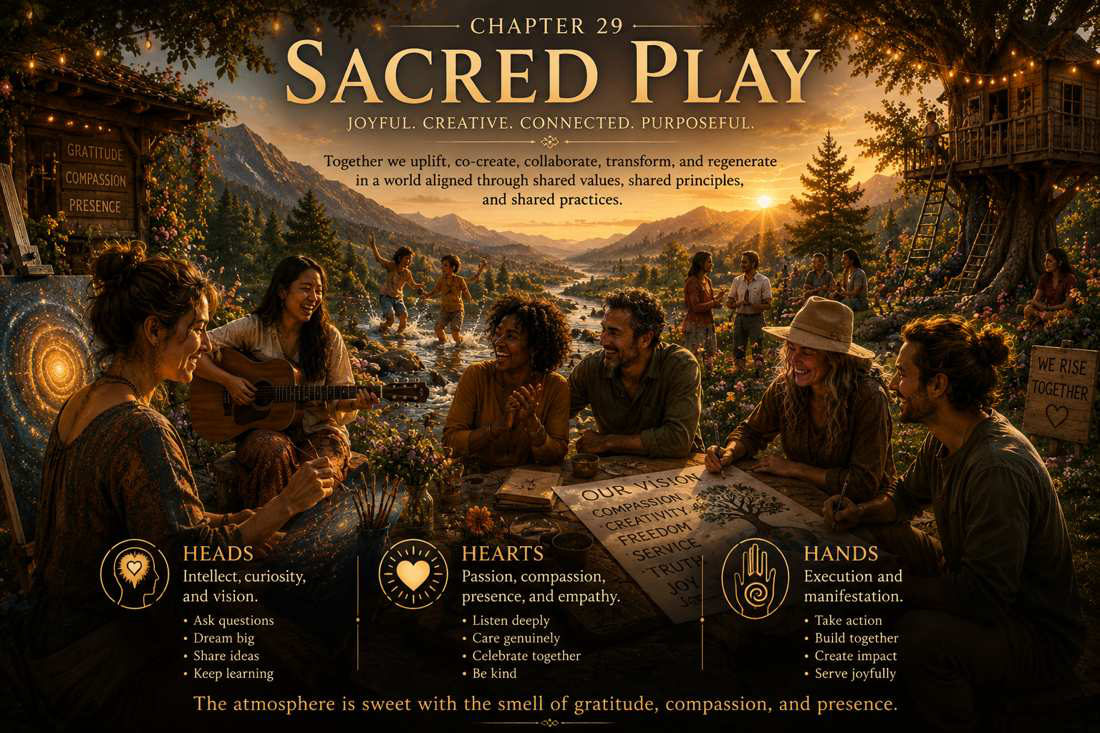
Sacred Play
Sacred Play is when you return, once again, to your magical 7-year- old self, when by yourself, or with family, friends, collaborators, and beyond - uplifting, co-creating, collaborating, transforming, and regenerating - in a joyful and accepting environment aligned through shared values, shared principles, and shared practices that create an extraordinary resonance of collective heads (intellect, curiosity and vision); hearts (passion, compassion, presence, and empathy); and hands (execution and manifestation).
One of my personal heroes of Sacred Play is Jerry Wonda.
Jerry "Wonda" Duplessis
Steward of Inspired Production
Play is often misunderstood. We tend to associate it with childhood, recreation, or the opposite of serious work. Yet some of humanity's greatest breakthroughs have emerged not from rigid planning, but from the freedom to improvise, explore, and create together. Musicians know this. Great jazz ensembles know this. So do extraordinary producers, artists, and collaborators.
When people trust one another deeply enough to play, something remarkable happens. Individual talent gives way to collective emergence, and the whole becomes greater than the sum of its parts.
Few people embody this more fully than Jerry "Wonda" Duplessis. Jerry knows what it means to begin with very little and create something that changes the world.
Born in Port-au-Prince, Haiti, Jerry immigrated to New Jersey as a teenager carrying little more than a bass guitar and an extraordinary love of music. He began playing in church, then anywhere he could find an audience - weddings, local bands, clubs - absorbing every style, every rhythm, and every lesson he could. Along the way he discovered that while musicians performed songs, producers shaped the environments in which great music could emerge. That realization became the foundation of a remarkable career.
The turning point came in an unlikely place: the basement of his family's home in New Jersey. With his father opening the house to young musicians pursuing impossible dreams, Jerry, his brother, cousin Wyclef Jean, Lauryn Hill, Pras Michel, and countless others built what became known as the legendary Booga Basement. It was more than a recording studio. It was a creative home where ideas could be explored without watching the clock, where trust mattered as much as talent, and where a group of young artists discovered the sound that would become The Score - one of the most influential albums in modern music.
From those humble beginnings, Jerry went on to become one of the most respected producers, songwriters, and music executives of his generation. A three-time Grammy Award winner with more than sixteen Grammy nominations, his work has helped shape the soundtrack of the past three decades. His publishing catalog exceeds 300 titles, his productions have sold more than 300 million records worldwide, and his music has been streamed billions of times. He has collaborated with an extraordinary range of artists including The Fugees, Whitney Houston, Carlos Santana, Shakira, Beyoncé, Rihanna, Alicia Keys, John Legend, Justin Bieber, Mary J. Blige, Michael Jackson, Bono, Eric Clapton, DJ Khaled, Migos, French Montana, and many others. Songs such as "Maria Maria," "Hips Don't Lie," "My Love Is Your Love," "Wild Thoughts," and numerous other recordings have become part of the global cultural landscape. His work has also extended into film scores and soundtracks, including the Golden Globe nominated "Million Voices" from Hotel Rwanda .
Yet what distinguishes Jerry is not simply the scale of his accomplishments, but the way he thinks about creation itself. Great records are rarely the product of a single genius. They emerge from relationships - between artists, musicians, engineers, writers, producers, and audiences. Jerry's gift has been creating environments where those relationships flourish, where extraordinary people bring out the extraordinary in one another. In many ways, he is not only a producer of music, but a producer of possibility.
That same spirit continues today through Wonda Music, Platinum Sound Recording Studios, artist development, publishing, education, and entrepreneurship. As a Governor of the New York Chapter of the Recording Academy and Co-Chair of its Producers & Engineers Wing, he continues to invest in the future of the music industry. His commitment to Haiti, to Newark, and to young creators has led him to champion education, healthcare, affordable housing, mental health, and creative opportunity, earning recognition from universities, cultural institutions, and civic organizations alike.
Jerry reminds us that the greatest producers are not simply makers of songs - they are stewards of human potential. They recognize talent, create trust, nurture collaboration, and help others find their voice. Long before we had language for Relational Literacy, Jerry was quietly practicing it in recording studios, rehearsal rooms, and communities around the world. His life reminds us that when relationships are composed with care, they create a harmony that echoes far beyond the music itself.
Sacred play can lead you to a world in which its atmosphere is sweet with the smell of gratitude, compassion, and presence.
Amit Sadh
Steward of Freedom
The first thing most people notice about Amit Sadh is that he is a successful actor.
The second thing they notice is that he is usually in motion.
Not from people. Toward them.
Over the years, Amit has become one of India's most respected actors, known for performances in films such as Kai Po Che! and Sultan, as well as acclaimed streaming series including Breathe and Avrodh. Yet some of the most important chapters of his life have unfolded far from film sets and cameras.
They happened on the road. Long before I knew much about Amit's career, I knew about the motorcycles. The mountains. The journeys. The long rides through the Himalayas and remote corners of India.
At first glance they look like adventures. The more I got to know him, the more they felt like something else. A search for freedom.
Amit's life has not been easy. He lost his father when he was young and passed through periods of darkness that might have broken many people. During some of those years, the road became a lifeline. The movement. The mountains. The vastness. The simple act of continuing forward.
What I find beautiful is that those journeys did not make him withdraw from humanity. They made him love it more.
Over and over, Amit finds himself drawn toward people whose stories are rarely heard. Indigenous communities. Villages far from major cities. Elders carrying traditions that modern life often overlooks. People living very different lives from his own.
There is a deep respect in the way he approaches them. Not as an observer. Not as a celebrity - as a fellow traveler. Perhaps that is one reason acting suits him so well.
At its best, acting is an act of empathy. It requires the willingness to step inside another person's experience, to see the world through their eyes for a while, and to return changed.
Amit seems to do that whether a camera is present or not.
Through our shared connection with celebrated healer Dr. Shashi Dubey (also known as Guruji), we discovered a similar appreciation for the inner journey that runs beneath the outer one. Repeatedly, our conversations returned to themes of service, humanity, and the strange gift of discovering yourself through encounters with people who appear very different from you.
In a time when technology increasingly shapes how we communicate, work, and live, Amit reminds me of something simple.
Human beings are still meant to meet one another. To listen and learn. To cross boundaries, and discover that the stranger is often carrying a piece of ourselves.
That is a form of freedom.
And perhaps it is one of the reasons Amit's story belongs here: Not because he leads an organization. Because he helps remind us what all the organizations are ultimately for.
Try This: One Useless Delight (about 5 minutes)
For the next few minutes, do one delightful thing with no purpose at all - hum, doodle, skip a step, toss something and catch it. Let it be gloriously useless. Joy is not the reward waiting at the end of the work; it is the fuel. Take your time with it. Breathe. And enjoy.