Sacred Self
Sacred Self is the quiet realization that you were never broken.
Not because you have finally healed every wound, overcome every fear, or become the person you imagined you ought to be. Quite the opposite. Sacred Self begins when you stop measuring your worth against an imaginary future version of yourself and finally come home to the one who has been here all along.
Most of us were trained otherwise.
Across generations, we learned that our value depended on achievement, approval, attractiveness, usefulness, intelligence, status, wealth, or belonging. We learned to look outside ourselves for permission to feel whole. We searched for someone to complete us because we had quietly accepted the story that we were incomplete.
It is one of the great misunderstandings of modern life.
When you begin to experience yourself directly, beneath the stories, behind the performance, before the fear of not being enough, something extraordinary begins to happen. You discover that your shadow and your light belong together. Your courage and your vulnerability belong together. Your masculine and your feminine belong together. None of them disqualify you. All of them are the foundation of your belonging.
You slowly come to realize, not as an idea but as an embodied experience, that you could never be anything other than a complete expression of life itself. Not a finished expression. Not a perfected expression. A complete one.
From that place, something softens.
The exhausting project of proving yourself begins to fall away. You no longer need to earn your right to exist, defend your worth, or negotiate your belonging. You can simply rest.
And from that place of rest, something even more beautiful becomes possible.
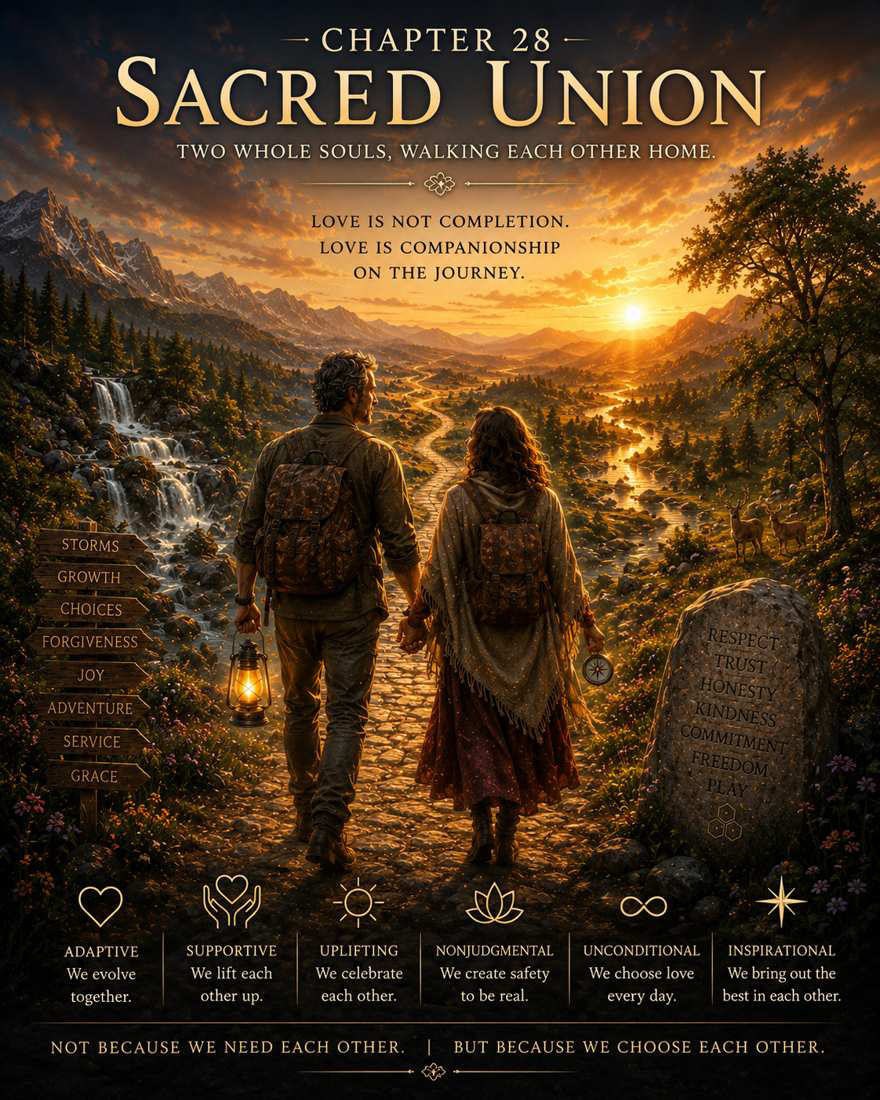
Only when we stop asking another person to complete us can we truly meet them in freedom.
That is the doorway to Sacred Union.
Chip Conley
Steward of Reinvention
Chip Conley has always cut an unusual swath: Where some people spend their lives becoming who they already are, Chip Conley seems to have spent his life simply becoming .
When I think about Chip, I don't first think about hotels, Airbnb, Baja (where he lives), or even the Modern Elder Academy. I think about reinvention.
Consistently, life handed him opportunities to cling to an old identity. And consistently, he let it go.
At twenty-six, he built Joie de Vivre Hospitality into one of the most influential boutique hotel companies in America. By any conventional measure, he had won the game. Yet after decades of success, he found himself asking a question that many high achievers eventually face: Now what? Not because the business wasn't working - but because something inside him was asking for a new chapter. That willingness to leave behind a successful identity, would become a recurring theme throughout his life.
A few years later, he found himself at Airbnb, helping a much younger founder named Brian Chesky navigate one of the fastest-growing companies in the world. What emerged wasn't traditional mentorship. It was something far more interesting. Wisdom flowed in one direction. Curiosity flowed in the other.
Chip often talks about becoming a Modern Elder , and I think that's one of the most important ideas he has given the world.
Our culture celebrates youth. It celebrates disruption. It celebrates speed - but what it often struggles to celebrate is wisdom.
Neither authority, nor hierarchy - wisdom. The kind that can only emerge after enough victories, failures, heartbreaks, surprises, and reinventions have accumulated inside a human life.
What I appreciate about Chip is that he never presents wisdom as certainty. He presents it as curiosity that has survived experience. That distinction is important- especially now.
We are entering an age obsessed with intelligence. Artificial intelligence in particular, but beyond that, machine intelligence. And computational intelligence.
Chip keeps pointing toward a different question: What about wisdom? Meaning? Purpose? What about the deeply human process of becoming?
Those questions become increasingly important as people live longer and careers become less linear. More and more people are discovering that midlife is not a finish line - it's a doorway.
Chip saw that before most people.
Through the Modern Elder Academy, he has helped thousands of people navigate transitions that many once experienced alone. Not retirement. Not withdrawal - renewal.
The word feels important. Because renewal is not about becoming someone else. It's about becoming more fully yourself.
When I look across the tsunami of technological change, I often think about how many people are quietly wondering whether they still matter. Whether they can adapt. Whether there is a place for them in the future.
Chip's life offers a gentle but powerful answer - yes. Not because change stops. But because reinvention never does.
In a world racing toward the future, Chip reminds us that wisdom is not the opposite of innovation. It may be the thing that helps us navigate it.
Chip reminds us that reinvention is rarely something we do once. It is a lifelong practice. Every stage of life asks something different of us. Every season invites another becoming.
And once we become willing to reinvent ourselves, perhaps the most important question of all begins to emerge: maintaining the courage to face the deepest parts of your own shadow and perceived limitations, and seeing it through to finding the limitless possibilities of life available to you on the other side.
Try This: Hand on Heart (about 2 minutes)
Place one hand gently on your heart and close your eyes.
Take three slow breaths.
Then quietly say:
"Nothing is missing."
Let your body respond before your mind does.
Notice any voice that argues.
Smile at it.
It has been trying to protect you for a very long time.
Rest your hand on your heart for one more breath, and simply ask:
What if I have always been enough?