The Business of Isness: Come to the Present and experience Divine Presence
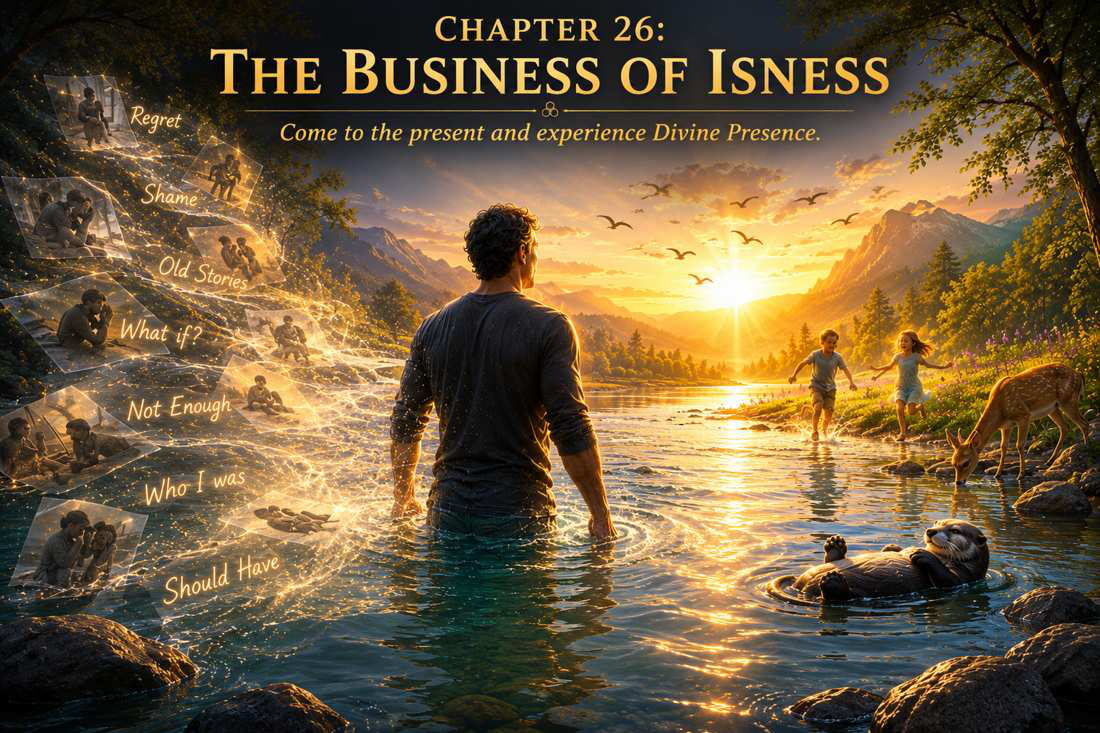
When people feel this first experience the release from the hooks in the heart from what the world owes them and they have owed the world cumulatively throughout their lives, and can genuinely watch the stories that have guided their lives float down the river behind them, never to be seen again; the entire infrastructure of the past dissolves, and they are left only with the present. And being simply in the present with no burden of story, no burden of blame, no bags to carry, no expectation of the future - can be disorienting.
It can feel like suddenly going back to your magical seven year old self. A sense of wonder. A sense of play. A sense of spaciousness. Gratitude and compassion all can come as waves. And eventually, this state can ground and become a constant. This is the state where simply put: Truth Is . Nothing more, nothing less.
Nothing to prove, no where to go, no one to be. It can be intoxicating, and could be a key to the proverbial “fountain of youth”.
Other people feel this when you are in that state. They are drawn to you, yet don’t know why. So are animals and children. You feel safe and expansive. You feel inviting. This is the elixir, the quintessence of this work. I call this the Business of Isness.
When you are in the state of Isness - fully present - the world aligns with you. Your projects naturally move forward. Your relationships become cleaner. Your business thrives more. Because you have become coherent and present. And in that state, you are more naturally joyful.
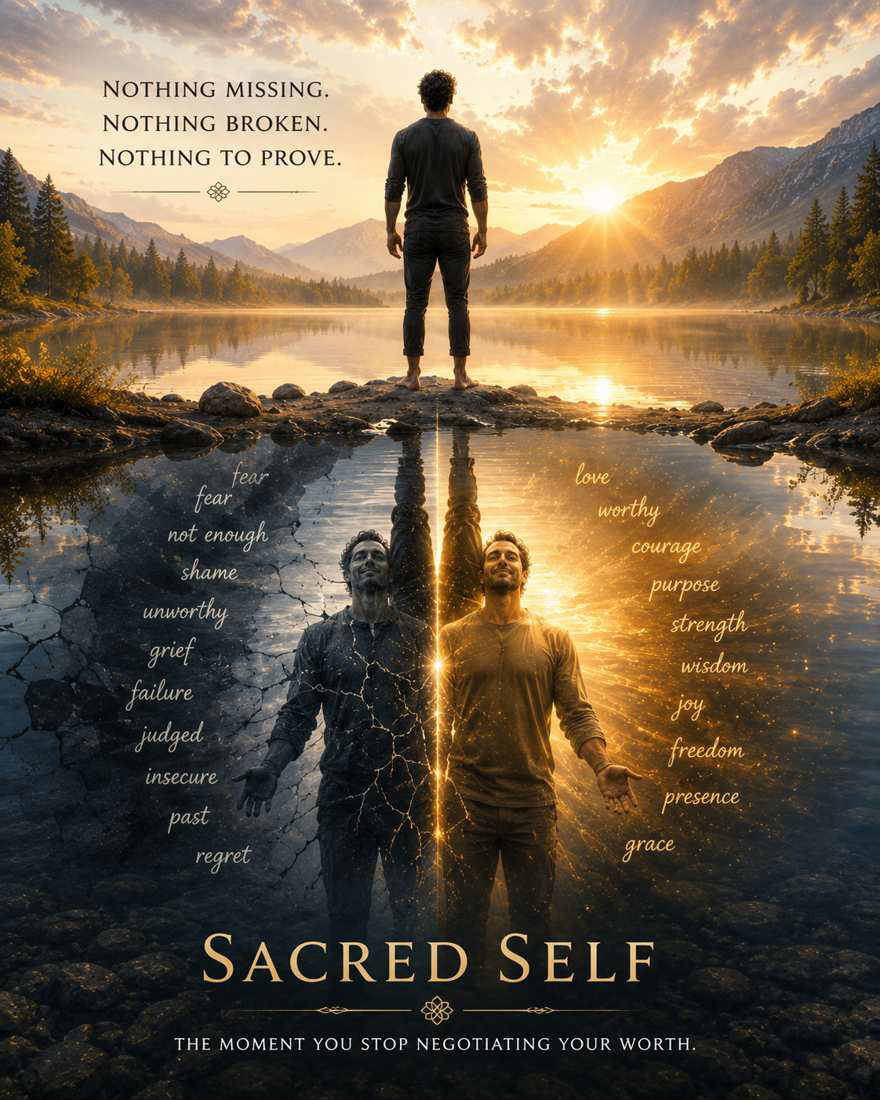
And this state naturally leads to Sacred Self.
And creating a foundation of coherence enables leaders to move with confidence into circumstances with great uncertainty. Barak Berkowitz knows about this.
Barak Berkowitz
Steward of Uncertainty
Some people make you feel more certain about the future after you speak with them. Barak Berkowitz has the opposite effect - and I mean that as a compliment.
Barak has spent decades at the center of technological transformation. He has held senior leadership roles at Apple. He helped shape Alexa at Amazon. He served as COO of the MIT Media Lab. He has spent his career close to the engines of innovation and the people building them.
What struck me during our conversation was not how much he knew. It was how comfortable he was admitting what he didn't.
That may sound like a small distinction, but it is actually quite significant.
The deeper I go into conversations about artificial intelligence, the more I notice that certainty is often inversely correlated with proximity. The people furthest from the technology frequently have the strongest opinions about it. The people closest to it often seem more cautious. At one point Barak said something that stopped me in my tracks.
"The closer you are to the models, the less you understand how they work."
He wasn't being dramatic. He wasn't trying to be provocative. He was describing a reality that many of the leading researchers themselves acknowledge.
The systems are doing things their creators never explicitly programmed them to do.
Behaviors, patterns, and capabilities emerge. Models increasingly demonstrate agency that was unanticipated and can stun its observers. Often the people building them are left staring at the results wondering exactly how they got there.
That doesn't mean the systems are magical. Barak was very careful about that.
In fact, he repeatedly pushed back against the tendency to anthropomorphize AI. These systems are not thinking; they are not knowing; they are not conscious in the way humans understand consciousness. Yet they are becoming increasingly capable of producing outcomes that feel uncannily human.
That combination creates a strange tension. The machines feel familiar; but underlying reality does not.
Again and again, our conversation returned to the same theme: uncertainty. Not uncertainty as a weakness, uncertainty as honesty.
For most of human history, we have liked to imagine ourselves in control. We create plans. We create forecasts. We create strategies. We create institutions that give us the comforting sense that someone is driving the bus. Barak challenged those assumptions at their roots.
Perhaps we have always had less control than we imagined? Perhaps agency itself is more complicated than we think: Perhaps what we call control has often been a useful story rather than an objective reality.
These are not easy ideas. They are not particularly comforting. Yet I found them strangely liberating.
Because if certainty is unavailable, then the goal shifts. The goal is no longer controlling the wave. The goal becomes learning how to ride it.
That is where our conversation unexpectedly converged: When I described the metaphor behind Surfing the Tsunami, Barak immediately understood it. The future, he suggested, is not something we are going to master - it is something we are going to navigate.
The distinction matters: One implies control the other implies adaptation. One implies dominance; the other implies relationship.
At one point he said something that, in many ways, captures the entire spirit of this book: "You cannot ride a wave if you don't let go."
I have thought about that sentence often since our conversation. Not because it is about AI, but because it is about being human.
The deeper challenge of the years ahead may not be technological at all - it may be psychological. The technology is changing exponentially, but humans are not. Neither are our institutions, our cultures, or our.nervous systems.
We are trying to absorb decades of change in a handful of years. Barak sees that clearly. He worries less about whether the technology will work, and more about whether we are prepared for what happens when it does.
How do societies remain coherent? How do people maintain meaning? How do organizations adapt?
How do human beings continue to experience agency, purpose, and connection in a world increasingly shaped by forces they do not fully understand?
These are not engineering questions. They are human questions. And perhaps that is why Barak belongs among the Modern Stewards.
Not because he offers certainty - but because he reminds us to be humble and keep asking the hard questions.
In a time when everyone seems eager to predict the future, there is something profoundly valuable about a voice willing to say:
Try This: Five Senses Now (about 2 minutes)
Right where you are, name five things you can see, four you can hear, three you can feel, two you can smell, and one you can taste. Let each one land. You have just arrived in the only place life is actually happening: now.