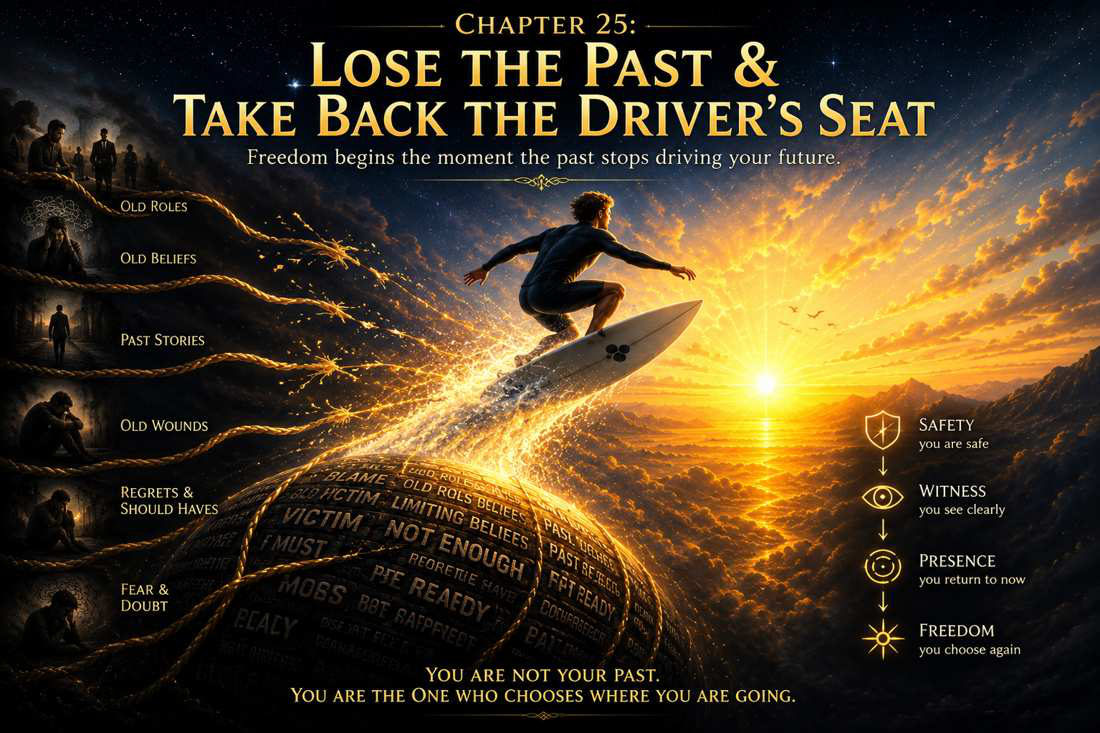
Lose the Past & Take Back the Driver's Seat
The Force That Pulls Leaders Into the Past
Even after safety returns, even after the Witness awakens, even after forgiveness begins to dissolve the emotional charge, there is still a force that every leader has to understand if they want transformation to stick. Because this is a transformation that is sustainable, and sustaining.
I call it narrative gravity.
Narrative gravity is the pull of the old self. It’s the way the past tries to reclaim you - quietly, persuasively, often in your own voice. It shows up as “realism,” as “prudence,” as “being responsible,” but underneath it is often fear disguised as wisdom. You hear it in the familiar phrases: “Don’t get your hopes up. This won’t last. Play it safe. You’re not ready. They’ll judge you. Who do you think you are? Prove yourself. Don’t disappoint anyone.”
It’s not just thoughts - it’s a reversion system. Narrative gravity pulls you back into old identities, old defenses, old blame, old emotional cycles, old roles and relational dynamics, old expectations, old self- doubt, old attachment patterns that once kept you safe. It’s the psychological equivalent of atmospheric drag. And its mission is simple: pull you back to who you were before you became freer - because it represents patterns that have become second nature - like a substrate of your worldview from a young age.
This is why leaders relapse into old behavior even after real progress. Not because they’re weak, not because the breakthrough wasn’t real, but because narrative gravity is often strongest right after expansion - because it moves our understanding from a long-familiar construct, to one that is new and untested. Hence we can snap back to the
comfort of what we have always known about ourselves - even if it is our belief, for example, that we are unloveable and unworthy.
The moment the heart opens, the moment courage rises, the moment clarity crystallizes, the moment a new freedom appears - the old identity panics. It fears dissolution. It fears losing control. It fears being irrelevant. It fears your growth, even if it claims to want it. So it reaches for what it knows - the dependable old patterns, which even if they come with baggage, are deeply familiar, and as such are the first in line for access.
Your ego also recruits allies: It pulls through environments that reinforce your old patterns; it leverages relationships that still depend on the old dynamic; it triggers habits the nervous system remembers; it uses social roles and reputational pressure; it uses stress. And because stress narrows cognition, narrative gravity becomes more persuasive as pressure rises.
This is the moment people say, “I’ve done so much work - why am I still triggered by the same thing?” Or, “Why do I step forward and then suddenly collapse back?”
Or, “Why do I forget everything the moment pressure hits?” The answer is not failure. It’s not just physiology - It’s physics. What you need is to escape the orbit of the past and reach escape velocity.
When you can name narrative gravity, you recognize the pull without being ashamed by it; you can stop mistaking it for truth; you stop letting it run your decisions; you stop calling regression “proof” that you can’t change.
And that recognition opens the next step: conscious identity creation - not who trauma told you to be, not who achievement told you to be, not who fear told you to be - but whom you choose to be with full awareness.
Joy Protocol gives you the five tools that weaken and redirect narrative gravity over time:
Safety → Relaxed vigilance → Witness → Presence → Freedom.
As those strengthen, something extraordinary becomes possible. Presence expands. Joy expands. Relationships strengthen. The future becomes stronger than the past. Transformation stabilizes. Identity becomes self-authored. Leadership stops being performative and starts being inevitable.
When you genuinely can lose or create a new story, you can let go of the past. Then you come into the present, and experience Divine Presence. That’s where it starts to get fun.
Try This: How Old Do I Feel? (about 3 minutes)
Recall a recent moment that hooked you. Ask gently: how old do I feel right now? Let the number surprise you. Then place both feet flat on the floor and say your true age aloud, returning to the present and taking back the wheel.