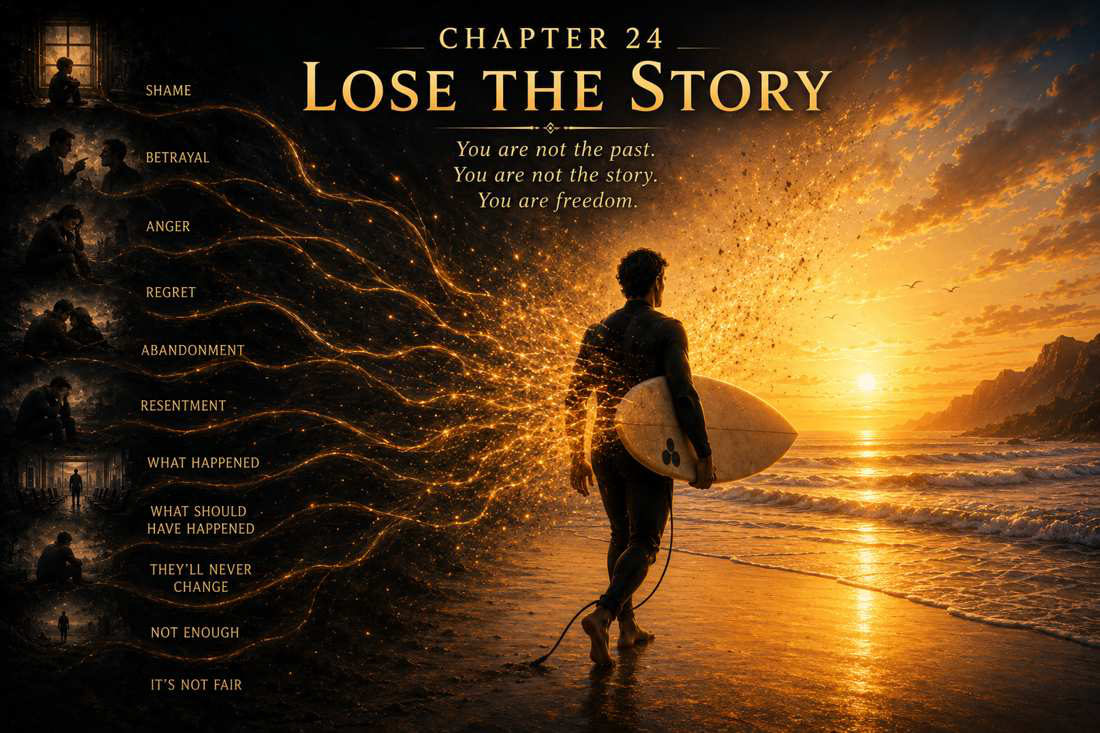
Lose the Story
Liberation Through Forgiveness
Even with safety returning and the Witness online, there is still one thing that can drag a leader back into the old world faster than almost anything:
The story.
The story of what happened or didn’t happen. The story of what should or shouldn’t have happened. The story of who did what to whom, or who did not do what. The story of who owes whom what. The story of how we were shaped. The story that quietly insists, “This means something about who I am,” or “This is the proof that I’m not safe,” or “This is why I must control.”
Stories are not inherently bad. They help us make meaning. But when a story is fused with unresolved emotion (which they frequently are), it becomes prison - and a loop. It becomes narrative gravity. It becomes the invisible architecture that keeps the nervous system loyal to a person’s past triggers and stories.
A leader cannot be free while they are still loyal to the story of their past.
We get deeply tied to our stories, as they are what we have known all our lives, and they are known, comfortable, and dependable. So we develop loyalty to them, and defend them.
That loyalty isn’t always conscious. In fact, it often feels righteous. It feels like “truth.” It feels like “justice.” It feels like “I’m just being realistic.” But if the story is still running your nervous system, it is not realism - it is repetition.
Forgiveness doesn’t make what happened okay. It doesn’t erase accountability. It doesn’t require reconciliation. It doesn’t mean you forget. It simply means, "This story no longer gets to run my life."
You allow it to occupy the passenger seat as you take over the wheel to drive the car.
When forgiveness is real, you can feel it in the body. The breath changes. The jaw softens. The shoulders drop. The emotional charge of the old story releases. The mind stops rehearsing. The system returns to now. And the strange thing is: once you are no longer carrying the story as identity, you become far more capable of clean truth .
Forgiveness doesn’t reduce clarity - it increases it. It doesn’t weaken boundaries; it strengthens them. It doesn’t create passivity; it restores agency and freedom.
Leadership is not built on confidence and clarity alone. It's built on inner freedom. Because in the age of AI, where speed will tempt performance and pressure will tempt control, the leader who cannot return to freedom will be led by their triggers. The leader who can forgive, can return. And they can choose again.
Freedom begins when the story loses its grip. Forgiveness is how it loses its grip.
Try This: (about 3 minutes)
Write, in a single sentence, the story you are telling yourself about a current struggle. Perhaps it is someone you have not yet forgiven. Perhaps it is yourself. Underneath it, write:
"I forgive you for everything. I forgive me for everything."
Read the two phrases aloud three times. Then take three slow breaths and notice what begins to soften. Observe how tightly you were holding the story, and how your grip begins to loosen. The story is a lens you are holding, not the light itself.