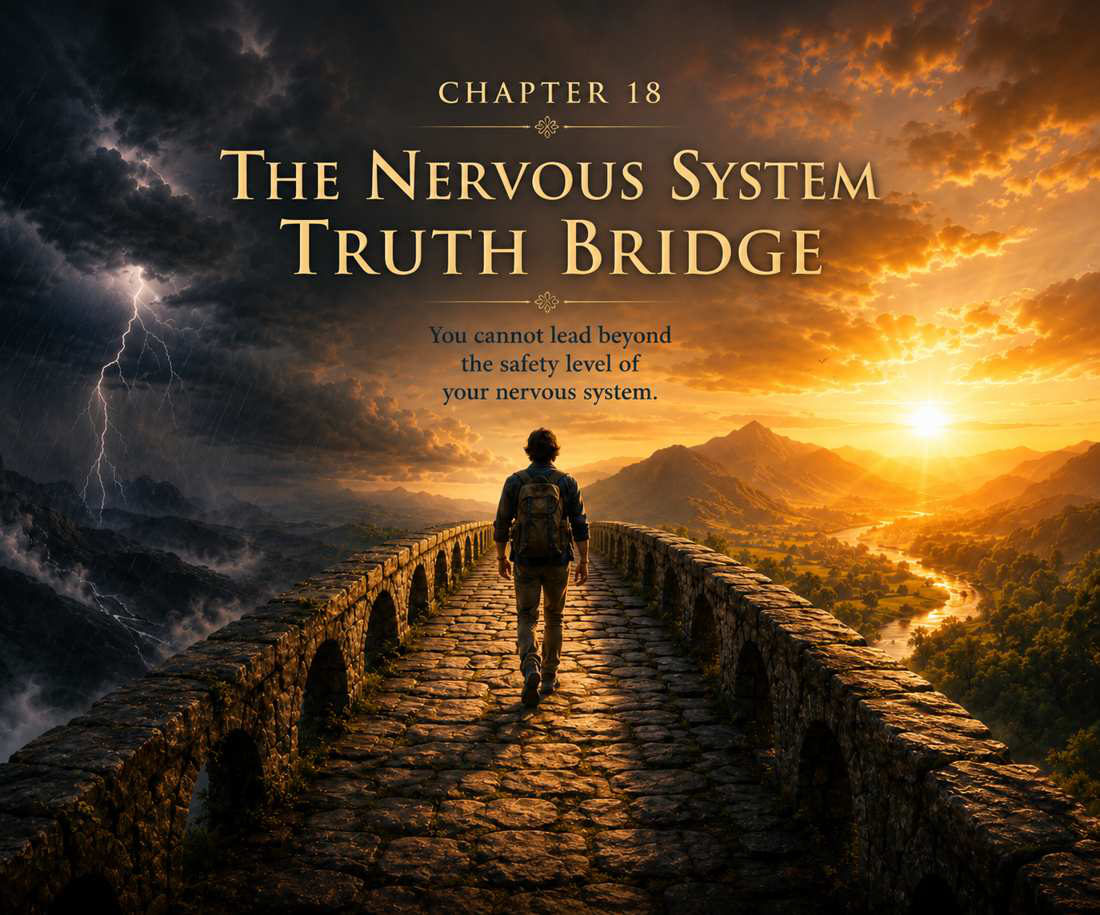
The Nervous System: Truth Bridge
Earlier in my adult life, when I thought about what made leaders powerful, I focused on the qualities we usually associate with leadership: motivation, strategy, communication, execution, emotional intelligence, culture, values, and the ability to align other people around a direction.
All of those matter. But years of watching human beings under pressure, including myself, kept showing me something underneath them. The same person who is brilliant on Tuesday can become brittle on Wednesday. A leader who listens beautifully in one conversation can become controlling in the next. Someone capable of enormous nuance when relaxed may suddenly see only threat, certainty, and sides when activated.
The sentence that eventually became important to me was simple: when our sense of safety collapses, our range narrows.
Stress responses are not character defects. They are part of the biological systems that help us mobilize when something feels threatening. Heart rate can rise, attention can shift, vigilance can increase, and the body can prepare for action. These responses are extraordinarily useful when the threat is real and immediate. They become more complicated when an old pattern, social conflict, uncertainty, or perceived loss of belonging activates some of the same protective machinery.
This became what I think of as the Truth Bridge. The body often tells us that something is happening before we have fully made sense of it.
A tightening chest, clenched jaw, shallow breath, sudden urge to control, disappear, defend, please, attack, or become absolutely certain may be useful information. Not proof that our interpretation is correct, but information that something within us has become activated.
That distinction matters. Activation is real. The story we attach to it may or may not be.
When we are highly activated, our available range can shrink. Curiosity becomes harder. Ambiguity becomes uncomfortable. Feedback can feel like attack. Difference can begin to look like opposition. We may micromanage, withdraw, seek approval, overplan, become defensive, demand certainty, or do whatever has historically helped us recover a sense of control.
None of this means that safety is the destination. Safety is the ground from which greater freedom becomes possible. When vigilance can relax enough, perception widens. We become more capable of curiosity, intimacy, creativity, disagreement, play, risk, and choice.
That is the sequence I have come to use:
Safety → Relaxed vigilance → Witness → Presence → Freedom
Safety gives us enough ground to stop bracing. Relaxed vigilance creates room to notice what is happening. The Witness gives us perspective. Presence allows us to meet what is actually here rather
than only what history tells us to expect. Freedom is the growing capacity to choose rather than simply repeat.
Our early environments matter here, though not in the deterministic way I once imagined. Childhood relationships, adversity, predictability, care, stress, and the wider environments in which we develop can influence the biological systems through which we respond to the world. Those systems remain adaptive throughout life, shaped not only by what happened early but also by later relationships, environments, practices, and experiences.
This matters enormously for leadership because organizations are relational systems. People make better use of judgment, disagreement, learning, and experimentation when they feel able to speak honestly, admit mistakes, ask questions, and take appropriate interpersonal risks. That is the heart of what organizational researchers call psychological safety.
At this point I want to begin introducing the Modern Stewards, not as authorities who prove the framework, but as living examples of what some of these principles can look like in practice.
Kjersten Moody
Steward of Calm Transformation
Kjersten has spent much of her career inside exactly the environments where pressure and complexity collide. She has led major data and AI functions at companies including State Farm and Prudential Financial and now serves as CEO of North America for
Elai. Her professional world includes enterprise technology, governance, transformation, large organizations, and the realities of asking human beings to adapt while the systems around them change rapidly.
But what has always stood out to me about Kjersten is not simply the scale of her competence. It is her steadiness.
Some leaders amplify the pressure already in the room. Others seem able to hold complexity without immediately exporting their anxiety into everybody around them. Kjersten belongs, in my experience, to the second group. She can engage difficult realities without pretending certainty, listen without losing direction, and create enough calm around complexity for people to keep thinking.
That quality matters profoundly in the AI era. Technology can change faster than organizations, relationships, habits, incentives, and human expectations can reorganize themselves around it. The challenge is therefore never merely installing the next tool. It is helping people make sense of change, build trust around it, question it intelligently, and adapt without abandoning the relationships and principles that make an organization worth belonging to.
Kjersten’s career has placed her repeatedly inside that challenge. At Prudential she led enterprise data, analytics, governance, and AI work at global scale; today at Elai she is working from another side of the transformation, helping organizations operationalize AI.
What I see in her is a form of calm transformation: strength without unnecessary force, technical capability without forgetting the human system in which technology has to live.
That brings us back to the Truth Bridge. When we become activated, the first task is not necessarily to solve the entire story. Sometimes it is simply to recognize that our range has narrowed and create enough space for choice to return.
This is one reason the Joy Protocol begins with the body. Breath does not solve every problem. Regulation does not make every conflict disappear. Safety does not make every decision obvious. What these practices can do is create more room between activation and action.
And in that room, the Witness becomes possible.
From there:
Safety → Relaxed vigilance → Witness → Presence → Freedom
The Joy Protocol is where we begin practicing that movement deliberately.
Try This: The Weather Check Before your next difficult conversation, pause for a moment and ask: What is most alive in me right now?
Let one honest word arrive: bright, heavy, restless, tender, angry, afraid, open, tight. Notice where you feel it in the body and take one unforced breath.
Do not immediately fix it or explain it. Just notice.
You have crossed the Truth Bridge: from the story about what is happening to direct awareness of what is happening in you.
That is where choice begins.