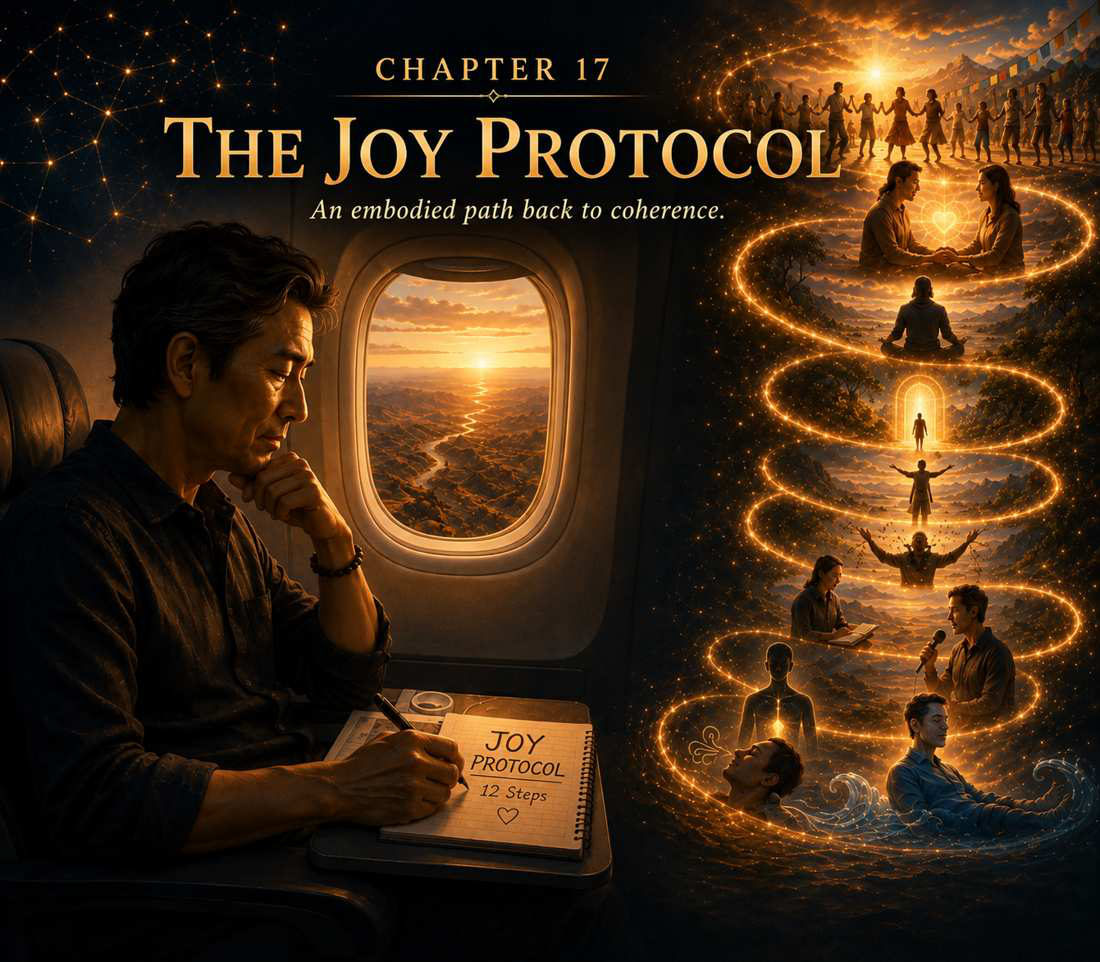
The Epiphany: The Joy Protocol Is Born
In 2022, on a plane somewhere between Miami and San Diego, shortly after attending Summit at Sea, something happened that changed the trajectory of my life. Nothing dramatic happened from the outside. No lightning bolt, vision, or mystical trance. I was simply sitting there, tired from travel, reflecting on the strange convergence of my life.
The pieces had been accumulating for years. The Vortex Principles had emerged in 2016 and 2017, giving language to much of what I had learned through leadership, transformation, relationship, and adventure. In 2019, the Forgiveness Mantra arrived and became one of the most powerful practices in my own journey of releasing stories rooted in the past.
Then, on that flight in 2022, it all came together. Decades of executive search and leadership advisory work, the Vortex Principles, the Forgiveness Mantra, years of meditation, Dzogchen practice, retreats, psychology, anthropology, spiritual inquiry, and close observation of what actually seemed to help people transform suddenly stopped feeling like separate streams. The whole architecture became visible.
It felt less like invention than recognition, as though something I had been gathering and living for years had finally become whole. What emerged was astonishingly simple: a pathway from pain rooted in the past toward joy rooted in the present. I first saw and described it in roughly twelve movements. The language would become more precise over time, with some movements eventually named separately, but the architecture itself was there.
That was the birth of the Joy Protocol.
What excited me was not the number of steps. It was the direction of travel. I could see a movement from reactivity toward awareness, from awareness toward release, and from release toward a more available relationship with life. I began describing it in language that still feels right to me today: from swimming in stories rooted in the past to dancing in joy rooted in the present.
This was never meant to become another belief system, spiritual identity, or program people would need to obey. The simplicity was part of its value. When life pulls us into fear, shame, anger, old identity, or emotional residue, we need some way to interrupt the momentum and become present enough to choose again.
The sequence begins with the most ordinary things imaginable. Breathe. Notice the body. Find your voice and name what is true. Create enough perspective to witness what is happening. Forgive where forgiveness becomes possible. Notice the story. Loosen the grip of the past. Return to what is actually here.
From there the journey becomes more than relief. Presence makes Sacred Self more available. Sacred Self changes the quality of union. Greater wholeness creates room for Sacred Play, gratitude, compassion, and the kind of presence that can move outward into relationship.
That movement outward became increasingly important to me. The Joy Protocol was never meant to end with a person becoming wonderfully centered in isolation. Awakening matters because of what becomes possible in relationship. The more honestly we can return to ourselves, the more available we can become to another human being, a team, a community, and eventually the larger systems of life around us.
Over the years that followed, I practiced it, tested it against my own life, shared it with others, and found more precise language for what had arrived on that flight. The pathway we now use names fourteen movements:
Breath → Body → Voice → Witness → Forgiveness → Lose the Story →
Lose the Past → Presence → Sacred Self → Sacred Union → Sacred Play →
Active Gratitude → Active Compassion → Active Presence
The articulation became more precise. The whole had already arrived on that plane somewhere between Miami and San Diego.
I do not think of the pathway as a promise that difficulty disappears. It is a return path, something we can practice when experience becomes crowded by everything we are carrying into it. Sometimes the return happens quickly. Sometimes it takes much longer. The point is not perfection. The point is that we can learn the way home.
Once I saw the sequence clearly enough to name it, another question became unavoidable: why could practices this simple sometimes
create such a profound shift in how people experienced themselves and one another?
To understand that, I needed a better understanding of the bridge between our stories, our bodies, our perception of safety, and the ways we respond when life activates us. That bridge was the nervous system.