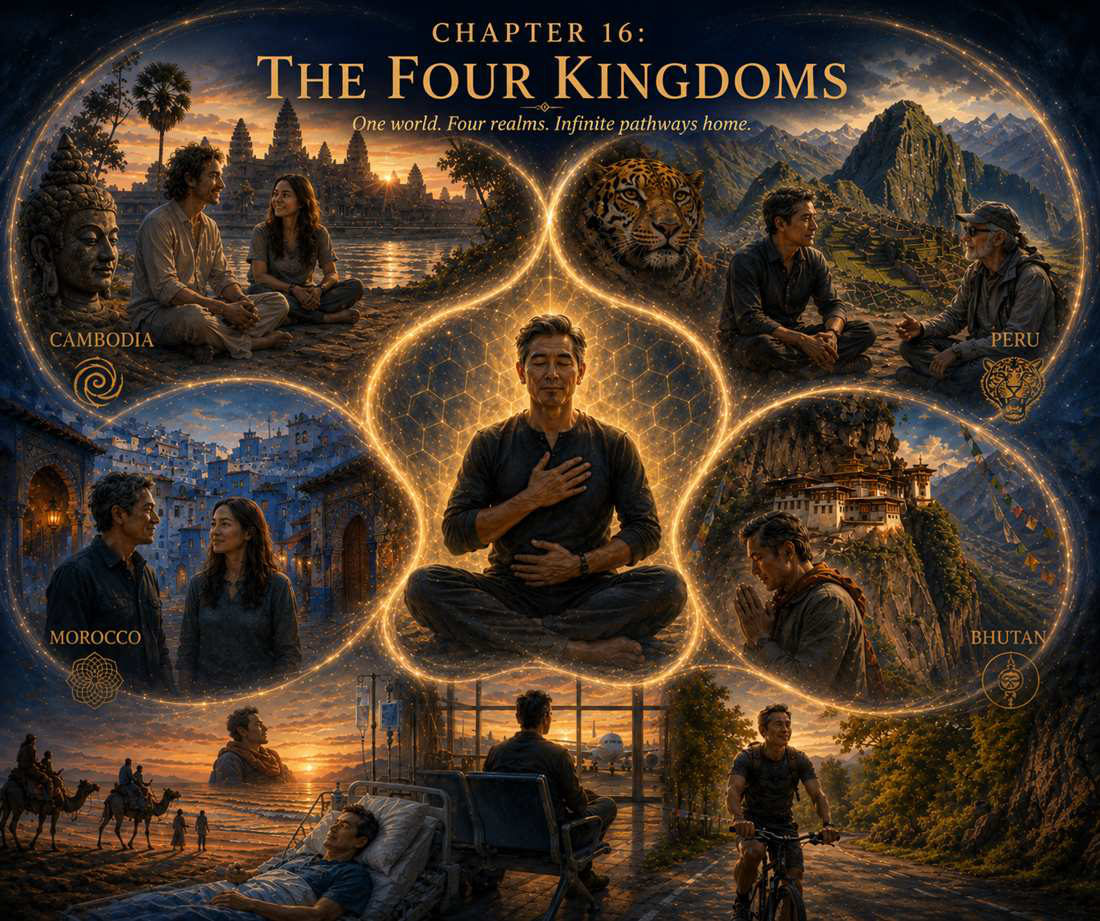
The Four Kingdoms
From 2024 into 2025, as travel and gathering fully reopened after the long disruptions of the pandemic years, I found myself moving through a series of journeys that felt less like tourism and more like initiation.
Cambodia. Peru. Morocco. Bhutan.
Four very different places, four different forms of encounter, and one question following me through all of them: What do we continue carrying long after we believe we have moved on?
In Cambodia, I spent two weeks with Chris Tracy and Ariel Lee of KLF.org exploring love, bliss, identity, and the inner structures through which we experience our lives. In Peru, Vortex journeys through the Sacred Valley and the Andes brought me into powerful conversations about shame, leadership, and the invisible burdens highly capable people can carry beneath extraordinary competence.
One encounter in Peru has never left me. After time at ancient sites near the Temple of the Jaguar, I met a man whose presence seemed to contain enormous capability and equally enormous pain. I did not yet know that he led a multibillion-dollar company.
At one point I asked if he would remove his sunglasses so we could speak eye to eye.
He did, then quietly said, “I have poop-colored eyes.”
He was talking about his eyes, of course, but what I heard underneath the words was shame.
We worked with the Forgiveness Mantra. I watched his expression soften, his breathing shift, and something in the way he held himself begin to loosen. I would never pretend that a few minutes erased a lifetime of experience. What mattered was seeing how quickly a different relationship to an old story could become possible.
It reminded me again that competence does not cancel vulnerability. A person can run a vast organization and still carry places within themselves that learned long ago to negotiate for belonging.
Later that year, Morocco turned the mirror toward me. My daughter Terra and I traveled through Tangier, Chefchaouen, Fez, and Essaouira: ocean wind, ancient streets, hidden riads, long meals, slow conversations, and prayer drifting through old stone cities.
After a difficult conversation in Essaouira, standing near the Atlantic, I suddenly saw my own inheritance differently. I could feel not only my adaptations, but the histories beneath them: my parents’ fears, losses, survival strategies, longing, and everything they themselves had learned before I arrived.
I had understood much of this intellectually for years. That moment was different. The pattern no longer felt like an explanation. It felt embodied, immediate, present.
That distinction mattered. Insight can tell us where a pattern came from. It does not automatically mean we have stopped living through it.
Bhutan deepened the lesson.
Tiger’s Nest has always felt sacred to me, a monastery improbably held against the cliffs above the Paro Valley, carrying centuries of devotion, silence, and practice. Somewhere on that climb, another piece of the architecture came together. Forgiveness, witnessing, presence, awakening, and freedom no longer felt like separate teachings. They looked increasingly like different movements within the same human journey.
Days later, traveling toward Laya in Bhutan’s highlands, where the Royal Highland Festival is held at about thirteen thousand feet, our guide shared something she had carried for years. We worked together with the Forgiveness Mantra, and I watched another shift unfold. What stayed with me most was not that I had brought her some foreign technique. The underlying movement already resonated with wisdom inside her own spiritual tradition. The language was different; the human need was recognizable.
Then life delivered the next lesson through something considerably less mystical: an airport.
On the journey home from Bhutan, I became stranded in Kolkata for fourteen hours inside an uncomfortable departure hall, fatigued, overstimulated, disconnected, and increasingly irritated. For a while, I spiraled into old familiar territory: abandonment, shame, anger, exhaustion, and the feeling that reality was personally misbehaving.
Eventually I realized that I had a choice. I could keep arguing internally with an airport that was showing absolutely no interest in negotiating with me, or I could use the practices I had spent years developing.
Breath. Body. Voice. Witness. Forgiveness. Release. Presence.
The airport became a dojo. The external situation did not change, but my relationship to it did. The remaining hours became surprisingly productive and even joyful. That experience may have taught me as much about practice as some of the monasteries had. A framework matters most when fluorescent lighting, exhaustion, bad chairs, and an airline delay are testing whether you actually know how to use it.
A few weeks later, back in Taipei after another intense stretch of travel and work, I landed in the emergency room with a 104-degree fever and viral bronchitis. Lying there exhausted among people confronting far more serious emergencies, I felt active gratitude in its most basic form. Health had temporarily disappeared, and its value became almost absurdly obvious.
Mortality and vulnerability have a way of rearranging the hierarchy of what matters.
A few days into recovery, riding my bike near home, another wave moved through me. Memories, old adaptations, grief, striving, fear, leadership, family, teachers, retreats, forgiveness, the Witness, and the recurring longing for freedom suddenly seemed less like separate chapters of my life and more like parts of one pattern.
The separation had been the illusion. The unity was the design.
That realization did not mean every wound was healed or every pattern had disappeared. It meant I could finally see the architecture connecting them.
And then another memory returned: a flight in 2022, when that architecture had first condensed into a sequence simple enough for me to write down.
That was the moment the Joy Protocol began to reveal itself.