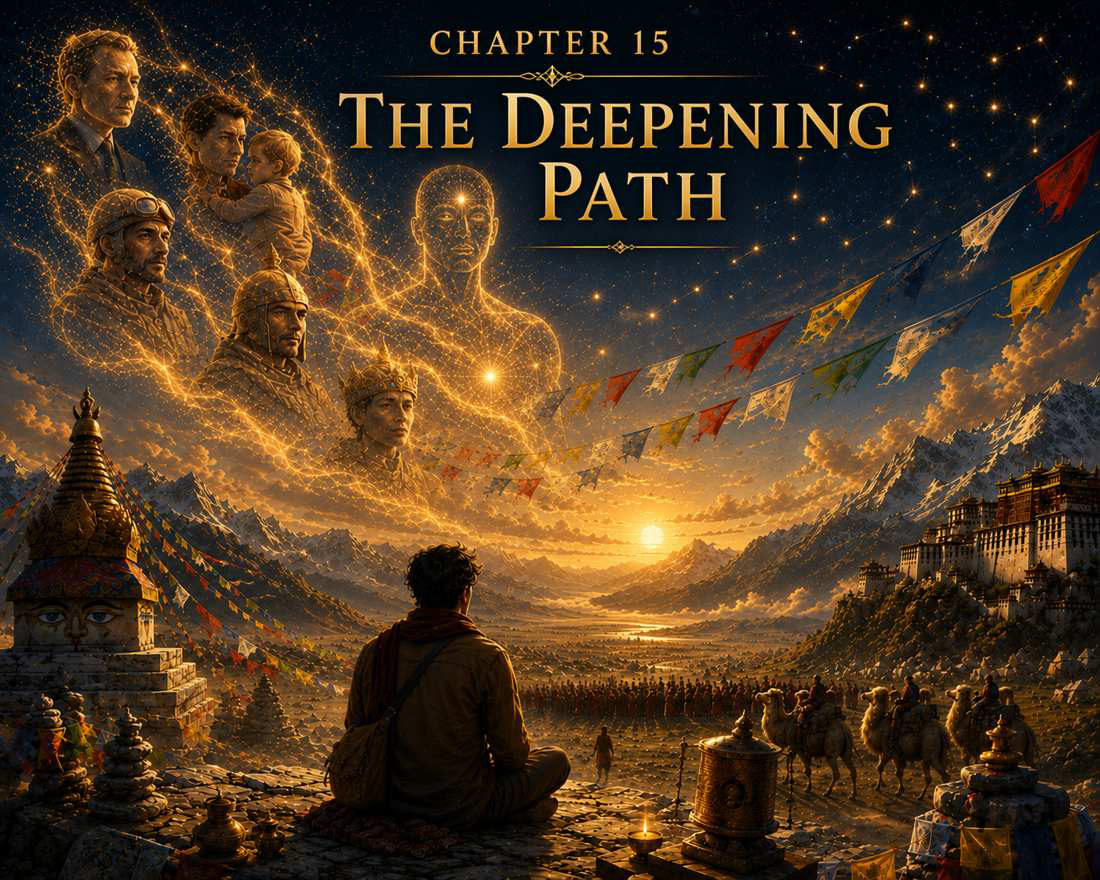
The Deepening Path
My deeper transformation did not begin in boardrooms. It unfolded slowly through years of searching for something I could feel long before I could name it.
In 2005, I began a deep journey of study with Nestor Perez, teacher, healer, and spiritual brother. Over the next twenty-one years, our conversations stretched across San Francisco apartments, long walks, tea tables, healing sessions, silence, arguments, laughter, and relentless inquiry into identity, suffering, consciousness, freedom, and what it actually means to awaken. The geography expanded too, from San Francisco to Dharamsala, Ladakh, Tiger’s Nest in Bhutan, and beyond.
I kept pushing for simplification, not simplification that diminished truth, but the kind that liberated it. How do you take ideas people may spend decades studying and make them emotionally accessible to human beings living real lives under real pressure? How do you speak about presence to an anxious leader, witness consciousness to a founder trapped inside an old story, or awakening to a ten-year-old without turning any of it into spiritual jargon?
That question became one of the deepest roots of what I would later call Speaking Cartoon: translating complexity into lived recognition without reducing its depth.
Through teachers, retreats, monasteries, healers, meditation, travel, and direct experience, another insight became increasingly important to me: much suffering grows from identification. We begin confusing
ourselves with the role, wound, fear, performance, identity, or story we are carrying. Yet experience also seemed to reveal another possibility, a capacity to witness those things without being completely defined by them.
Once you glimpse that distinction directly, even briefly, something changes. You may still contract, suffer, become afraid, or forget. I certainly did. But some part of you now knows that the storm is happening within experience; it is not the totality of who you are.
Years later, in Ladakh, I crossed Khardung La into the high Himalayan landscape of the Nubra Valley, rode Bactrian camels through the mountain desert, and sat among thousands of people receiving teachings from His Holiness the 14th Dalai Lama while prayer flags snapped through the cold wind. The scale of the place seemed to rearrange my perspective. Status and achievement felt very small against mountains that appeared almost outside human time.
These journeys were not simply pilgrimages for inspiration. I came to think of them as opportunities to plug back into what I called Isness, the experience of being with reality before immediately trying to manage, improve, label, or extract something from it. Over time that idea became The Business of Isness: the recognition that sometimes being fully present, listening carefully, and trusting what is actually unfolding is not a retreat from the work. It is the work from which wiser action becomes possible.
Again and again, I found that the more tightly I gripped identity, certainty, and control, the more constricted life became. When I could loosen that grip and become more present, possibility returned. Not
magically, and not because difficulty disappeared, but because I was no longer using so much energy defending an identity against reality.
Yet even after years of this work, something still felt incomplete. I was learning how individuals could awaken more deeply to themselves, but I had not yet found a sufficiently powerful container for helping high-capacity people explore these questions together while still carrying the pressure, complexity, ambition, relationships, and responsibilities of modern life.
Vortex had taken me a long way toward that possibility. But something more was beginning to emerge.
That came next.