The Hidden Ladder
For a long time, I thought the Joy Protocol was a process. Then I thought it was a practice. At another point I thought of it as a way of interrupting deeply ingrained emotional patterns. All of those descriptions contain part of the truth, but none of them quite reach the deepest one: the Joy Protocol is a journey.
It is a sequence, a ladder, a path whose individual movements appear in many traditions and forms. I did not imagine that every element of this path was new. Versions of these movements appear across contemplative and philosophical traditions, particularly in practices of awareness, witnessing, non-attachment, forgiveness, compassion, and presence. Buddhism, Stoicism, and other traditions arrive through very different histories and language, and I am not suggesting that the Joy Protocol is a restatement of any of them. What struck me was that patterns I had encountered through lived experience often echoed questions human beings have been exploring for a very long time.
The path begins with breath, not because breath is magical, but because breath interrupts momentum. One conscious breath can create the smallest opening between what is happening and our automatic response to it. That opening can be enough to notice the body: the tightening chest, the knot in the stomach, the clenched jaw, the urge to run, fight, please, perform, or shut down.
Once we begin noticing the body, voice becomes possible. By voice I do not mean performance, positioning, or having the perfect explanation. I mean the willingness to name our actual experience:
what we feel, what we fear, what we want, what hurts, what matters, and what we know to be true for us.
When breath, body, and voice begin working together, another capacity becomes available: the Witness, what I sometimes call the Director of the Movie. The Witness can observe an experience without becoming completely consumed by it. We can notice fear without concluding that we are fear, notice anger without surrendering all choice to anger, and notice the story we are telling without assuming the story is the whole of reality.
That space creates the possibility of forgiveness. I do not mean forgiveness as moral obligation, virtue signaling, or pretending that harm did not matter. I mean forgiveness as liberation: the possibility of no longer organizing the present around an injury from the past. People often experience that shift physically as well as emotionally. Breathing changes. Shoulders release. The body may stop preparing for a confrontation that ended years ago.
As forgiveness loosens what has been held, the story becomes easier to see. We begin recognizing the explanations, identities, interpretations, and narratives through which the past has continued shaping the present. The past itself is no longer happening, but the story can keep recreating its emotional reality long after the original event is gone.
This is what I mean by Lose the Story and eventually Lose the Past. Neither means forgetting, denying, or erasing what happened. They mean becoming freer to meet this moment without requiring yesterday to dictate every response today. As that grip begins to loosen, presence becomes more available.
Presence is not perfection or permanent serenity. It is simply greater availability to what is actually here. And within that space another possibility appears: Sacred Self, the recognition that worth does not need to be continually earned through achievement, usefulness, approval, or performance. Self-love, in this sense, is not narcissism. It is the end of chronic self-abandonment.
From there, Sacred Union becomes possible at another level. I use the term first for an inner integration: doing and being, strength and tenderness, thought and body, action and receptivity, the masculine and feminine qualities that can exist within any human being regardless of gender. The more those inner divisions soften, the more relationship with another person can emerge from greater wholeness rather than from the demand that someone else complete what we refuse to meet in ourselves.
Then comes Sacred Play, a capacity children understand instinctively and adults often abandon. Play appears when creation becomes more important than performance, curiosity becomes stronger than self- protection, and people feel free enough to experiment together without turning every moment into evaluation or achievement.
From there emerge three practices that increasingly become ways of living: Active Gratitude, Active Compassion, and Active Presence. Gratitude becomes a way of noticing rather than an obligation to be positive. Compassion becomes a lived response rather than a moral performance. Presence becomes less about a formal practice and more about how we meet what is actually in front of us.
At that point the journey begins moving outward. What starts within the individual enters relationships, organizations, communities, society, and eventually our relationship with the living world. This is where the Joy Protocol begins flowing naturally into Tsunami OS.
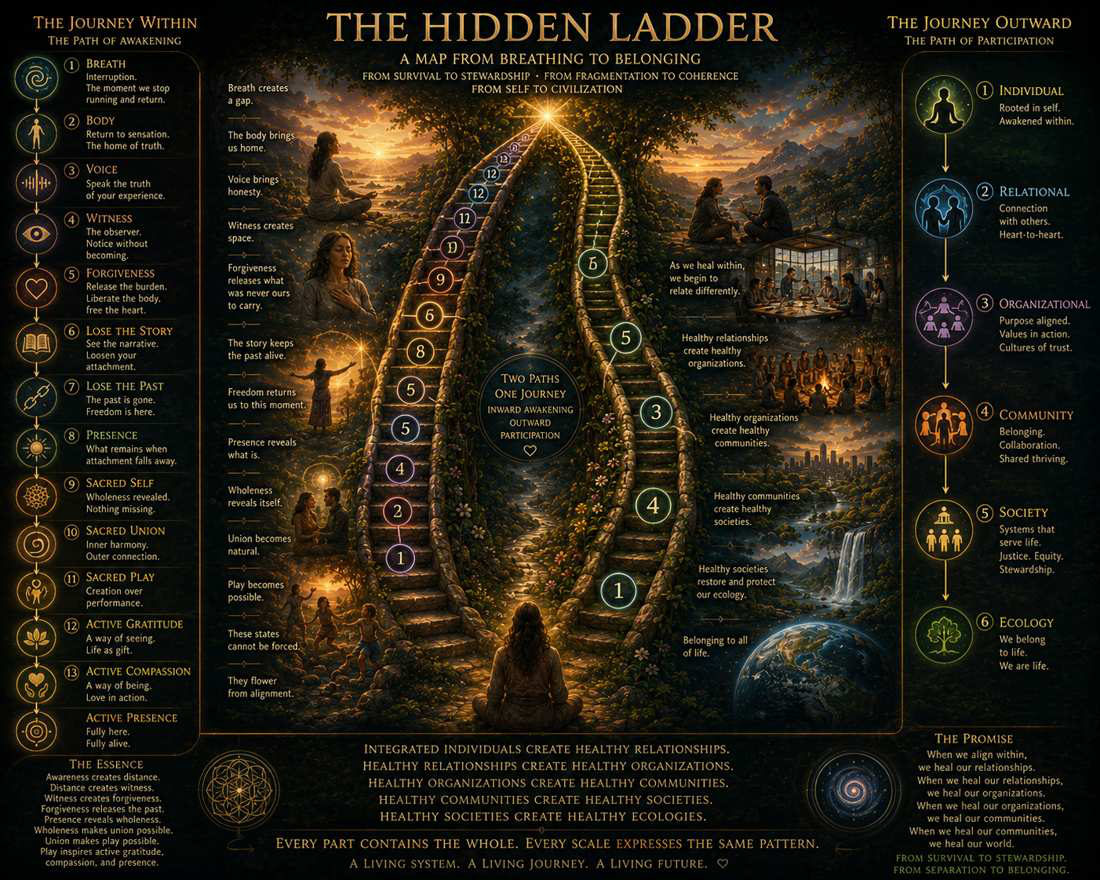
I think of the architecture as two intersecting movements. The inward path is the path of awakening:
Breath → Body → Voice → Witness → Forgiveness → Lose the Story →
Lose the Past → Presence → Sacred Self → Sacred Union → Sacred Play →
Active Gratitude → Active Compassion → Active Presence
The outward movement is alignment in relationship:
Individual → Relationship → Organization → Community → Society →
Ecology
The Joy Protocol helps us awaken more fully to ourselves. Tsunami OS asks what happens when that greater awareness enters relationship: how we align our values, principles, practices, choices, technologies, and ways of living with one another and with the larger living systems to which we belong. Participation naturally follows, but alignment comes first.
Together they describe the movement this book keeps returning to: from survival toward stewardship, fragmentation toward coherence, and isolated selfhood toward deeper belonging.
Or perhaps the whole thing can be said more simply.
From breathing to belonging.