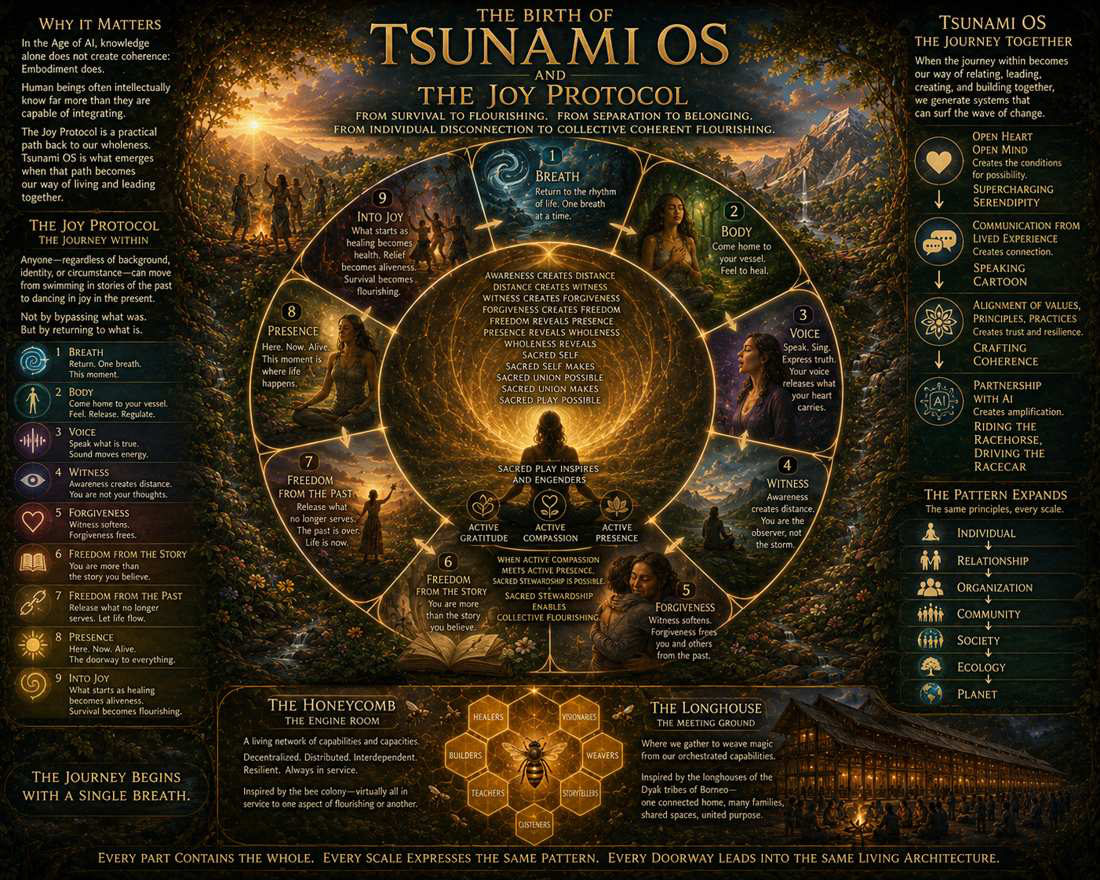
The Birth of Tsunami OS and The Joy Protocol
For the longest time, I thought transformation happened primarily through insight gained through direct experience: a great book or show, a profound realization, a peak experience, a breakthrough conversation at midnight with somebody unusually awake and emotionally caffeinated. Those moments matter enormously. But over the years, I began noticing something humbling: we can understand something long before we know how to live it.
A person can understand forgiveness intellectually while still carrying an old hurt into every new relationship. A leader can know everything there is to know about burnout while continuing to operate like an emotionally overclocked laptop with far too many tabs open and a sleep schedule they are not proud of. A couple can understand every healthy communication framework in the world and still find themselves reenacting the same argument on Tuesday night.
Family has a particular talent for exposing this gap. You can spend decades becoming an accomplished adult and then walk through the front door of your childhood home and discover, with impressive efficiency, that some part of you is suddenly seventeen again.
That gap between what we know and what we can actually embody became increasingly important to me. Knowledge helps, sometimes profoundly, but knowledge alone does not create transformation. Something has to move from understanding into lived experience.
The Joy Protocol emerged gradually from my own healing, the adventures and retreats I had been leading, leadership work, relationships, loss, forgiveness, long stretches in nature, and years of watching what seemed to help people become more available to their lives again. I did not sit down one morning and invent a protocol. I recognized a pattern that had been revealing itself for years.
One of the first things I noticed was how quickly difficult moments can pull us away from what is actually happening now. An argument evokes an earlier argument. Rejection awakens an older wound. Uncertainty activates a familiar story about who we are or what is about to happen. The present becomes crowded by memory, interpretation, anticipation, and all the meaning we have accumulated around them.
The Joy Protocol became a practical path for finding our way back. Its premise is not that the past should be erased or that pain can be transcended by pretending it never happened. It is almost the opposite. We turn toward experience honestly enough that we no longer need every old experience to keep directing the present.
I began describing the movement as going from swimming in stories rooted in the past to dancing in joy rooted in the present. The language is playful, but the work itself can be demanding. Return requires honesty. Forgiveness can require courage. Letting go of a story we have carried for years may feel less like losing an idea and more like losing part of our identity.
Yet the sequence kept appearing. We begin with something extraordinarily simple: breath. Breath brings us closer to the body. The body helps us notice what is actually happening. Voice gives
experience language. Witness creates enough space to see ourselves with greater perspective. Forgiveness loosens what has been held. Story begins to release its grip, and the present becomes more available.
What surprised me was what happened after that. What began as healing could become health. Relief could become aliveness. Survival could become play, gratitude, compassion, relationship, and eventually stewardship. The work was no longer simply about feeling better. It was about becoming more available to life.
That is why the Joy Protocol eventually became the inner foundation of something larger. As I watched the same questions appear in relationships, leadership teams, organizations, communities, and eventually in our relationship with artificial intelligence, Tsunami OS began forming around it. The Joy Protocol helped answer the question, How do I come home to myself? Tsunami OS grew from the next question: How do we live, build, relate, and adapt together once we begin from there?
The distinction matters. The Joy Protocol is not a theory of everything, and Tsunami OS is not a prescription for how everyone should live. They are evolving maps drawn from lived experience, meant to be tested against life rather than obeyed as doctrine.
The path begins simply.
With one breath.