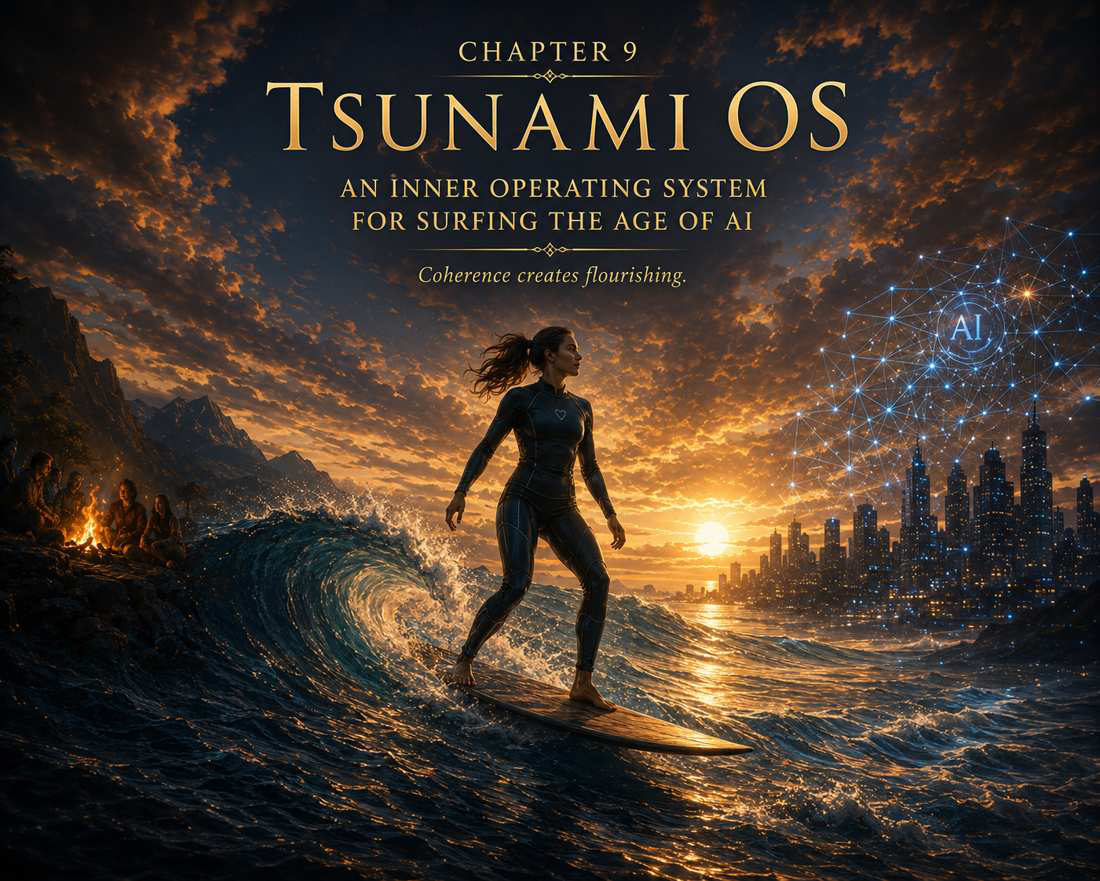
Tsunami OS: An Operating System for Surfing
Somewhere along the way, I began realizing that humanity did not simply need better technology. We needed better ways of being human in relationship with it.
That distinction became increasingly important as I moved through leadership work, founder communities, AI circles, retreats, organizations, and conversations around the world. The excitement surrounding artificial intelligence was real, but so was another experience: people were trying to absorb extraordinary amounts of change while continuing to work, lead, parent, love, make decisions, and somehow remain recognizable to themselves.
The instinctive response was often to optimize harder. More systems. More productivity. More information. More performance. More hustle. More output. Yet acceleration alone was not creating flourishing. People could become increasingly capable externally while becoming less aligned internally and relationally.
That led to another question: What would an operating system for coherent flourishing actually look like in the Age of AI?
Not a productivity system or rigid philosophy. Something lived, embodied, relational, and adaptive. A way to remain capable of movement without losing ourselves or one another.
That became Tsunami OS.
The surfing metaphor matters because surfing requires something very different from control. You need presence, responsiveness, balance, humility, adaptation, and a healthy respect for forces much larger than yourself. You cannot order the ocean into compliance. You learn to read what is happening, adjust continuously, and remain sufficiently centered to move with it.
The more I thought about Tsunami OS, the more I realized that its central concern was alignment in relationship. Are our values aligned with our choices? Are our stated principles visible in our actual practices? Are the people inside an organization living inside the culture its leaders describe? Are our technologies strengthening the lives we say we care about, or quietly pulling us somewhere else?
You can feel misalignment almost immediately. A person says one thing, feels another, and repeatedly does a third. A company displays beautiful values while the people inside it feel exhausted, frightened, or unseen. A relationship contains endless communication but very little genuine presence. An organization pursues growth while gradually disconnecting from the humans responsible for creating it.
Alignment does not mean perfection or permanent agreement. It means enough coherence among what we believe, what we say, what we choose, and how we relate that energy is not continually lost to contradiction.
Several practices inside Tsunami OS help create that alignment.
The Joy Protocol is its inner foundation. Breath, body, voice, witnessing, forgiveness, release of old stories, and presence help us become more available to ourselves. Sacred Self, Sacred Union, Sacred Play, Active Gratitude, Active Compassion, and Active Presence move that awakening toward a more spacious way of living.
Supercharging Serendipity begins with an open heart and an open mind toward people and circumstances. Missed your plane? Something unexpected may now become possible. Find yourself beside a stranger on the next flight? Perhaps a conversation begins that changes something important. Receive an invitation that makes no rational sense and awakens genuine curiosity? Sometimes “Sure, why not?” opens doors that optimization would never have noticed.
I have always imagined this a little like the charging stations on the Hot Wheels racetrack of my childhood. Possibility is scattered everywhere. We do not have to manufacture all of it. Sometimes we simply have to recognize the opening and drive through.
Speaking Cartoon is another practice. It means leaning into story, metaphor, imagery, humor, context, and deep simplification so that an idea can be felt through lived experience rather than understood only as abstraction. I sometimes describe it as speaking in a way a ten-year-old could enter instinctively and reach for the popcorn.
This does not mean making ideas childish. It means making them human. Some truths become easier to recognize when we can see ourselves inside an image or story. Intellectual sophistication has its place, but complexity is not the same thing as depth.
Then comes Crafting Coherence, the alignment of values, principles, and practices: heart, head, and hands. Values express what matters. Principles help us decide what is right. Practices are the best ways we currently know to act on those commitments. When the three drift apart, trust erodes. When they increasingly align, people can feel it.
The same question extends into our relationship with artificial intelligence. AI can amplify extraordinary capability, but amplification makes alignment more important, not less. A poorly aligned organization can move in the wrong direction faster. A frightened person can generate more fear. A creative person can explore more possibilities. A coherent team can coordinate with extraordinary speed.
The deeper question is therefore not simply how powerful AI becomes. It is what we choose to align that power with.
That is where Tsunami OS points: toward humans who can remain more awake to themselves, more aligned in relationship, more capable of adapting without abandoning their values, and more intentional about the systems they help create.
We do not need to dominate the wave.
We need to learn how to surf it together.
Try This: Name Your Current OS
Pause for a few minutes and notice the unspoken rule you may be running today:
Stay ahead.
Need no one.
Never drop the ball.
Keep everyone happy.
Do not let them see you struggle.
Write yours in one honest sentence. Then ask, without judgment:
Does this rule still serve the life and relationships I actually want?
You cannot consciously change an operating system you cannot yet see.