The Wave
At first, this wave of AI-driven change felt almost playful. People were generating cartoon images of themselves as astronauts, Vikings, anime heroes, Renaissance royalty, and highly questionable spiritual mystics holding glowing wolves beneath moonlit waterfalls while somehow still looking emotionally available and professionally employable. Entire group chats temporarily lost productivity as humanity collectively discovered something both exhilarating and slightly unsettling: “Oh no...this thing is actually kind of amazing.”
Then came the writing, coding, research, design, analysis, translation, and increasingly sophisticated forms of problem-solving. The acceleration became harder to dismiss, and the conversation changed with it. Writers and artists began wondering what abundance of generated language and imagery would mean for their work. Teachers started reconsidering education in a world where information and assistance could be available almost instantly. Lawyers, accountants, consultants, programmers, designers, and leaders across almost every knowledge profession began asking which parts of their work would change, which would disappear, and which might become more important.
Founders oscillated between exhilaration and low-grade nausea. Parents started asking what kind of world their children were actually growing into, while leaders of large organizations confronted the uncomfortable reality that the technologies changing their industries were evolving much faster than the institutions responsible for adapting to them. AI-native companies appeared with extraordinary speed, capital flooded toward new models and applications, and assumptions that had seemed stable only a few years earlier began moving underneath everyone’s feet.
The wave became real, and what fascinated me most was the emotional atmosphere surrounding it. You could feel people moving between awe and uncertainty almost hour by hour. At moments we sounded like children discovering magic for the first time; at others, like medieval villagers hearing reports of dragons somewhere beyond the hills. Both reactions made sense because artificial intelligence does more than change what humans can do. It also changes how we understand our own capabilities and, inevitably, how we begin thinking about our value.
We are creating systems that can respond, generate, synthesize, reason across many kinds of information, communicate fluently, and participate in increasingly complex forms of work. Human beings respond relationally to systems that communicate with us this way, even when we know perfectly well that the system is not another human being. We project intention, personality, hope, irritation, trust, fear, and meaning onto responsive technologies with remarkable speed. Anyone who has ever apologized to a Roomba after accidentally kicking it already understands the basic instinct.
At the same time, acceleration itself has consequences. Human attention and institutions do not adapt at the same speed as software. Entire industries can now change in months, cultural signals travel globally in hours, and people can spend their days moving among work, news, messages, markets, relationships, entertainment, and multiple competing versions of reality. A modern mind can begin to feel less like a coherent operating system and more like a web browser with seventeen tabs open, three frozen windows, mysterious background music, and absolutely no idea where the sound is coming from anymore.
You can feel that overload almost everywhere. People absorb enormous quantities of stimulation while carrying uncertainty about work, identity, belonging, economics, relationships, attention, and the future itself. Even highly successful people sometimes feel that the external world is changing faster than their internal maps can keep up.
Yet I remain profoundly hopeful. Not because the transition will be painless; it will not be, and different people and communities will experience it very differently. Every major technological transformation has created possibility alongside disruption, and there is little reason to expect this one to be different. But underneath enormous technological change, some human needs remain remarkably persistent: belonging, meaning, inspiration, touch, laughter, beauty, purpose, creativity, trust, and one another.
This is where I see one of the great opportunities hidden inside the wave. As machines become more capable across many cognitive tasks, we may become more conscious of the human capacities we most want to cultivate: judgment, imagination, wisdom, stewardship, emotional intelligence, discernment, play, intimacy, trust, presence, and the ability to create meaning together. AI can participate in many of these domains and may become extraordinarily useful within them, but it does not remove the human responsibility for deciding what kind of life and society those capabilities should serve.
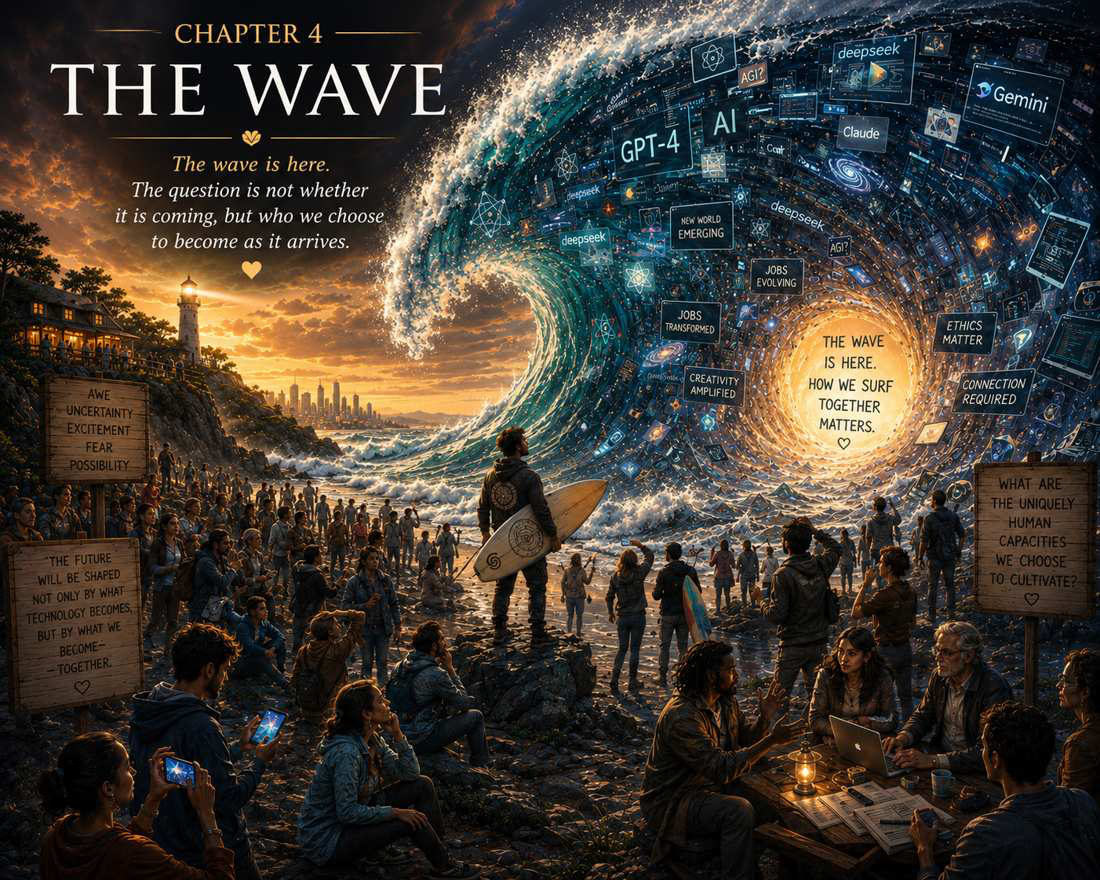
Artificial intelligence is therefore pushing us toward a question much deeper than productivity or efficiency: What are the human capacities we most want to strengthen as our machines become more capable? The future will be shaped by what the technology becomes, but also by what human beings become in relationship to it.
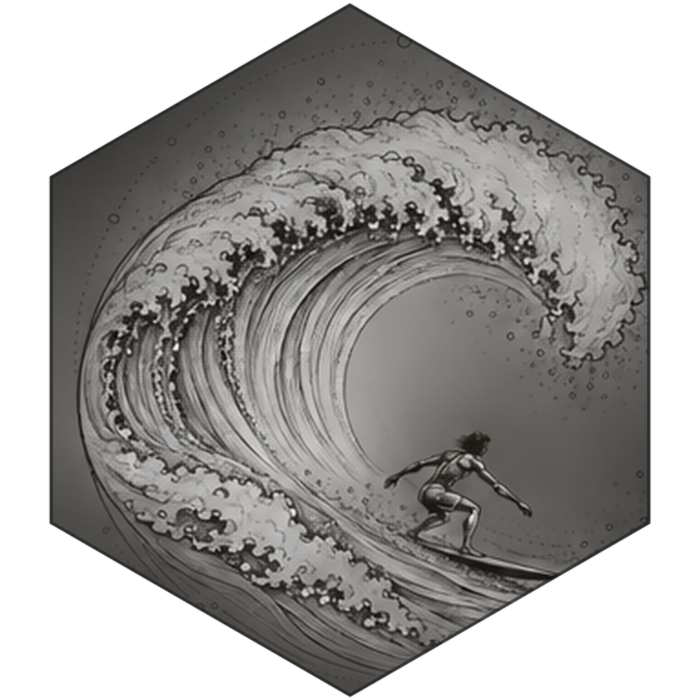
Given the path of my own life, another question naturally followed: if humanity is entering a wave this large, who helps people learn how to surf it?