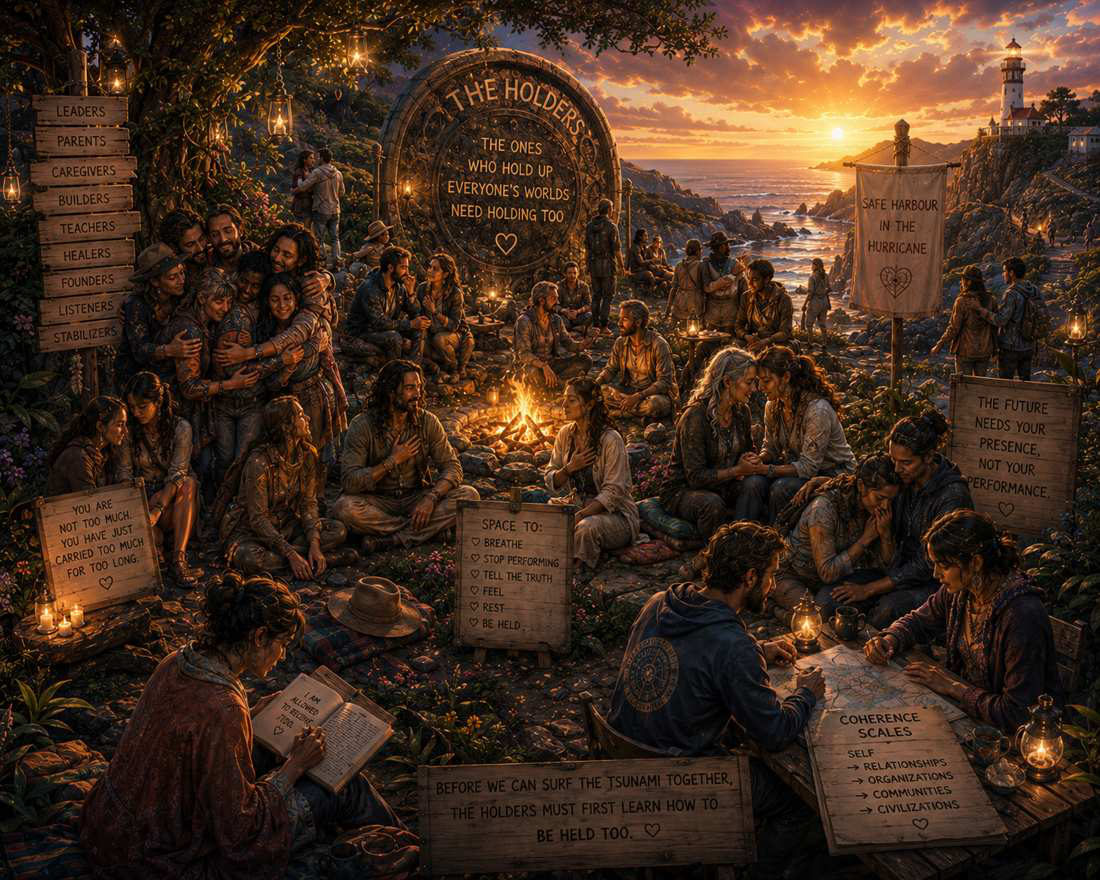
The Holders
Every civilization quietly depends on people who carry more than they let the world see: the stabilizers, listeners, builders, leaders, parents, caregivers, founders, teachers, healers, kings and queens, lions and tigers, lionesses and tigresses. They are the people others call at two in the morning when something has gone sideways and everybody else suddenly forgets how to breathe. They become safe harbors in the hurricane.
I have spent forty years supporting these humans while being one myself. Over time, I noticed a pattern. The more capable they became, the more responsibility life handed them: a team to lead, a family to support, a company to hold together, a relationship to repair, a community to stabilize, a future to help build. And because they could carry so much, the world slowly began assuming they always could.
That is where the danger begins, usually quietly. Many holders become extraordinarily skilled at functioning while gradually disconnecting from themselves. I know because I did. I learned how to keep moving while exhausted, how to appear calm while overwhelmed, and how to care for everyone else while placing parts of myself somewhere near the back of the line.
For much of my life, I understood my drive as adventure, curiosity, connection, intensity, and the desire to “scale light,” by which I mean helping more people experience healing, forgiveness, joy, presence, and possibility. All of that was real. I have lived an extraordinarily fortunate life filled with friendships, wilderness expeditions, boardrooms, startups, mountains, remote villages, founder circles, Summit gatherings, transformation adventures, artists who also
happened to be investors, long conversations under desert skies, and enough strange turns of fate to convince me the universe has a genuine affection for improvisational theater.
From the outside, it probably looked as though I simply loved movement and possibility. I did. But underneath that was another layer I could not see clearly for many years: what I came to think of as an orphan pattern. I do not mean orphan in the literal sense. I mean an internal belief that belonging had somehow to be earned through usefulness, contribution, achievement, responsibility, or being the person capable of carrying the most weight without visibly collapsing.
I have since recognized versions of that pattern in many high-capacity people, particularly leaders, helpers, caregivers, founders, and those everyone else depends upon. When children experience instability in important relationships, some learn very early to become useful, responsible, watchful, pleasing, accomplished, or unusually self- sufficient. What begins as adaptation can become identity long after the original circumstances have changed.
Life becomes heavy when worth is unconsciously tied to carrying, and the Age of AI can intensify that pressure. More information, stimulation, uncertainty, comparison, possibility, and velocity arrive every day, along with the expectation that capable people will continue adapting while somehow remaining calm, available, reassuring, and strategically optimistic on Zoom.
You can see it in leaders trying to steady organizations while privately uncertain themselves, parents raising children inside realities that barely existed a few years ago, founders moving between inspiration and exhaustion, and teams in constant digital contact who may still
be starving for genuine human presence. Again and again, I came back to the same realization: the holders needed holding too.
They did not necessarily need fixing or further optimization. Sometimes they needed space to breathe, stop performing, tell the truth, reconnect with their bodies and lives, and rediscover the parts of themselves buried beneath responsibility. They needed room to laugh without immediately converting the experience into a productivity metric or networking opportunity.
That became one of the hidden foundations beneath Vortex, my transformation-adventure work, long before I could have explained it this way. People often assumed those experiences were primarily adventure-led transformation, and there was certainly plenty of adventure: the High Atlas of Morocco, volcanoes in Costa Rica, the jungles of the Riviera Maya, Tiger’s Nest in Bhutan, remote beaches in Thailand, mountains, oceans, and occasional jungle roads apparently held together through equal parts engineering and optimism.
But many people experienced something closer to transformation-led adventure. Around fires and on trails, people who had spent years performing competence began speaking more honestly. Founders cried. Leaders softened. Couples reconnected. Bodies relaxed. Laughter returned. People remembered pieces of themselves that had become obscured by roles and responsibility. They revisited old wounds, found forgiveness for others and themselves, and often returned home looking, as I liked to joke, like poodles coming back from the cleaners: somehow puffier, lighter, and much more themselves.
What fascinated me was how quickly things could begin to shift once people no longer felt required to perform. The body often softened first. Then came greater honesty, grief, relief, laughter, inspiration, creativity, and connection. Beneath enormous accomplishment I often found people who were overloaded, overextended, overidentified with responsibility, and profoundly under-held.
Somewhere inside those experiences, another realization emerged. The future of leadership may depend less on dominance, certainty, or always being the smartest person in the room and more on the capacity to create and sustain coherence under pressure. The leaders who help others navigate rapid change will need intelligence and expertise, certainly, but also groundedness, adaptability, presence, compassion, resilience, and the ability to help people think and relate well when uncertainty rises.
Coherence can then move outward. A person who can remain grounded has a better chance of creating healthier relationships. Healthier relationships can strengthen organizations. Organizations built on greater trust and honesty can contribute to stronger communities. None of this happens perfectly or automatically, but the pattern compounds.
And that brought me to a simple conclusion: before humanity can learn to surf a wave this large together, many of the people holding everyone else will have to learn that they are allowed to be held too.