Relational Flourishing
We Become Ourselves Together
Long before I began thinking deeply about artificial intelligence, I found myself wrestling with a much older question: what does it actually mean to flourish? I do not mean simply to succeed, accumulate wealth, titles, followers, achievements, or build a life that looks impressive from the outside. I mean something simpler and harder: to wake up feeling deeply alive, at home in your own body, connected to people you love, to work that matters, to nature, and to life itself.
Over the years, I began noticing something that changed much of what I believed about leadership, organizations, and life. Flourishing is profoundly relational. Very few of the moments we treasure most are moments of isolated success. They are moments of connection: a child asleep on your shoulder, a meal with friends where nobody wants to leave the table, music around a fire, the silence that follows genuine forgiveness, or walking beside the ocean and realizing that for a few minutes the voice inside your head has stopped asking you to become someone else.
Those moments do not happen because we have optimized ourselves. They happen because we have come more fully into relationship with ourselves, with other people, and with life.
As I have watched founders, enterprise leaders, investors, artists, educators, family-business stewards, and people from almost every walk of life, another pattern has become difficult to ignore. Human beings continuously affect one another. We calm each other, inspire
each other, exhaust each other, create trust, provoke fear, widen possibility, and sometimes shut it down. Our bodies and minds are constantly reading relationship, often long before we consciously understand what is happening.
That led me to wonder whether we have been thinking about intelligence too narrowly. For most of our lives we have spoken about IQ, Intelligence Quotient. More recently, EQ, Emotional Intelligence, helped broaden our understanding by recognizing that cognitive ability alone does not explain what makes someone an extraordinary leader, partner, parent, or friend.
The Age of AI may be inviting us to take another step. What if one of the capacities that matters most is Relational Intelligence? What if RQ belongs alongside IQ and EQ?
By Relational Intelligence, I mean our capacity to cultivate healthy, adaptive, life-giving relationships across the different scales of our lives. It begins with the relationship we have with ourselves and extends outward to intimate relationships, families, organizations, communities, intelligent technologies, nature, and ultimately life itself.
Once I began looking through that lens, I started seeing the pattern everywhere. A forest does not flourish because one magnificent tree overpowers all the others. A beehive does not flourish because one extraordinary bee works harder than the rest. Rivers, coral reefs, immune systems, healthy families, thriving organizations, and resilient communities all reveal versions of the same principle: the health of the whole depends profoundly on the quality of the relationships within it.
That realization changed the way I thought about leadership. Leadership became less about directing people and more about creating conditions in which people could flourish together. Organizations became less interesting to me as machines for maximizing performance and more interesting as networks of relationships. Communities became less about agreement and more about belonging. Even artificial intelligence began to look different.
If AI becomes an increasingly powerful amplifier of human capability, then the question is not only how intelligent the systems become. It is also what happens to us in relationship with them. Do they deepen curiosity or dependency? Expand creativity or encourage passivity? Strengthen human connection or slowly displace it? Help us exercise judgment, or make it easier to avoid judgment altogether?
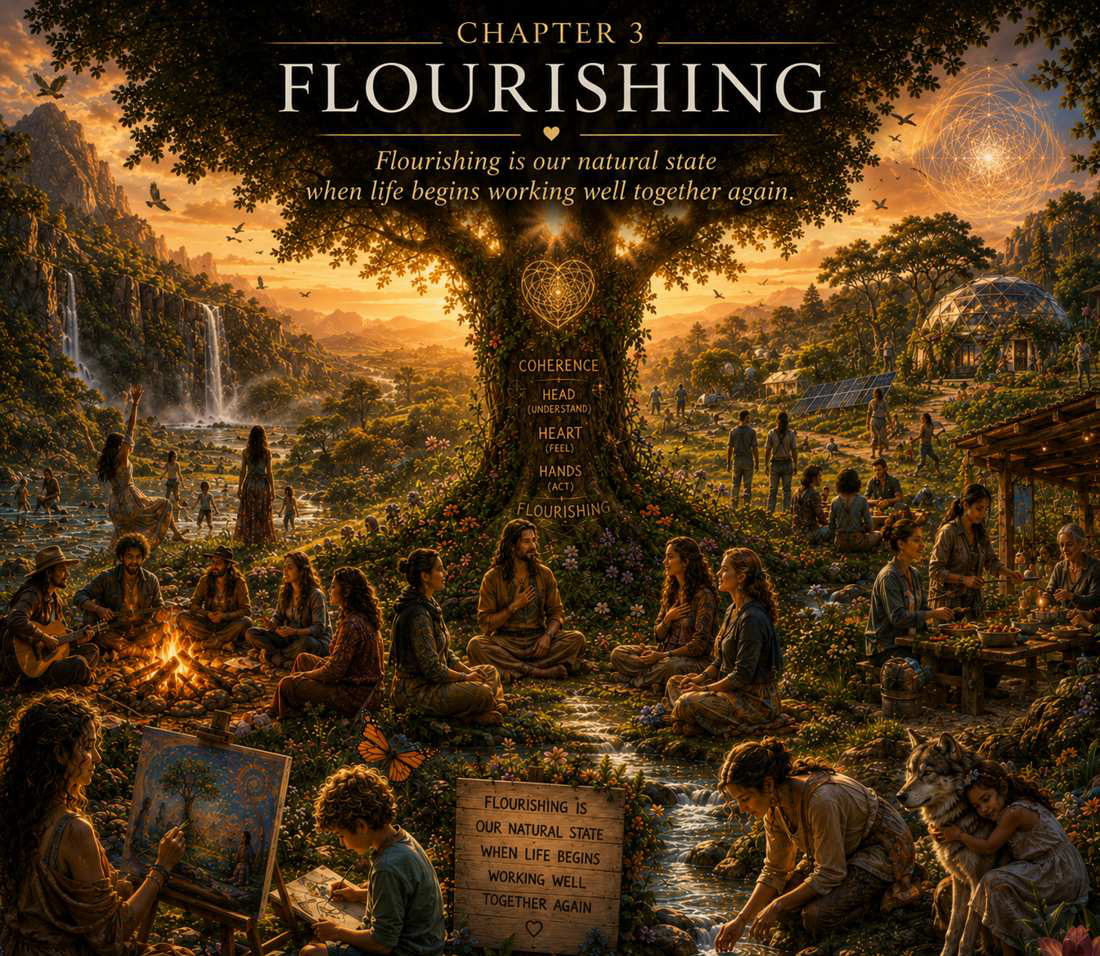
This is where coherence enters the picture. Coherence appears when important relationships within a system begin working together rather than continually pulling against one another: when our values and actions align more closely, when relationships become places of trust rather than vigilance, when organizations allow people to contribute without constantly defending themselves, and when communities create enough belonging for difference to remain possible.
That is the soil in which flourishing grows. We cannot manufacture it through optimization alone. Flourishing emerges more naturally when the relationships carrying a life or system become healthy enough to support it.
The chapters that follow explore what that means in practice. How do we deepen the relationship with ourselves? With one another? With organizations and communities? With nature? With increasingly intelligent technology? And ultimately, with life itself?
If coherence is the pattern that allows the whole to hold together, Relational Intelligence is one of the capacities through which we learn to live that pattern.