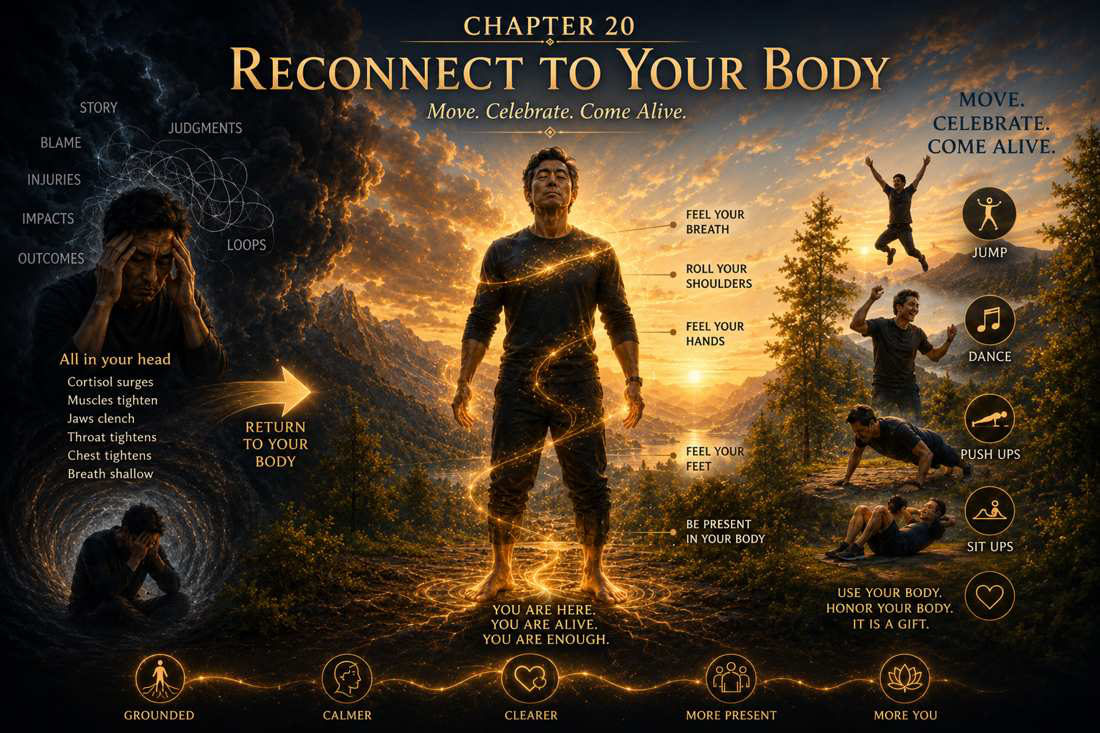
Reconnect to your Body
When we become caught in an old story, attention can move almost completely into the mind. We replay what happened, imagine what should have happened, rehearse what we might say next, assign blame, defend ourselves, predict outcomes, and construct increasingly elaborate explanations for why we feel the way we do.
Meanwhile, the body is still there.
The jaw may be tight. Shoulders may have risen toward the ears. The chest may feel constricted. The stomach may be knotted. Hands may be clenched without our noticing. We can become so absorbed in the story that we lose contact with the physical experience happening underneath it.
That is why the second movement of the Joy Protocol is Reconnect to Your Body.
Breath interrupts momentum. The body brings us more fully into the present.
I do not mean analyzing the body or asking it to prove anything. A sensation does not automatically tell us that our interpretation of an event is correct. It simply tells us something is happening in us right now. That information matters.
Reconnecting can be remarkably ordinary. Feel your feet against the floor. Notice your hands. Roll your shoulders. Stretch. Stand up. Walk. Dance badly for thirty seconds. Do a few squats or push-ups. Shake your arms out. Put your face into cool water. Step outside and feel air against your skin.
The practice is not about performing embodiment correctly. It is about returning attention to the physical human being who has been sitting underneath all that thinking.
Movement can be especially useful because it changes the channel. When I ride my bike, swim, dance, walk in the mountains, or simply move enough to feel myself again, the story does not necessarily disappear. But it is no longer the only thing happening.
There is a body here too.
A body that has carried you through every joy, disappointment, argument, adventure, illness, love affair, board meeting, heartbreak, sunrise, and ridiculous decision of your life. We spend enormous amounts of time evaluating our bodies, managing them, improving them, criticizing them, dressing them, photographing them, and worrying about them. Sometimes it is worth simply appreciating that we have one.
This is part of why embodiment matters so much to me. The present is not an intellectual concept. We experience it through sensation: feet on earth, air in lungs, sunlight on skin, music moving through the chest, cold river water, tired legs climbing a mountain, another person’s hand in ours.
The body gives the present somewhere to happen.
Try This: Head to Soles
Let your attention travel slowly from the top of your head toward the soles of your feet. Notice your forehead, jaw, throat, shoulders, chest, stomach, hands, hips, legs, and feet.
If you find tension, numbness, warmth, heaviness, tingling, or nothing much at all, simply notice it. You do not need to fix it.
Then move in whatever way feels natural: stretch, stand, shake out your hands, walk across the room, or take one slow turn around wherever you are.
You began by finding your breath. Now you have found the body that is breathing.
That is another step home.