The House of Weather
Before we learn language, we learn atmosphere. Long before we can explain ourselves, we are already sensing tone, tension, warmth, unpredictability, affection, distance, play, and danger. Childhood is full of weather, and every family has its own climate.
I am sharing some vulnerable parts of my own story not because I expect your childhood to resemble mine, but because I hope my memories may help you notice your own. As you read about my parents, perhaps you will find yourself thinking about yours, or about your own partners, children, work, ambitions, adaptations, and the stories you have carried forward without quite realizing it.
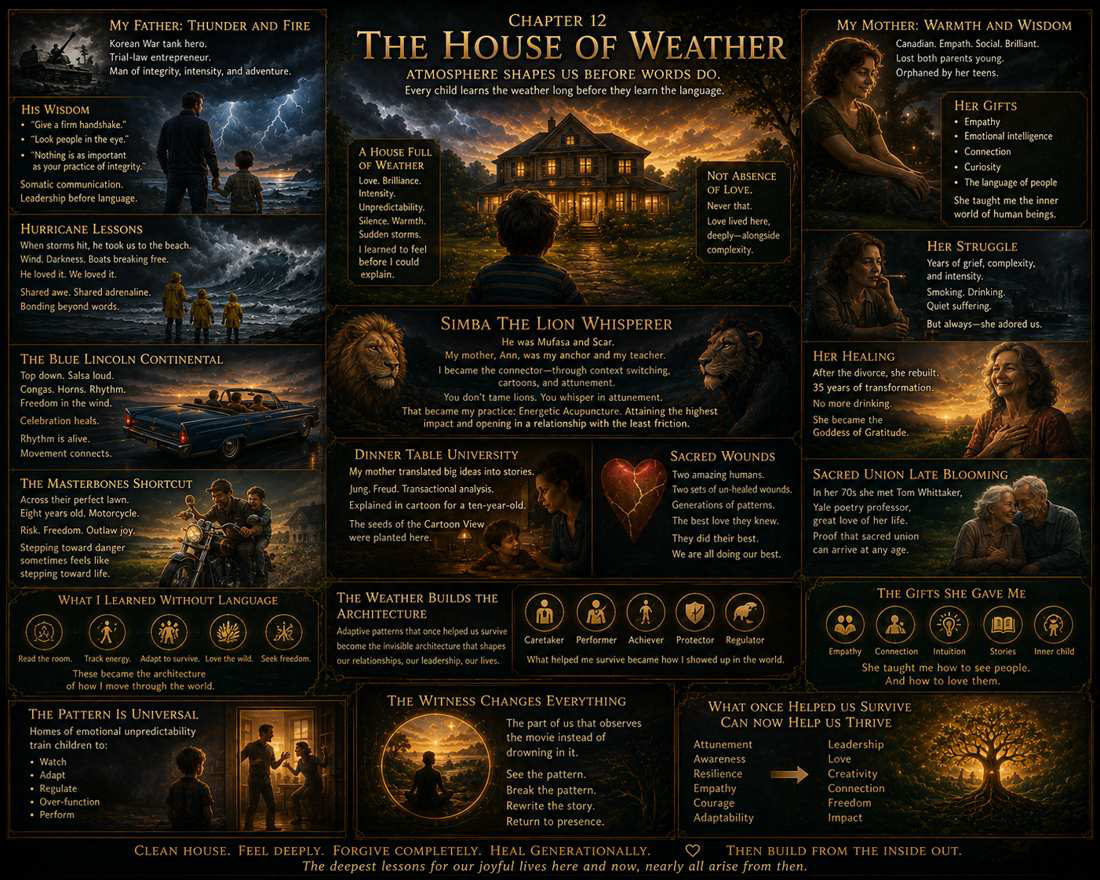
My journey began in a house with all kinds of weather, including some heavy weather. There was never an absence of love. Love lived there deeply alongside brilliance, intensity, warmth, adventure, unpredictability, silence, and sudden storms.
My father, Stephen, was a Korean War veteran who later became a trial lawyer and entrepreneur. He found enormous meaning in the military and returned with ambition, charisma, professionalism, adventure, and fire. On good days he was proud, ethical, funny, expansive, and larger than life. On harder days, he could become thunder in human form.
He also gave us wisdom that stayed with me. “Give them a firm handshake and look people in the eye,” he would say. Another lesson mattered even more: integrity was not something to perform when convenient. It was a practice. Both ideas became important to me
long before I had language for leadership, presence, or relational intelligence.
But the emotional temperature of our house could change quickly. My father would sometimes honk the horn of his shiny red Triumph TR6 as he approached the house, and we would scramble like the Little Old Lady in the Shoe, straightening everything and preparing for his arrival. Part of us was simply waiting to discover what kind of weather had come home.
Looking back, I became very good at reading atmosphere. I noticed tension, distance, mood, and energy quickly. Like many children growing up around strong personalities, I learned to adapt myself to the emotional field around me. At the time, none of this felt like intelligence. It simply felt like being a child in a family I loved.
My father was an extraordinary mixture of forces. I sometimes think of him as part Mufasa and part Scar, if you know your Lion King. He had grown up with a father whose restaurant business kept him away much of the time, and the military later gave my father structure, identity, and a model of strength that influenced the way he led both professionally and at home.
I learned to relate to him through shared intensity, adventure, big nature, big weather, and big experiences. Years later I would jokingly think of myself as a kind of lion whisperer. You do not overpower a lion. You learn to pay attention. You notice timing, energy, context, and the least-friction point of connection. Much later, that instinct became part of what I called Energetic Acupuncture, finding the smallest relational opening capable of creating the greatest movement.
There was another side to my father that shaped me just as deeply: his love of wildness. When hurricanes came toward our home, only a few houses from the beach in Milford, Connecticut, he would sometimes put us into yellow raincoats and march us down toward the water. The sky darkened, wind tore through the trees, spray moved sideways through the air, and boats strained against their lines.
He loved it. I did too.
Some part of both of us came alive around large forces. I learned very young that awe, danger, movement, and aliveness could sit astonishingly close together. That current would later run through wilderness expeditions, adventure retreats, leadership work, and much of what became Vortex.
He also owned a blue Lincoln Continental convertible with white leather seats. He would put the top down, grin sideways at us like a pirate, and turn the salsa up loud enough for the neighborhood to feel it. Congas, horns, timbales, summer air, heated leather, and rhythm moving directly through the seats into the body.
I had no theory for any of this. I only knew that movement connected us. Rhythm changed the room. Celebration changed us. Years later I would recognize how much of my love for world music, dance, somatics, and emotional energy had begun there, with wind in my face and my father laughing as though life itself were music.
There was plenty of mischief too. A few houses up the street lived neighbors with a famously immaculate lawn, which may have been precisely why my father decided it made an excellent shortcut. One afternoon he put me, perhaps eight years old, on the back of his Honda 175 motorcycle, revved the engine, and tore straight across their perfect grass, leaving an enormous track behind us. This was particularly outrageous because he was Milford City Attorney at the time.
It was reckless, hilarious, exhilarating, and completely alive. Experiences like that helped form my lifelong attraction to freedom, risk, movement, and the strange clarity that can appear when attention becomes total.
My mother, Ann, was an entirely different weather system. Where my father brought thunder, she brought warmth. Canadian by way of Winnipeg and Nova Scotia, she lost both parents young and entered adulthood carrying losses most people her age had never faced.
She was a psychiatric nurse, deeply empathic, emotionally perceptive, endlessly social, and extraordinarily interested in people. I became one of her great conversation partners. When she pursued graduate study in psychiatric nursing while I was still young, our kitchen conversations began filling with simplified versions of Jung, Freud, transactional analysis, relationships, conflict, and the mysteries of why people do what they do.
She rarely taught me through abstract theory. She used stories, gestures, voices, metaphors, and examples a child could understand. Looking back now, I can see that some of the earliest seeds of Speaking Cartoon were planted in that kitchen.
My mother also had her own difficult years. Life with my father was intense, and grief and complexity accumulated. There were years of smoking, drinking, and struggle. Yet through all of it she loved us fiercely, and we loved her.
After my parents divorced when I was seventeen, I watched something remarkable unfold. My mother rebuilt her life. She stopped drinking, became increasingly radiant and present, and over the decades that followed grew into the person I came to call the Goddess of Gratitude. In her seventies she met Tom Whittaker, the great love of her later life, reminding me that profound love and renewal do not belong only to the young.
When I look back at the two of them now, I do not see villains and heroes. I see two complicated human beings carrying their histories, gifts, fears, hopes, wounds, strengths, and immense capacities for love. I inherited something from both.
From my father came adventure, intensity, courage, appetite, rhythm, risk, and a willingness to walk directly into weather. From my mother came empathy, curiosity, emotional language, storytelling, warmth, and an instinct to look beneath behavior toward the human being underneath.
I also inherited adaptations. I became watchful, relationally sensitive, quick to read a room, capable of moving between very different people and emotional worlds. Some of those capacities became strengths. Some became burdens when I forgot that adaptation was not the whole of who I was.
That is one of the central ideas behind the Joy Protocol. We do not need to condemn the strategies that helped us navigate earlier parts of our lives. Many of them were ingenious. We can honor what they gave us while becoming free to decide whether we still need them.
The weather of childhood matters, but it does not have to become the permanent climate of adulthood.
We can learn to notice the storm without becoming the storm. We can understand where our patterns came from without making them our destiny. And, sometimes slowly and sometimes in a single startling moment, we can begin choosing how we want to live now.