The 10 A.M. Bike Ride
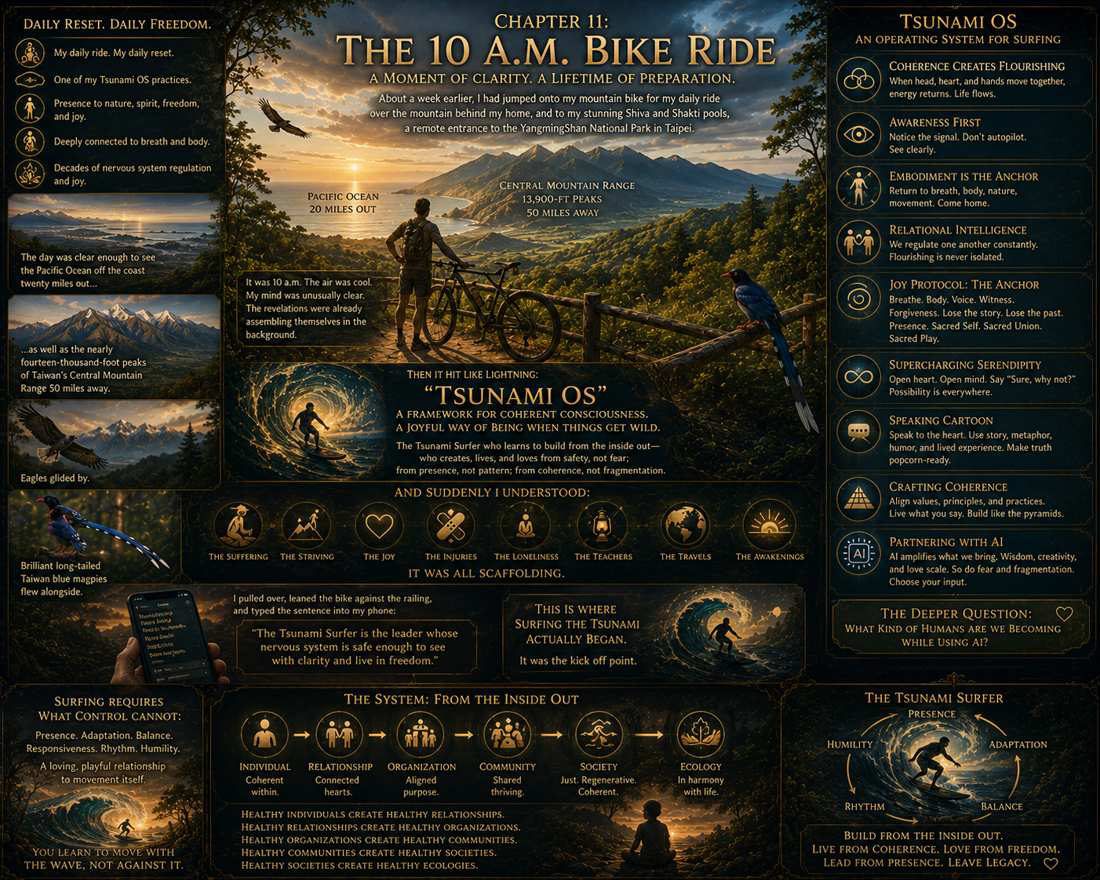
The moment I think of as the beginning came on one of my daily mountain-bike rides behind my home in Taipei, climbing toward the Shiva-Shakti Pools near Yangmingshan National Park. The day was clear enough to see the Pacific Ocean off the coast, as well as the nearly thirteen-thousand-foot peaks of Taiwan’s Central Mountain Range in the distance. Taiwan blue magpies were moving through the trees.
That ride has been one of my great reset practices for decades. I ride to return to breath, body, nature, freedom, and joy. Something about the combination of movement, mountain, water, and solitude has always helped the noise fall away enough for deeper patterns to become visible.
It was around ten in the morning when one of those patterns suddenly arrived with unusual clarity. I was climbing when two words landed almost fully formed:
Tsunami OS.
At first I understood it as a way of remaining coherent when life becomes wild: learning to move from the inside out, to meet change with greater presence rather than simply reacting from fear or old pattern. I did not yet understand the architecture we have now developed around awakening, alignment in relationship, Relational Intelligence, or the Joy Protocol. Those would emerge later. But the seed was there.
I pulled over, leaned the bike against the railing, and began typing into my phone. One sentence captured what I was trying to reach:
The Tsunami surfer is a leader grounded enough to see clearly, adapt freely, and remain in relationship while the wave moves around them.
In that moment, parts of my own life suddenly looked less random. The striving and joy, injuries and loneliness, teachers and adventures, leadership work, relationships, transformations, wilderness, mistakes, and moments of awakening all seemed to have been preparing me to recognize something I had been living before I had language for it.
This is where Surfing the Tsunami began for me. Not as a finished framework, and certainly not as a book. It began as an intuition on a bicycle: there had to be a way to meet accelerating change without abandoning ourselves or one another.
To understand why that question mattered so much to me, we have to go further back, to the place where most of us first began learning what it meant to belong.