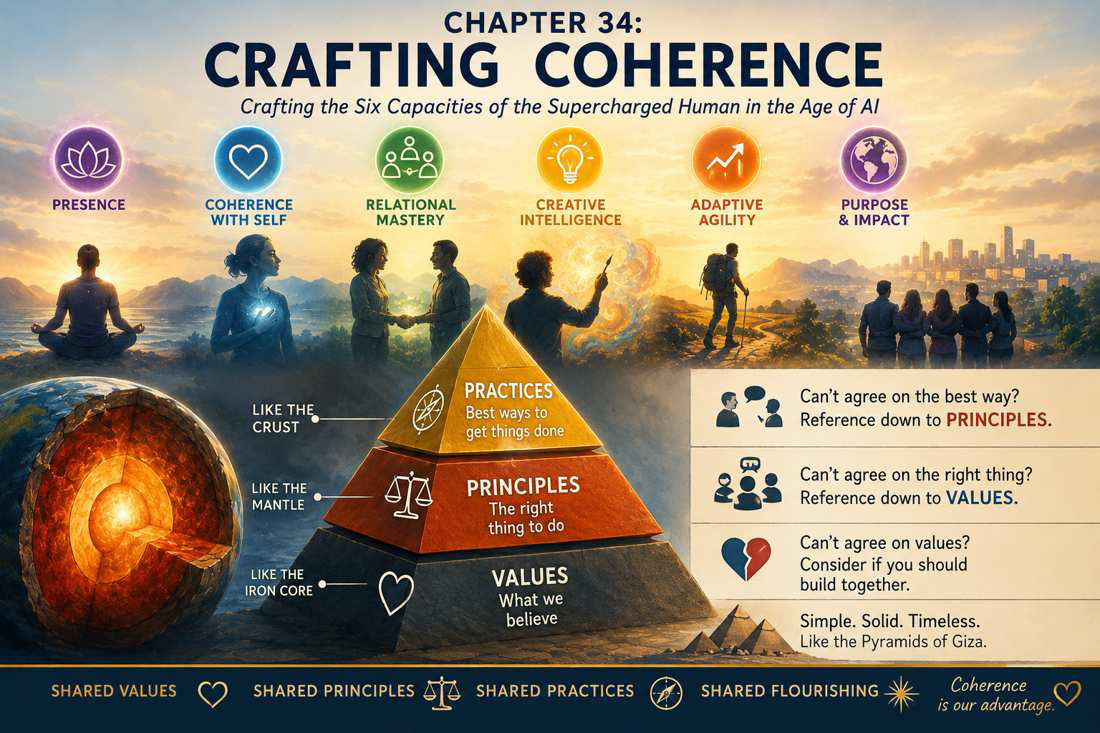
Crafting Coherence
Crafting multi-relational alignment of the Supercharged Human in the Age of AI.
After decades of working with leaders across continents - founders, CEOs, investors, creatives, families, communities - and after years of inner work, nervous system exploration, retreats, and supporting breakdowns, recoveries, and long conversations beside oceans and fires and conference tables - something eventually became impossible for me to ignore:
Human flourishing follows recognizable patterns. So does human fragmentation. Defragmentation is dramatically influenced through creating coherent frameworks for relational, organizational, and collective thriving - based upon shared values, shared principles and shared practices.
Shared values are what we each, and collectively believe - like the iron core of the earth.
Shared principles are what we each (and hopefully collectively) believe are the right thing to do - like the ocean of magma sitting atop the iron core of the earth.
Shared practices are the ways we each - and ideally collectively - agree are the best available ways to get things done. And there is always the possibility that anyone, from anywhere, will discover a better way.
When we can’t agree on the best way to get things done, then we refer down to the principles - the right thing to do.
When we can’t agree on the right thing to do, we refer down to our values - our beliefs. And if we genuinely have different values, then it is potentially time to reconsider whether or not we should be working or building together.
It is actually that simple. Like the Pyramids of Giza. Very difficult to turn that construct on its head. I know from deep experience.
Try This - Close One Gap (about 4 minutes)
Name one value you hold, and one small action today that would embody it. Do that action - or name honestly, and kindly, why you will not. Coherence is simply your values and your behavior standing in the same room. A modern version of this craft appears in the work of Kyle Hermans, whose practice has always been to make possibility visible before others can fully believe in it.
Kyle Hermans
Steward of Possibility
One of the reasons I enjoy speaking with Kyle Hermans is that he has an unusual ability to see connections where other people see divisions.
Ideas that seem unrelated; people who appear to be on opposite sides; problems that feel impossible - Kyle somehow finds these threads and weaves them into coherence. When I learned more about Kyle’s story, that began to make sense: he grew up in apartheid South Africa, a society organized around separation. People were separated by race, class, and opportunity - invisible lines that everyone was expected to accept as normal.
Yet some of Kyle's earliest experiences told him a different story. He found friendship, connection, and humanity across those lines. Years later, he would say something that has stayed with me: "We have our own apartheid in our minds."
The first time I heard that, I stopped - because it feels poignantly true. Not only politically, but also personally, organizationally, and collectively.
We divide things that belong together: Logic and intuition; work and meaning; innovation and humanity; technology and wisdom. Us and them.
Over the years, Kyle has become fascinated by what happens when those divisions begin to dissolve.
His work in leadership, transformation, innovation, and organizational change as Global CEO, Oxford Leadership, and Founder & CEO, Be Courageous Research has repeatedly led him to the same conclusion: most organizations do not suffer from a lack of ideas - they suffer from fragmentation. Teams that don't fully trust one another. Leaders who cannot say what needs to be said. People who stop bringing their full creativity to the work. Organizations that slowly lose connection to their purpose.
The problem is rarely intelligence - it is separation.
That insight eventually became the foundation for much of Kyle's work. Not teaching people to become fearless - teaching them to become courageous. There is a difference. Fearlessness is mostly mythology. Courage is what happens when you move forward despite uncertainty.
Kyle often speaks about courage and creativity almost as twins: The courage to say the right thing; the courage to try the right thingt; the courage to imagine something that does not yet exist; the courage to build it. And the creativity to see what does not exist, and imagine the possible. nnAs artificial intelligence accelerates, I find Kyle’s perspective increasingly valuable.
Kyle is not anti-technology - far from it. He sees the extraordinary potential; and he sees the pattern recognition and amplification.
What concerns him is something else: The possibility that humans begin outsourcing too much of themselves. Their thinking, imagination, judgment, responsibility, and courage. Because while
machines may become extraordinarily capable, possibility still begins inside a human being.
Someone has to ask the new question; imagine the new future; take the first step. Again and again, that is the place Kyle returns to: possibility ; and the belief that something better can emerge when people reconnect with themselves, with one another, and with the courage required to create what comes next.
Kyle is living proof that possibility is a powerful beginning. But possibility alone does not build enduring organizations or lasting relationships.
Eventually, every possibility encounters a deeper question: Can it be trusted? And in the Age of AI, where the future is now , trust grows through true partnership between humans and intelligence, structured to be recursively coherent as the partnership deepens.