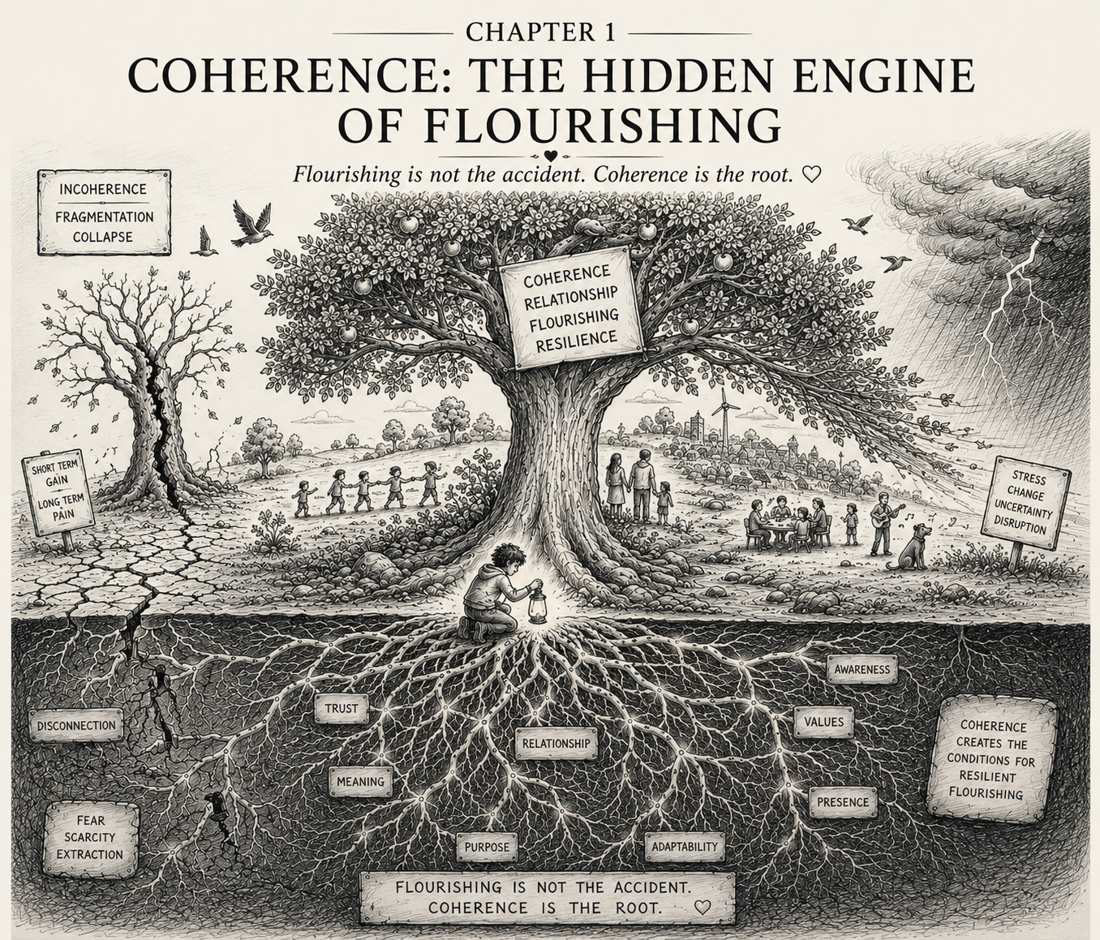
Coherence: The Hidden Engine of Flourishing
There is a deeper question underneath artificial intelligence, leadership, business, nervous systems, politics, ecology, community, and even human flourishing itself. It is the question of coherence, because nothing that is profoundly incoherent can flourish for long. An incoherent human being eventually fragments. Relationships collapse under sustained pressure. Organizations lose trust, meaning, and adaptability. Societies can turn against themselves, and ecological systems can become unstable when the relationships that sustain them break down.
The pattern repeats across scales, and once you begin to see it, you cannot unsee it. Nature reveals it constantly. A flourishing ecosystem is not merely abundant; it is held together through countless interdependent relationships. Predators and prey exist in dynamic balance. Water, sunlight, nutrients, growth, decay, and regeneration interact continuously without destroying the whole. Resilience emerges through adaptation rather than rigidity. A forest flourishes because those relationships remain sufficiently coherent as conditions change.
The same is true for us. The modern world often mistakes flourishing for expansion, growth, optimization, accumulation, stimulation, and scale. Yet systems can appear to flourish while becoming increasingly incoherent underneath because their values, principles, practices, and underlying structures are no longer aligned.
The deeper test is what happens under pressure. Can a person, relationship, organization, or society continue to adapt through
uncertainty, disruption, technological acceleration, emotional strain, loss, and conditions previous generations never had to navigate? This is where resilience enters the picture, because flourishing that depends entirely on favorable conditions is fragile by definition.
And this is ultimately why this book exists. At first glance, it may appear to be a book about artificial intelligence, leadership, embodied awareness, organizational transformation, or the future of work. It is all of those things, but underneath them is a larger inquiry: What allows human beings, relationships, organizations, communities, societies, and ecosystems to remain capable of coherent flourishing amid accelerating complexity?
Artificial intelligence did not create that question. It has made the question far harder to ignore. AI is not the deepest subject of this book; it is one of the most powerful pressure tests. The deeper subject is coherence itself.
Coherence is not agreement, sameness, conformity, or control. It is the capacity for many interdependent parts to remain in generative relationship with one another across time and changing conditions. That principle can appear within a human being, a family, a leadership team, a company, a community, an economy, an ecosystem, and civilization itself. Similar patterns repeat across scales, suggesting that flourishing has a fractal quality.
The challenge of our era is therefore larger than the extraordinary speed of technological change. Humanity is entering conditions of complexity that place simultaneous pressure on attention, relationships, identity, meaning, community, institutions, and our
ability to make sense of what is happening around us. When those relationships break down, flourishing becomes harder to sustain.
This book explores the opposite possibility: that coherence can be cultivated and flourishing can become more resilient; that individuals and systems can remain adaptive without losing their integrity; and that we can move beyond extraction and optimization toward ways of living that are more regenerative, relational, and alive.
Not as a permanent state or a rigid ideology, but as a continuing practice of returning to relationship with the conditions that allow life to flourish. That is the journey underneath every chapter that follows.